

His second molar and his third molar disagree with each other.
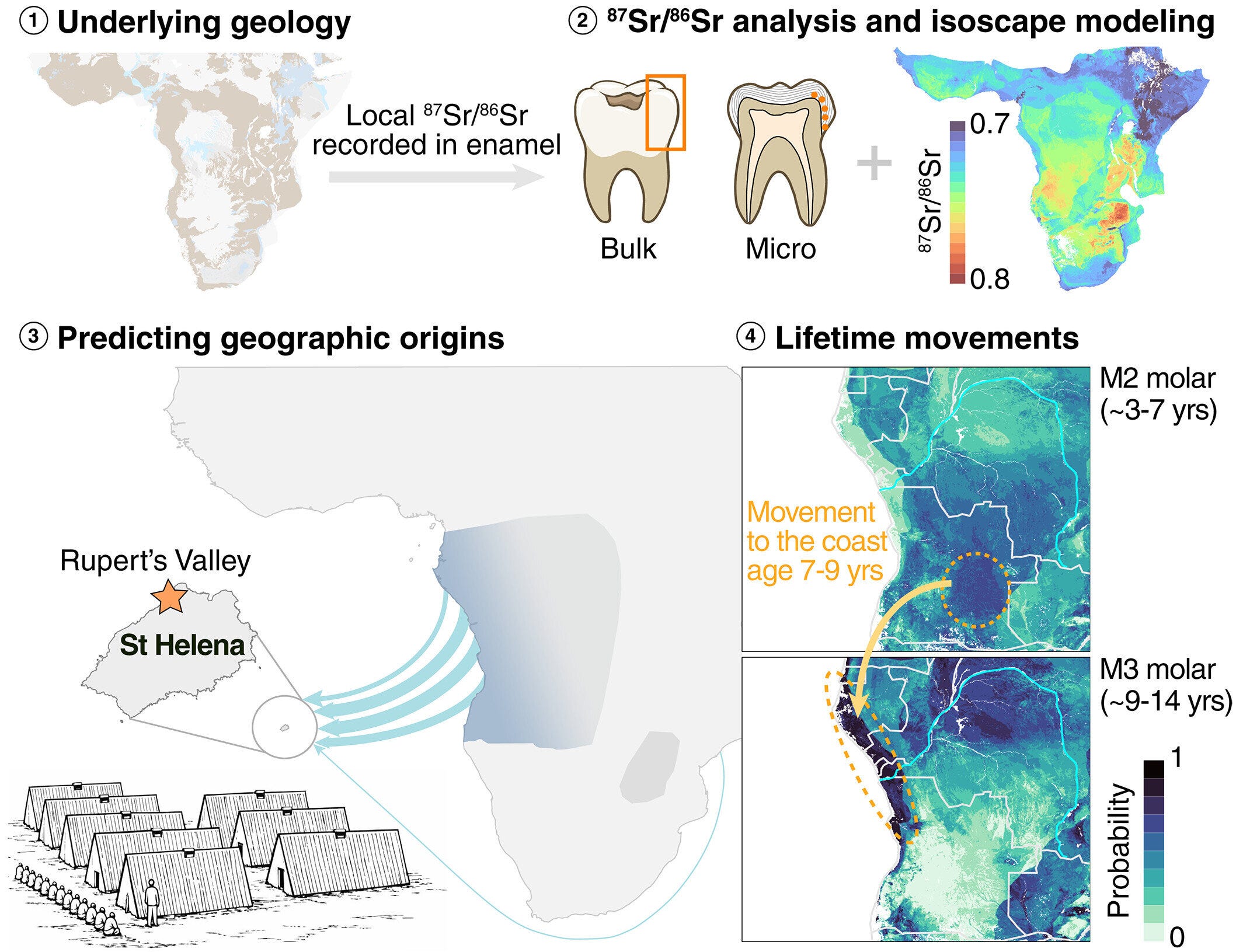
Both came from the same mouth. Both belonged to a man who died sometime between 26 and 35 years of age, sometime in the mid-19th century, in Rupert’s Valley on the island of St Helena. But the strontium locked into each tooth was laid down at different points in his childhood, and the numbers don’t match. The molar that mineralized earlier carries a signature consistent with inland Angola. The one that came later reads coastal, close to the likely port where he was eventually put on a ship. Somewhere between those two windows of enamel formation, roughly age seven to nine, he moved. Or was moved.
This is Individual 289, one of 152 people whose teeth were sampled for a new study in Science,1 and his case2 is the clearest illustration of what the researchers were actually trying to do: use the chemistry of teeth to reconstruct journeys that no ship’s manifest ever recorded.
St Helena is an odd place to end up buried. It’s a volcanic speck in the South Atlantic, over a thousand miles from the African coast, with no plantation economy and no reason for enslaved people to be there at all except that after 1807, when Britain outlawed the slave trade, the island became a way station for the Royal Navy’s West Africa Squadron. Ships caught running captives across the Atlantic were intercepted and brought to St Helena for adjudication. The people aboard were legally “liberated.” Functionally, many of them were dumped on an island in the middle of nowhere, malnourished and sick, with nowhere else to go. Archival records put the number landed between 1840 and 1863 at nearly 27,000. About 8,000 died within a short time of arrival and were buried in two unmarked graveyards in Rupert’s Valley.
Those graveyards stayed unmarked until 2007, when airport construction cut through them and uncovered the articulated remains of 325 people. What followed was a decade of community deliberation on St Helena about what to do with the dead: how to study them, whether repatriation was possible, how to commemorate people who never consented to any of it, including the archaeological attention they were now receiving. The strontium study grew directly out of that process.


