
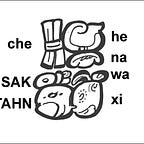
The glyphs sit at the bottom of an inverted L, tucked into the corner of a room that nobody was ever meant to admire. Nine hieroglyphs of mathematics, then two more that don’t belong to any calendar system at all. So says, the text reads, followed by a name: Sak Tahn Waax. White-chested Fox.

That’s it. That’s the whole announcement. No royal titles, no cosmic parentage, no k’atun-ending fanfare. Just a scribe, somewhere around 781 CE, writing down a formula and then putting his name on it, the way anyone might sign a worksheet.
Franco D. Rossi, David Stuart, and Heather Hurst, the team that deciphered the text, are calling1 it the first known instance of a Classic Maya mathematician-astronomer claiming credit for intellectual work. Not an artist. Not a sculptor. Someone who did the math.
That distinction matters more than it might sound like it should.
A room full of scratch paper
Structure 10K-2 at Xultun, Guatemala, is a small masonry building that archaeologists opened in 2010 after it had spent roughly a millennium buried under fill. Its interior walls were painted with portraits of seated men bearing the title taaj, “obsidian,” a designation for ranked specialists. One wall shows the Xultun ruler Yax We’n Chan K’inich dressed as a maize deity with a scorpion’s tail. It’s a formal room, in other words, or it started as one.
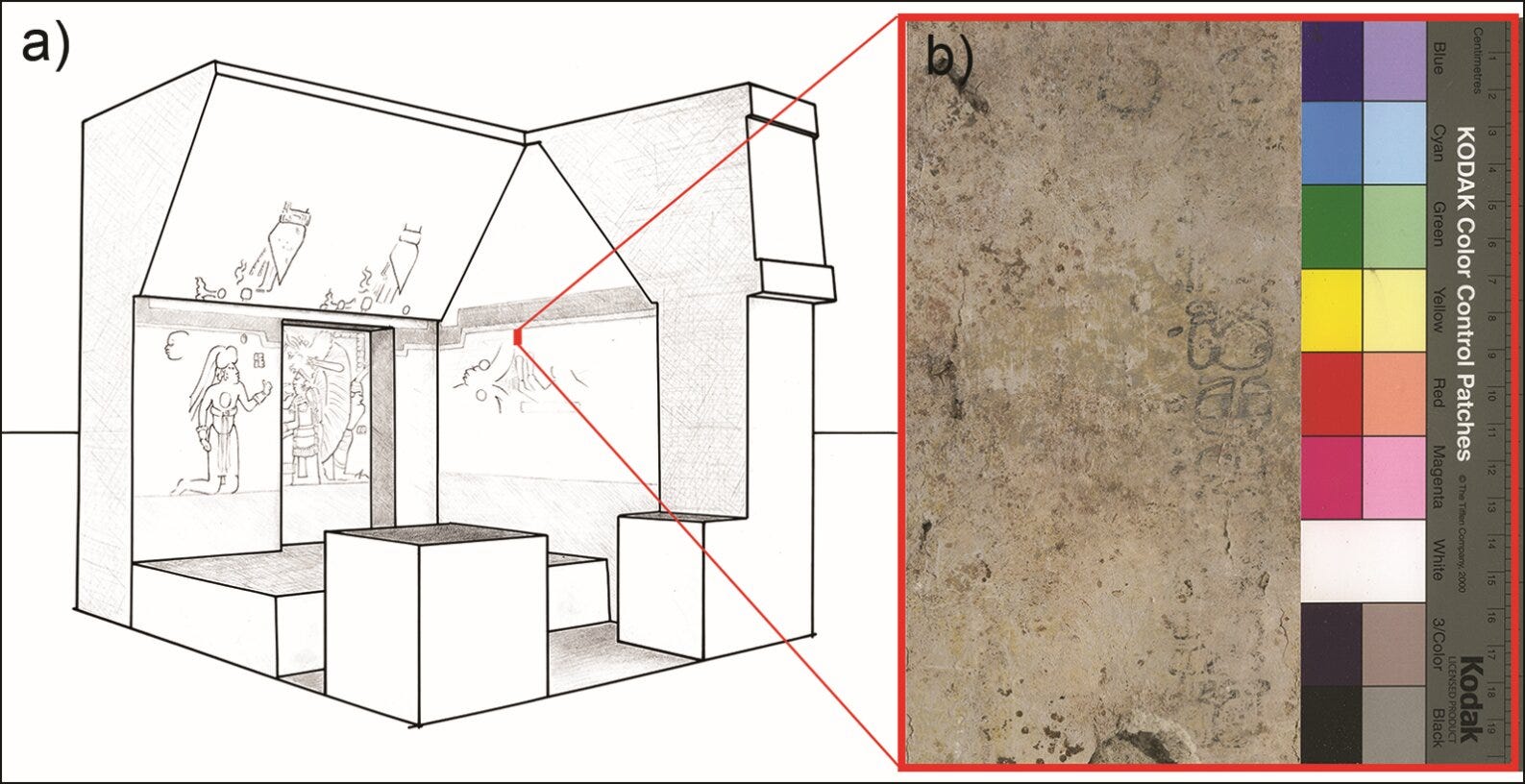
What happened next is the interesting part. Someone kept coming back and writing on it. Painting numbers over the portraits. Reusing patched plaster surfaces for fresh calculations. By the time the room went out of use, it held more than 50 discrete texts crowded into the northeast corner and along the east wall: a lunar table, columns of “super numbers” divisible by both the Mars and Venus cycles, a ring number, and dense little clusters of calendrical arithmetic that have almost nothing to do with the room’s original decorative program.
Rossi, Stuart, and Hurst read this as a workspace, not a monument. The kind of place where someone was training in calendrical calculation, possibly while making bark-paper codex books, of which only four pre-Columbian examples survive anywhere, all centuries younger than this room and none of them archaeologically excavated. If that reading holds, 10K-2 is the closest thing we have to a Classic-period scriptorium caught mid-use, walls covered in the equivalent of scratch paper.
Scratch paper, notably, tends not to get signed. Most of it doesn’t say who did the arithmetic. Text 19 does.
Reading a formula that was never meant to be permanent
Reconstructing it took more than a decade. The east wall’s plaster had suffered from root growth and water infiltration, and much of Text 19 survives only as faint pigment traces. The team layered flatbed scans, infrared photography, and dStretch-processed imaging to pull 11 glyph blocks out of a surface that, to the naked eye, mostly looks like eroded stone.

What emerged is a sequence of five dates connected by four intervals, expressed in the conventional Maya vocabulary of Distance Numbers, followed by that two-glyph attribution. The whole formula spans exactly 2,920 days, which is not an arbitrary span. It’s the lowest common multiple of the 584-day Venus synodic cycle and the 365-day solar year, meaning Venus’s position relative to the sun repeats almost exactly every 2,920 days, or eight solar years, or five Venus cycles. This interval shows up constantly in Maya inscriptions, most famously in the Dresden Codex Venus tables.
What’s unusual about Text 19 isn’t the total. It’s what the scribe did inside it. Rather than dividing the 2,920 days into the five Venus periods that generated the number, he parceled it into a completely different sequence of nested intervals: 20 days, then 260, then 1,560 (two Mars cycles), then 1,080 (three 360-day Tun cycles), each interval larger than the last. Read in order, those intervals happen to follow a Fibonacci-like progression, though whether the Maya mathematician who built this recognized that pattern as such, or simply arrived at it through some other logic entirely, is not something the epigraphic record can tell us. The team is careful not to claim more than the text supports.
Nine glyphs to state the math. Then two more.
The name at the end
Cheheen, the first of those closing glyphs reads, a quotative particle that shows up elsewhere in Maya script meaning roughly “so says” or “thus spoken.” It’s the kind of marker used to attribute a statement to someone. What follows is unambiguous: SAK-TAHN-wa-xi, Sak Tahn Waax, White-chested Fox.
The authors are appropriately cautious about what this attribution actually means. It’s possible White-chested Fox calculated and painted the formula himself. It’s also possible the phrase cites him as an authority, the way a modern text might say “according to so-and-so,” crediting someone else’s method rather than one’s own hand. Either reading still makes this the only known case of a Classic Maya mathematical text naming an individual responsible for the intellectual content, as opposed to naming a king whose reign the calculations happen to serve.
That’s a strange gap in the record, when you sit with it. Maya scribes and sculptors signed things. Painted ceramics carry artists’ signatures. Carved monuments sometimes name the sculptor. Rossi, Stuart, and Hurst note that individual scribes and artists were increasingly visible in the eighth century, claiming credit for craft and style in a way that represented a real cultural shift. But the people doing the underlying astronomical and calendrical calculations, the ones whose work actually determined when kings were inaugurated or monuments erected, stayed invisible. Their results got carved in stone. Their names didn’t.

Part of the explanation may simply be genre. Formal inscriptions were built to display outcomes: coordinated dates, celestial alignments, the appearance of destiny aligning with political timing. They weren’t built to show the mechanics behind those outcomes, and mechanics are exactly what tend to carry an individual’s fingerprints. Text 19, sitting in a back room where nobody but other specialists would ever read it, had no audience to perform for. Maybe that’s precisely why a name could attach to it. There was no larger narrative for the name to compete with.
Why this text and not one of the other 50-plus in the room remains an open question the authors don’t try to resolve. Several other inscriptions in 10K-2 look, by their handwriting, like they could be the work of the same scribe. If so, White-chested Fox may have produced much of what’s on that wall, and chose to sign only the one formula that reads as a complete, self-contained composition rather than a fragment of some larger calculational tool. A finished piece, maybe, rather than a working note. It’s a guess grounded in the text’s structure, not a certainty.
Contemporaries in India, Mesopotamia, China, and Greece who worked out solar and planetary cycles have long had names attached to their achievements. Astronomy in the Classic Maya world produced calculations of comparable sophistication and, until now, no comparable names. Somewhere in northeastern Guatemala, in the final years before Xultun’s central precinct emptied out, a mathematician sat in a back room and did something that turns out to have been almost unheard of. He took credit.
Further Reading
Saturno, W.A. et al. 2012. Ancient Maya calendrical tables from Xultun, Guatemala. Science 336: 714–717. https://doi.org/10.1126/science.1221444
Saturno, W.A. et al. 2015. To set before the king: residential mural painting at Xultun, Guatemala. Antiquity 89: 122–136. https://doi.org/10.15184/aqy.2014.11
Rossi, F.D., Stuart, D. & Hurst, H. 2026. The identification and work of an eighth-century Maya mathematician. Antiquity 100(413). https://doi.org/10.15184/aqy.2026.10378


