

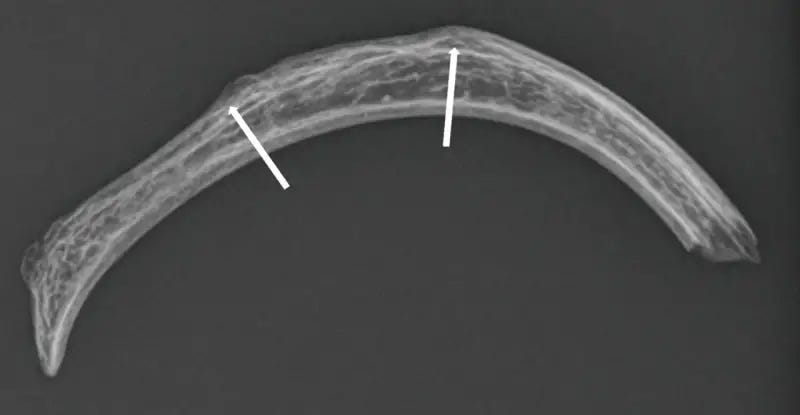
The fourth rib on the left side had healed wrong. Not shattered, not obviously violent, just subtly bent, a greenstick fracture where the outer curve of the bone had splintered while the inner surface stayed whole. Whoever excavated E84 SK906 from the East Kirk of St Nicholas in Aberdeen could easily have walked past it. Rib fractures in children’s skeletons are common and usually mean nothing sinister. Falls. Rough play. The ordinary hazards of being young in a world without padded surfaces.
But this rib sat next to something harder to explain away. Three lumbar vertebrae, compressed and wedged, the kind of injury that in a modern emergency room triggers an automatic child-protection referral. Together they became the test case for a new diagnostic model built by Elizabeth Ashcroft, Rebecca Crozier, and Marc Oxenham, published this year in Childhood in the Past.1 The model has an unglamorous name, the Archaeological Jigsaw Model, but it’s trying to solve a genuinely hard problem: how do you responsibly say a child was abused a thousand years ago, using nothing but bone?
Osteoarchaeology has always been squeamish about this question, and for good reason. Bones don’t testify. They don’t explain intent, and intent is usually the whole legal and moral weight of the word “abuse.” A fracture from a fall and a fracture from a blow can look nearly identical by the time they’ve healed. Skeletons preserve unevenly, children’s bones worse than adults’, and a missing skull, as in this case, closes off entire categories of evidence before the analysis even starts. Add to that the discomfort researchers understandably feel about implicating long-dead parents or caregivers in an interpretation that can never be confirmed, and you get a field that has historically looked away.


