
Anthropology.net
Evolutionary Insights by Anthropology.net
The Map in Your Head Isn’t the Map on the Ground
0:00
-24:04

Paid episode

The full episode is only available to paid subscribers of Anthropology.net

The Map in Your Head Isn’t the Map on the Ground

A cellphone-data study of two million Americans and 300,000 Senegalese suggests human movement runs on two different engines, one for the neighborhood and one for everywhere else

A visiting pastor once put up a slide during a sermon at a church in upstate New York. It was Saul Steinberg’s famous New Yorker cover, the one where Ninth Avenue fills half the frame and China is a smudge near the horizon. The pastor was making a point about self-absorption. Jianxi Gao, a network scientist at Rensselaer Polytechnic Institute sitting in the pews, started thinking about something else entirely: whether that distortion was just a joke about New Yorkers, or whether it was actually how human beings process space.

That question turned into a paper in the Journal of the Royal Society Interface,1 and the answer it arrives at is more interesting than the premise suggests. People do not treat distance as a single, uniform currency. The two miles between your apartment and your job feel nothing like the two miles between your apartment and a friend’s place across town, and that difference is not just psychological noise. It shows up, cleanly and repeatedly, in the structure of where people actually go.
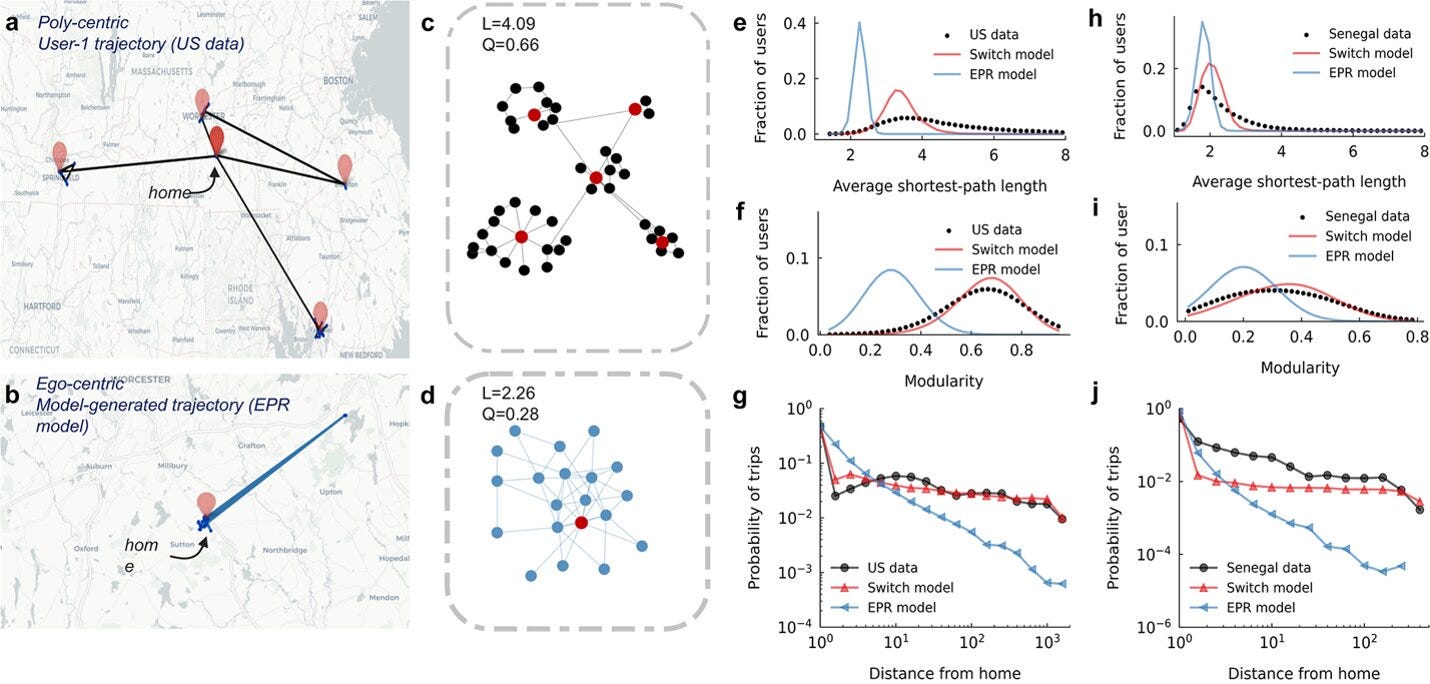
The polycentric modular structure of human mobility networks. (a, b) Real-world cell phone trajectories show polycentricity (multiple activity centers, marked in red) compared to the egocentricity of traditional models. (c, d)Corresponding mobility networks where nodes are stay points and edges are trips. (e–g) Network metrics for the U.S. dataset: shortest-path length (e), geometric modularity (f), and trip distance from home (g). (h–j) Corresponding distributions for the Senegal dataset. Across both datasets, empirical polycentric mobility yields networks with high shortest paths, high modularity, and frequent distant trips. Traditional egocentric models (e.g., the EPR model) fail to capture these properties, whereas our proposed model closely aligns with real-world mobility data. Credit: Zhong et al.
User's avatar

Continue reading this post for free, courtesy of Anthropology & Primatology.