

Regourdou 1, a young adult Neanderthal from Montignac, France, dated to 70 to 56 ka BP (thousand years before present), is one of seven individuals in a new 3D study of the Neanderthal heel bone, and its heel is missing data in the region where the study finds the sharpest difference from our species. That region is the tuberosity, the rear end of the bone, where the Achilles tendon attaches. Four of the other six Neanderthal heels in the sample also needed more of that region reconstructed than of the surfaces that meet the ankle bone.
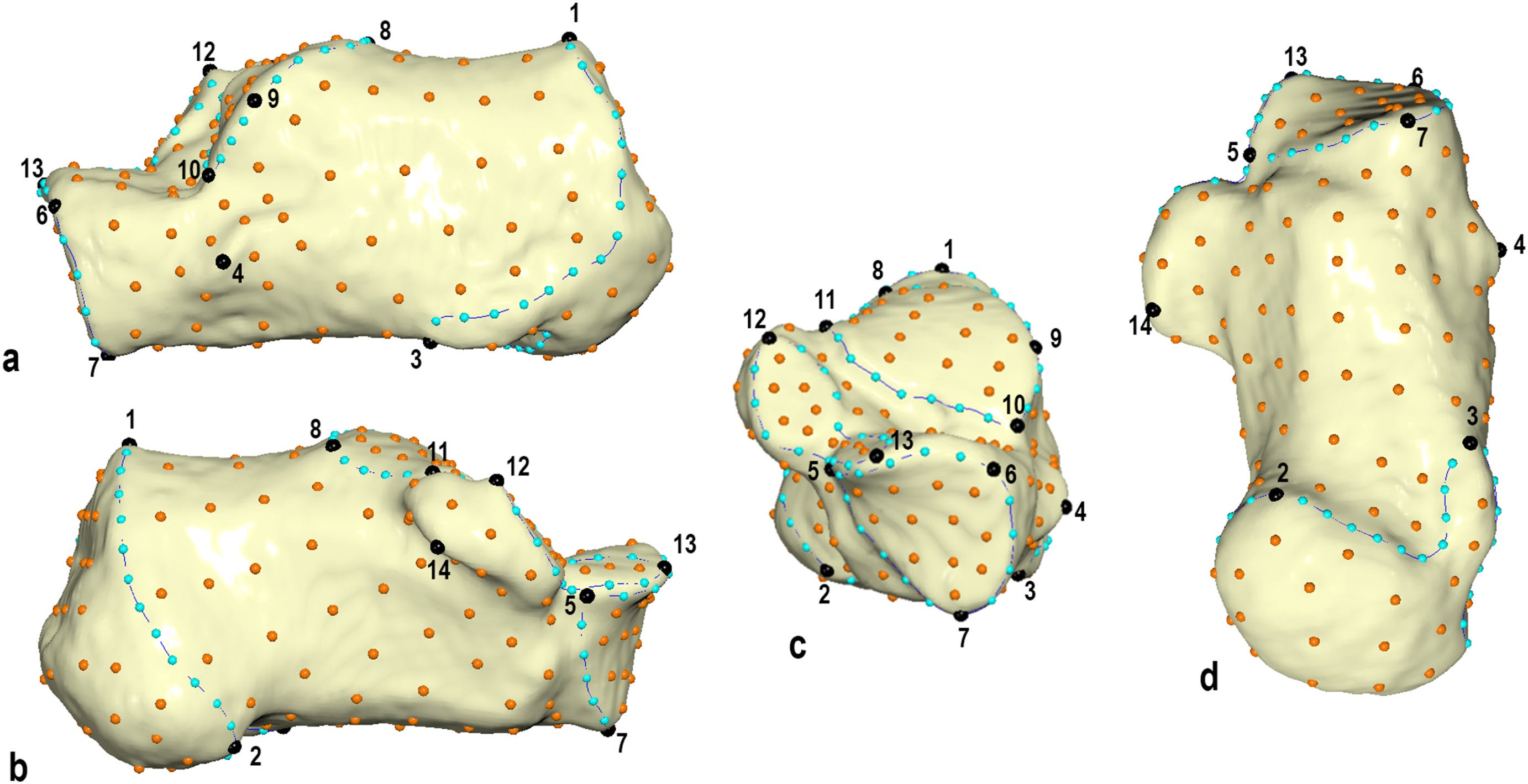
I start with that gap because the press release starts with a much simpler claim: “In all likelihood, the Neanderthals had flat feet.” The older picture has Neanderthal feet built almost like ours, with sturdier bones and larger joint surfaces. The new paper, in the Journal of Human Evolution,1 argues that the heel also differs in shape, and that the difference points to a foot that stood and took load in another way. I think it makes a good case for that much, but the authors treat flat feet as a hypothesis, and so should we.
Rita Sorrentino of the Universities of Palermo and Bologna is the paper’s first author, and Maria Giovanna Belcastro, professor at the Department of Biological, Geological, and Environmental Sciences of the University of Bologna, coordinated the study. The team compared the calcaneus, or heel bone, of 7 Neanderthals (Homo neanderthalensis) with that of 64 Homo sapiens. Neanderthal heels came out shorter from front to back, wider from side to side and taller from top to bottom, even though their overall size falls within the range of H. sapiens. From the joint surfaces the authors infer a foot that habitually rolled inward, a posture called pronation. More cautiously, they suggest a lower lateral longitudinal arch, the lengthwise arch along the outer side of the foot.


