

At Florisbad, in South Africa’s Free State Province, a human tooth came out of a spring vent of white sand, alongside a partial human cranium. In 1996, R. Grün and colleagues dated that tooth to 259 ± 35 thousand years ago (ka) using electron spin resonance (ESR), which reads the radiation damage stored in tooth enamel. The method needs to know how much radiation the tooth received each year. For the Florisbad cranium’s tooth, that yearly dose came from white sand layers in Unit F, at least 2 m above the deposits that bracket the fossil, and the uranium in the tooth was assumed instead of measured.
Anyone who follows this fossil probably carries that number around. The usual picture of its setting is familiar too: grasslands when lake levels were high, and arid ground with brackish pools in dry phases, like the pools and wetlands at the site today.
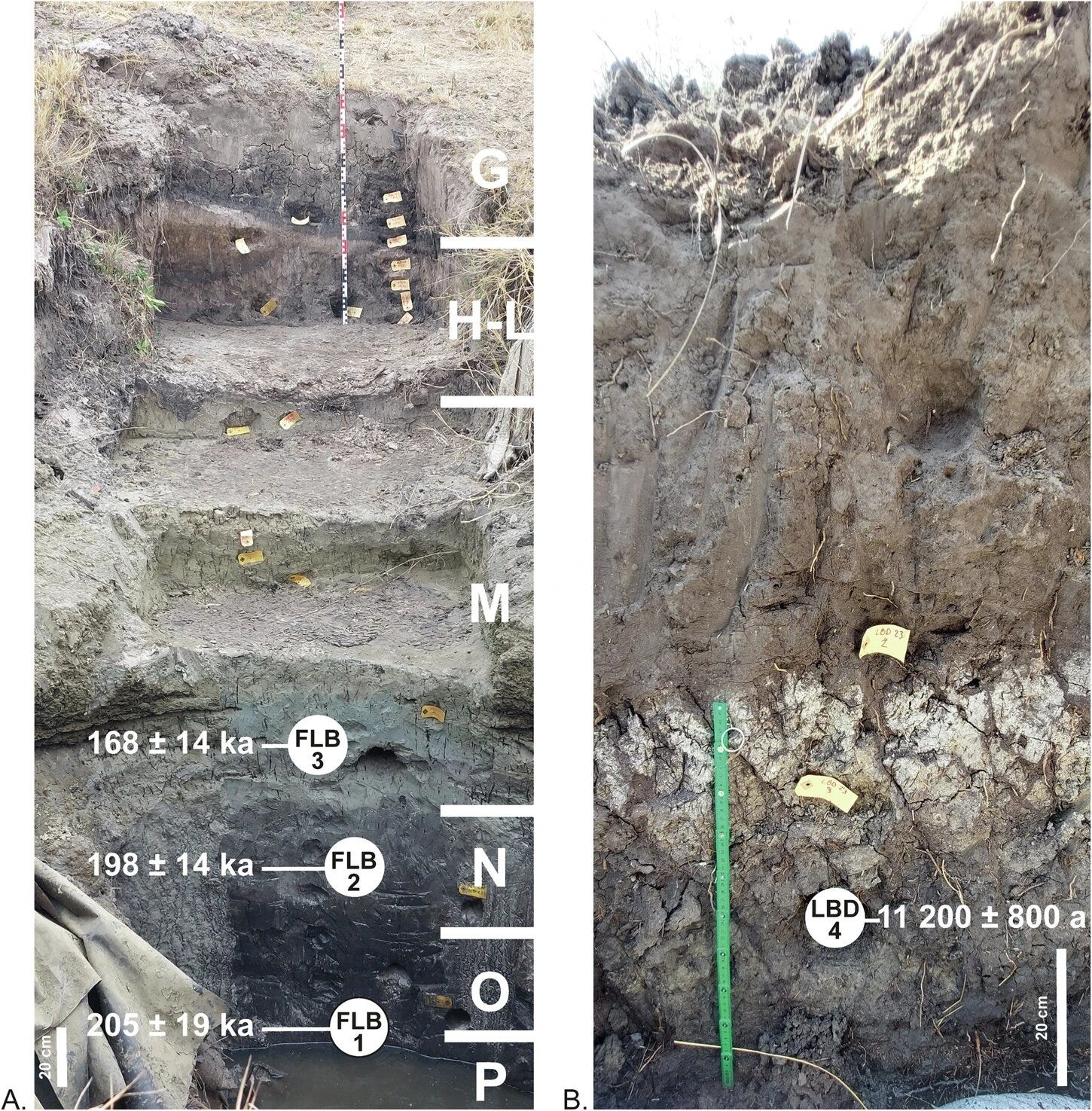
A new paper in Communications Earth & Environment,1 with Michaela Ecker of Kiel University and Michael B. Toffolo of Archéosciences Bordeaux as corresponding authors, revises the first belief and complicates the second. New luminescence ages on the sediments below and above the fossil give a range of 212 ka to 154 ka. Plant waxes from the same sequence show that most of the Pleistocene record does not match South Africa’s modern biomes, which is what the authors mean by non-analog environments, the settings they say supported early Homo sapiens.
The authors also reread older stone tool and animal bone reports against this record and propose that shifts in ecosystem productivity may have shaped how people used tools. I think the date is the most consequential result, because it changes a number other researchers rely on. The press release never says the fossil’s age has changed.


