

Near the bottom of the Predynastic deposits at Heliopolis, about 8 meters under what is now northeastern Cairo, Ernesto Schiaparelli’s workers recovered flint directly from groundwater in 1905 and 1906, and the count from that work has a hole in it. The Heliopolis flint collection holds 187 cores, the stone blocks that blades were struck from, but only 549 blades and bladelets (small blades). That works out to 2.9 blades per core, yet most of those cores still show four to eight blade scars on their working faces. The authors of a new study calculate that at least twice as many blades were made as were found.
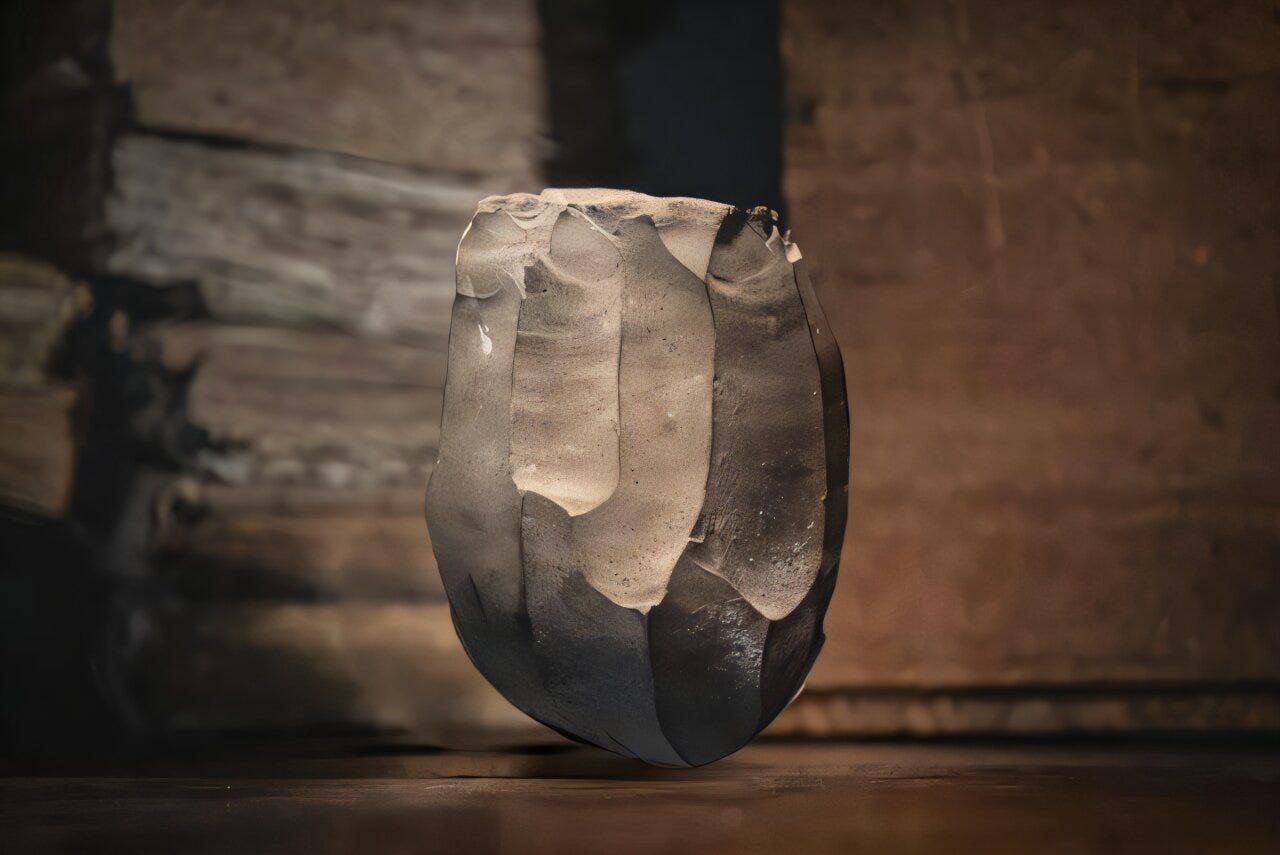
Where the rest went is the question behind the paper, and the answer pushes against a common picture of early Egypt: that specialized production of everyday goods arrived with the state, once there were rulers demanding surplus.
Writing in the Journal of Anthropological Archaeology,1 Francesca Manclossi, Giulio Lucarini and three co-authors argue that a small group of expert knappers (flint workers) ran a blade workshop at Heliopolis at the end of the fourth millennium BCE, shortly before the Egyptian state emerged, and supplied their neighbors. These were communities of the Lower Egyptian Culture, the Predynastic groups of the Nile Delta and Memphite region. The authors think the experts probably farmed too, that no authority controlled them, and that users retouched (trimmed the edges of) and resharpened their own tools. They call this arbitrary craft specialization, a term from Perlès (2012) for a community in which some members take on a specialist role without exclusive control of raw material or know-how.
The larger claim follows from that. When standardized blades began arriving from desert mine workshops such as Wadi Sannur in the Protodynastic period (Naqada IIIA–B), Lower Egyptian communities could adopt them quickly because the split between people who made blades and people who used them was already in place. I think the paper carries the first half of this argument better than the second, and the reasons are in the count of those missing blades.
How do flint cores reveal a Predynastic workshop?
The first job was showing that a collection dug more than a century ago could be trusted. The Museo Egizio in Turin held about 4,000 stone artifacts loose in 40 wooden boxes, mixed with material from other sites and market purchases. Labels and inventory numbers, checked against archives, tied 2,869 pieces to Heliopolis, and field notes place most of them in the lowest layer of the so-called Prehistoric Village, a dark deposit about a meter thick sitting directly on sand with no human traces. Cores, flakes under 20 mm and burnt fragments all survive, which is what you expect when workers kept what they found instead of the handsome pieces.
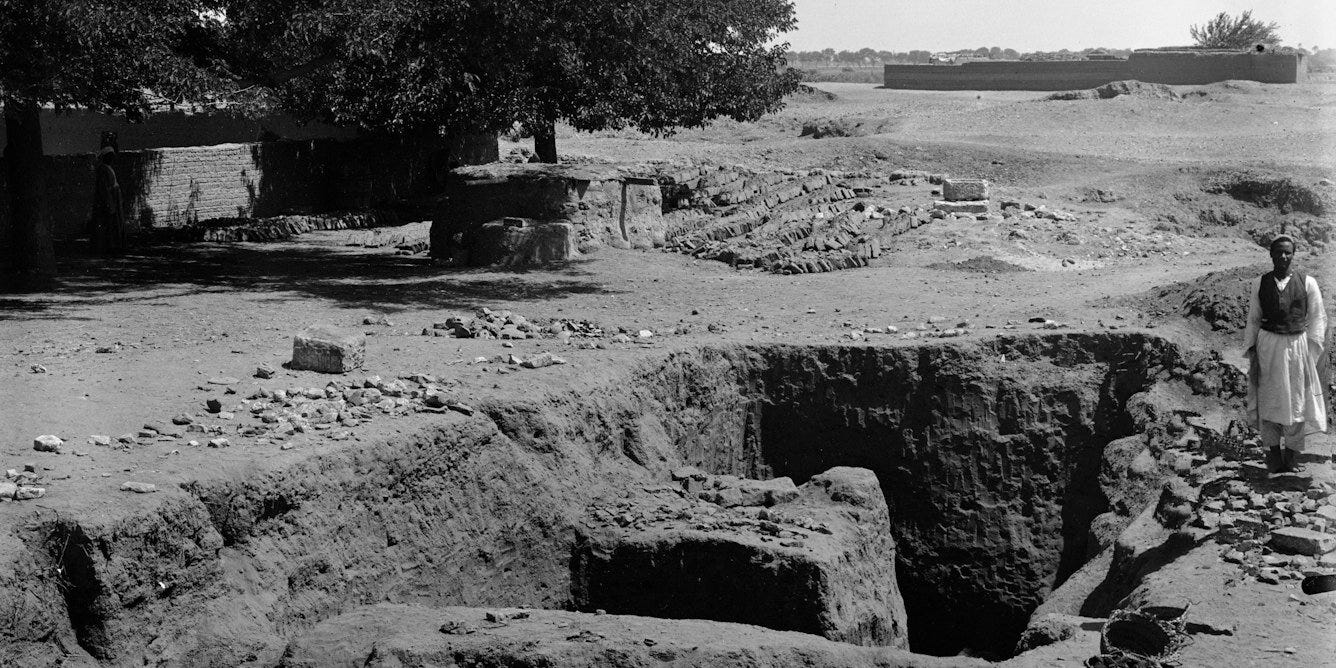
The control comes from Area 251, about 500 meters south, excavated in 2019 by the Egyptian-German Heliopolis Project beside an installation interpreted as a brewery. It produced the same sequence, along with 2,546 chipped-stone pieces. Pottery places both deposits in the late Lower Egyptian Culture (Buto IIB) and a transitional phase (Buto IIIA/IIC). The paper reports no radiocarbon dates for either one and describes the pottery analysis as preliminary. I accept the phase assignment for this comparison, because two excavations a century apart found matching layers with matching pottery, but a phase is not a date range.
The analysis itself is a chaîne opératoire, a reconstruction of the whole sequence of choices from selecting a pebble through striking blades, using them and throwing them away. It can address how work was organized because each step is a learned habit that leaves marks in the stone, showing how skilled a knapper was and which steps happened where.
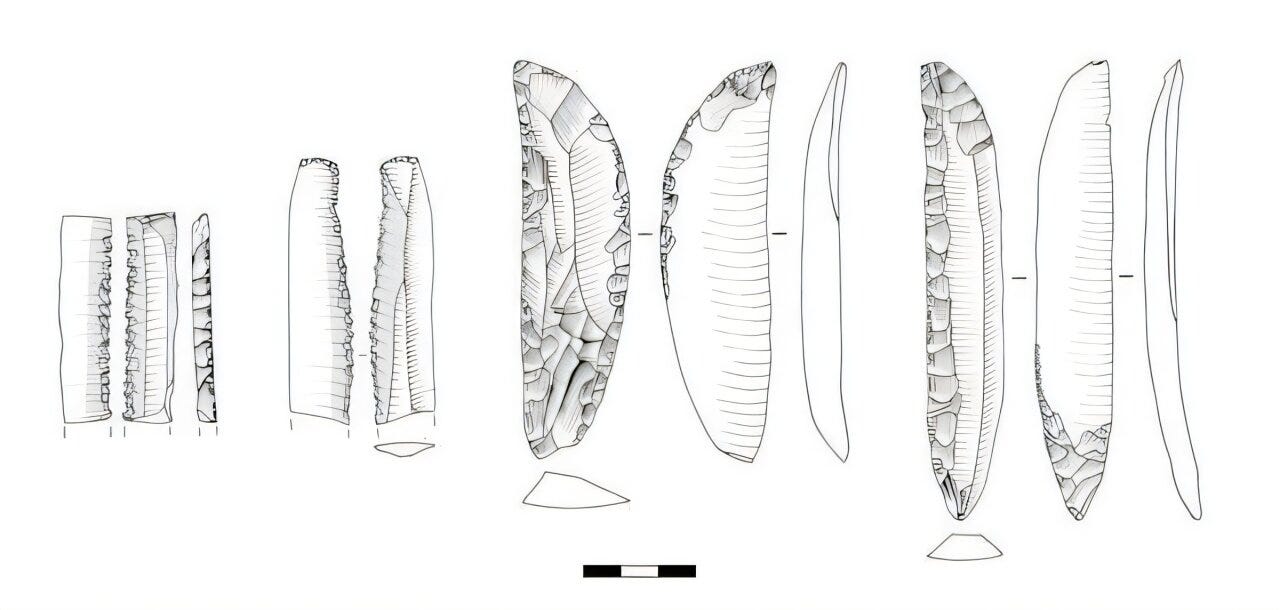
The workshop argument comes from setting the two areas side by side. Schiaparelli’s area has one core for every 2.9 blades, while Area 251 has 14 blade cores and 284 blades, one for every 20.3. Most Area 251 cores also carry at least one hinged removal (a blow that curled out and stopped short), and the edges above their working faces often preserve repeated failed blows. The authors read this as experts at one spot striking more blades than they kept, while less practiced people elsewhere made a few of their own and probably got most of their blades from the workshop.
The link to farming runs through sickle elements, blade segments with a visible gloss from use. Their retouch varies widely in Schiaparelli’s collection, which the authors take to mean that users maintained their own. A few carry fine, evenly spaced serrations attributed to pressure retouch (pressing off tiny flakes with a pointed tool instead of striking them), probably with metal tools, and those, they suggest, may be sickles that expert knappers made and used themselves.


