

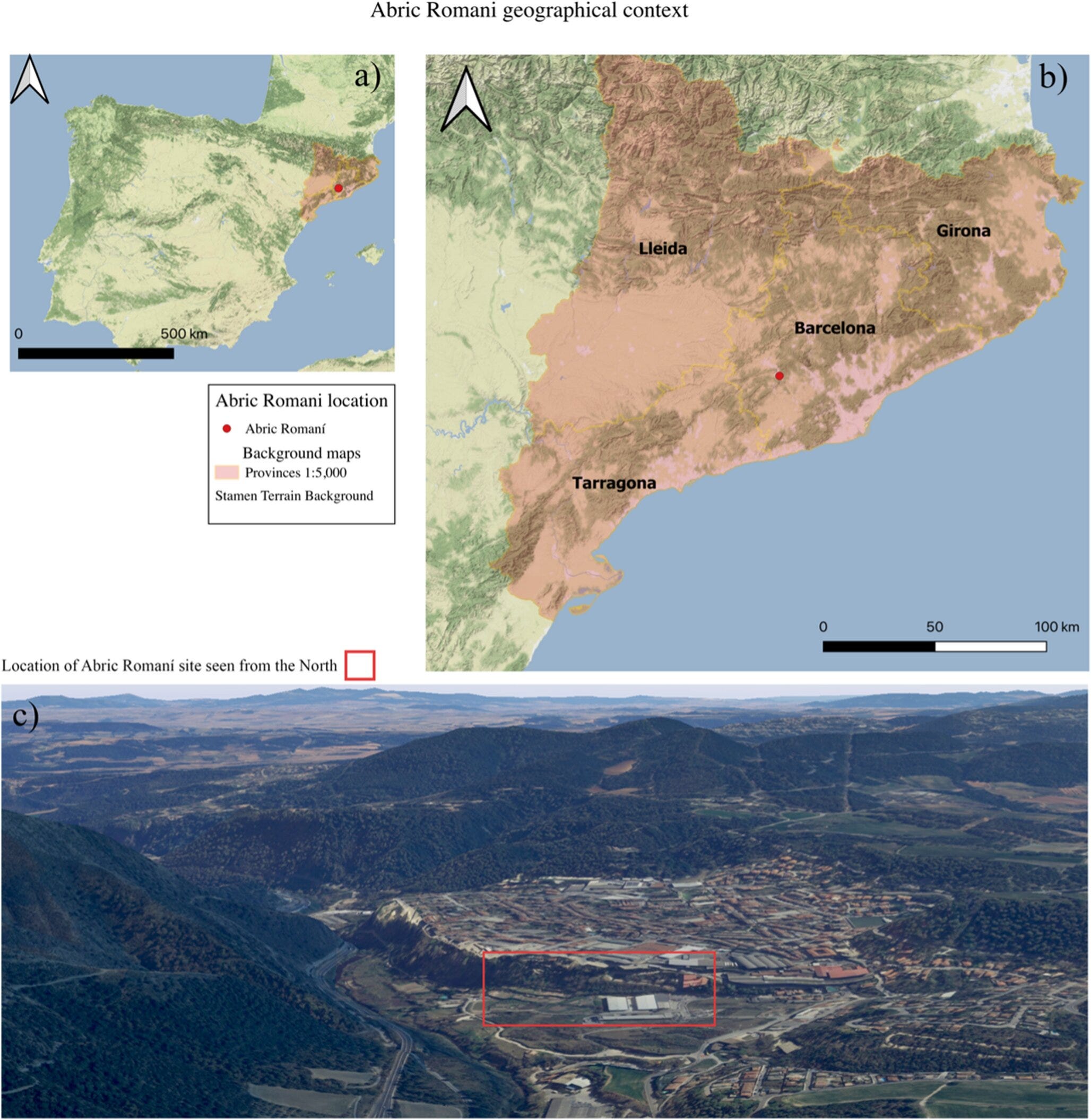
In squares R60 and S59 of level Ra at Abric Romaní, a rock shelter above the Anoia River at Capellades, near Barcelona, a small group of Neanderthal charcoal fragments comes from a different tree than almost everything around it. Nearly all the fuel burned in this level was mountain pine. These fragments are Prunus, which the authors’ cross-sections most likely place in the P. spinosa type, and the paper offers three possible reasons for their presence without choosing among them.
The oddity is a good way into a paper whose main subject is less exotic. Neanderthal campsites are usually read through bones and stone tools: bones show where carcasses were processed, and knapping debris marks where tools were made. Charcoal tends to be treated as a record of which trees grew nearby. The reader’s working assumption is that Neanderthals at Abric Romaní already organized the shelter into hearth areas and work areas, and that the evidence for it comes from fauna and lithics. This study asks what the position of 640 charcoal fragments adds to that picture, and my reading is that it adds detail rather than revising anything.
What did the Level Ra charcoal show?
The paper is by Tomás Fernández-Iriarte (IPHES-CERCA, Tarragona) with Bàrbara Mas, M. Gema Chacón, Palmira Saladié, Josep Vallverdú and Ethel Allué, published in 2026 in the Journal of Paleolithic Archaeology.1 Abric Romaní has a sequence the paper gives as 70 ky long (110–40 BP, dated by U-series), and sediment built up in level Ra at up to 80 centimetres per thousand years, which is why the record is so fine-grained. The abstract places Ra at the beginning of MIS 3. The text gives no age for Ra itself.
Of the 640 fragments, 484 (75.63%) are Pinus sylvestris type, 17 (2.66%) are Prunus, 86 are undetermined conifer and 53 are undetermined. “P. sylvestris type” is a lumped category, because three mountain pines (P. nigra ssp. salzmannii, P. sylvestris and P. uncinata) have wood anatomy too similar to separate under the microscope.
Mapped across the excavated surface, the charcoal falls into two patterns. In the northern section it forms a broad concentration overlapping the hearths, and in the southern section it occurs as smaller, isolated clusters, often away from hearths. The authors read the north as consistent with primary refuse, meaning burnt fuel left where it burned. They read the south as possibly secondary refuse, meaning combustion residue moved elsewhere, perhaps when hearths were cleaned. Whether that southern reading holds is the question the paper cannot settle, and it says so.


