

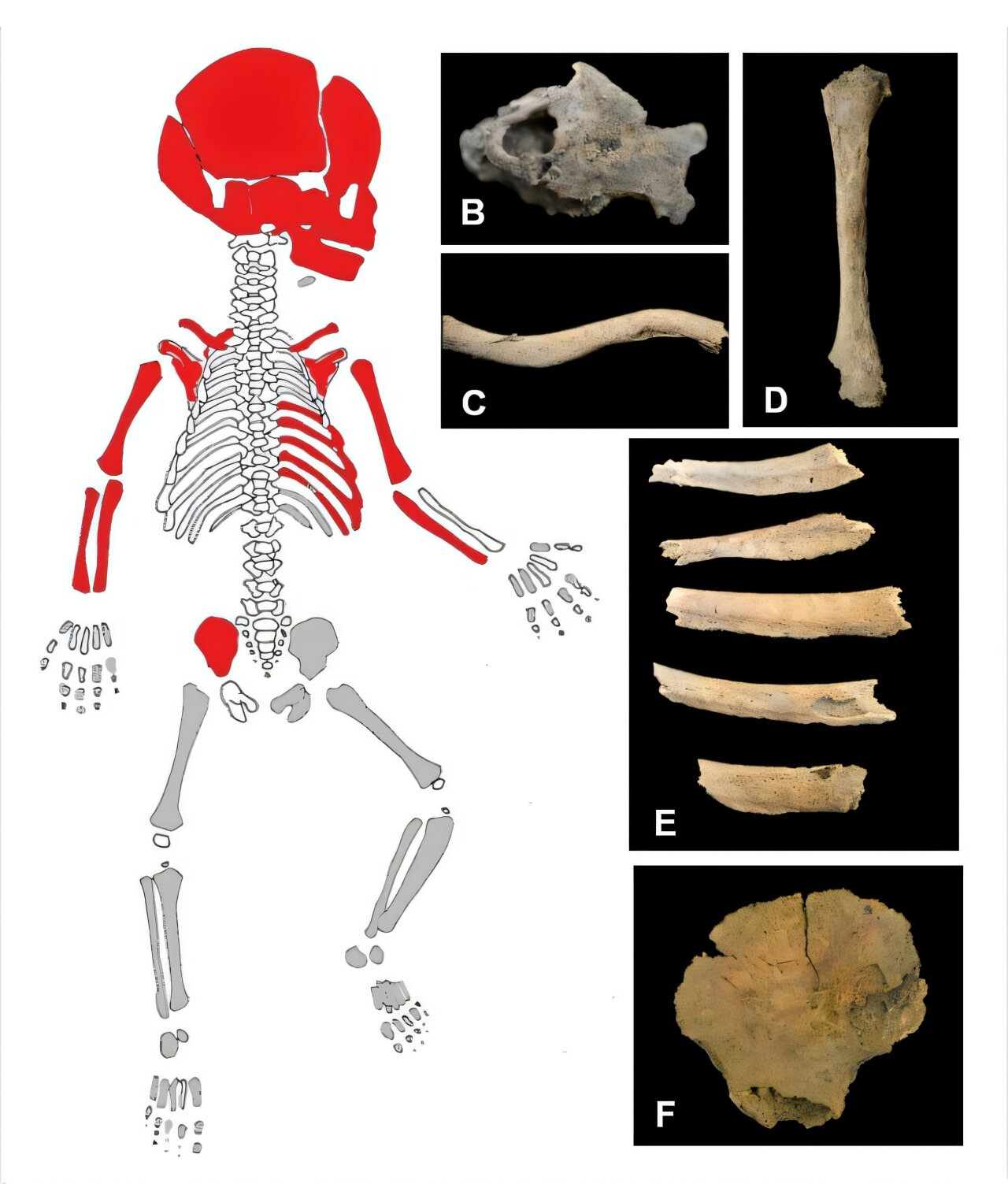
One of the first ancient Ecuador genomes ever published belongs to a baby of six to nine months, buried at Salango on the central coast around 2,300 years ago in the Very Early Guangala phase (about 300 to 200 BCE). The infant, Burial 369, lay in a mound near the north edge of the sanctuary, beneath another juvenile and with ritual materials. The skeleton carries lytic (bone-eroding) lesions on both shoulder blades, both forearms, the right hip, the right first rib and five left rib ends, and the skull is porous on the outside and grooved on the inside. DNA from the left petrous bone, the dense part of the skull base, produced 8,367 reads that a classification program assigned to Mycobacterium tuberculosis, the bacterial group that includes the tuberculosis pathogen.
That infant is one of four people in the first ancient genomes from Ecuador, reported in PNAS Nexus1 by John Lindo (University of California, Berkeley), Richard Lunniss (Universidad Técnica de Manabí) and colleagues. Salango’s history gives a reason to expect turnover in its population: a volcanic eruption at Pululahua around 330 BCE that the paper says ended the Formative tradition, then elite burial complexes, chiefdoms and, by the Manteño period, a maritime exchange network centered on Spondylus shell. I suspect most of us assume that upheaval on that scale, in one stretch of coast, brought in new people at some point. The paper sets out to test that assumption.
The four genomes come from two Very Early Guangala individuals, one Early Guangala individual (about 1,900 BP) and one Early Manteño individual (about 740 BP), with mean coverage between 0.54x and 2.31x. They cluster together and near ancient and present-day people from Ecuador, Colombia and Peru, and the authors conclude that Salango’s cultural changes happened largely within a stable local population rather than through large-scale replacement. A demographic model dates the split of the Ecuadorian coastal lineage from other Southern Native American lineages to about 9,800 years ago (95% CI: 9.6 to 10.1 ka). I think the continuity result is plausible but less secure than the abstract suggests, and that the divergence date is the weakest number in the paper.


