

At the base of a collapsed building in the walled center of Ake, in northern Yucatán, someone built one of five small square shrine-like structures (they average 10 square meters) and made a fragment of an Early Classic stela, carved around AD 600, its central piece. Excavators recovered more Chen Mul effigy censer sherds from this feature than from anywhere else at Ake so far. Censers are clay incense burners, and Chen Mul is a modeled style the paper dates to AD 1200 to 1550. The shrine belongs to a Postclassic settlement (AD 1100 to 1550), which means its builders were handling a carved monument at least five centuries old.
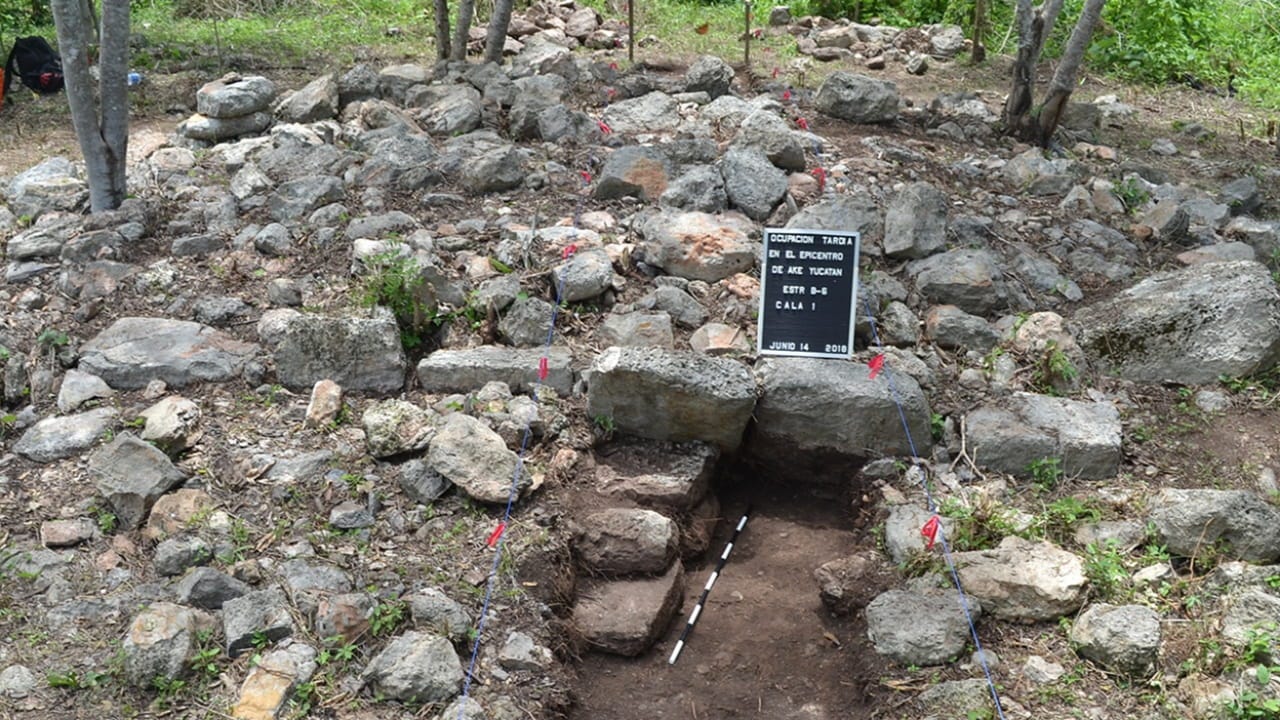
I would start from that shrine because it cuts against a picture many readers carry: that after the Classic period (AD 300 to 900) the great cities of northern Yucatán were left as empty stone. Roberto Rosado-Ramirez of the University of Virginia’s Department of Anthropology says this view appears in tourism material and in some academic narratives. At Ake itself, earlier archaeologists, including Ruben Maldonado Cardenas (1995) and Beatriz Quintal Suaste (1993), proposed that the post-AD 1100 material was left by pilgrims visiting sporadically from Mayapan. Specialists have not held the empty-city view uniformly, since the paper itself lists post-collapse settlements at Dzibilchaltun, Kuluba, Ek Balam, and Uxmal.
What did Rosado-Ramirez find at Ake?
The paper is a single-author study in Latin American Antiquity (2026).1 It argues that a community lived inside Ake’s walled center from about AD 1100 to 1550, among buildings that had been decaying since the political collapse of AD 1000 to 1100. Ake had been a city of as many as 19,000 people at its peak around AD 900 (Table 1), organized around a 2.5 hectare paved plaza ringed by its seven largest buildings. Rosado-Ramirez links the later occupation to Maya ideas about ruins as living places, and he argues that the break that matters in northern Maya history came with Spanish colonial rule. This post asks how much of that account the excavated evidence supports, and the answer differs claim by claim.


