

The one marmot bone at Valdegoba Cave that carries a cut mark is a right half-jaw from an old adult, and it comes from disturbed sediment. The cave sits in the Úrbel River gorge near Huérmeces, about 28 km northwest of Burgos in northern Spain, and its Neanderthal-bearing Levels 4 and 5 date to about 140–120 ka (thousands of years ago). A new preprint1 uses that jaw and three beaver bones to argue for Neanderthal beaver butchery and marmot processing at the site.
Most readers carry a picture in which Neanderthal meat means large hoofed animals, and the authors open by saying the field has long reconstructed it that way. They also note that rabbits and tortoises at Bolomor Cave in Spain already showed small prey predating the Upper Paleolithic (Blasco and Fernández Peris 2012), and that cut-marked beavers and marmots are known from other European sites. Valdegoba adds one more case to an existing list, and I think the paper is better read that way than as a challenge to the old picture.
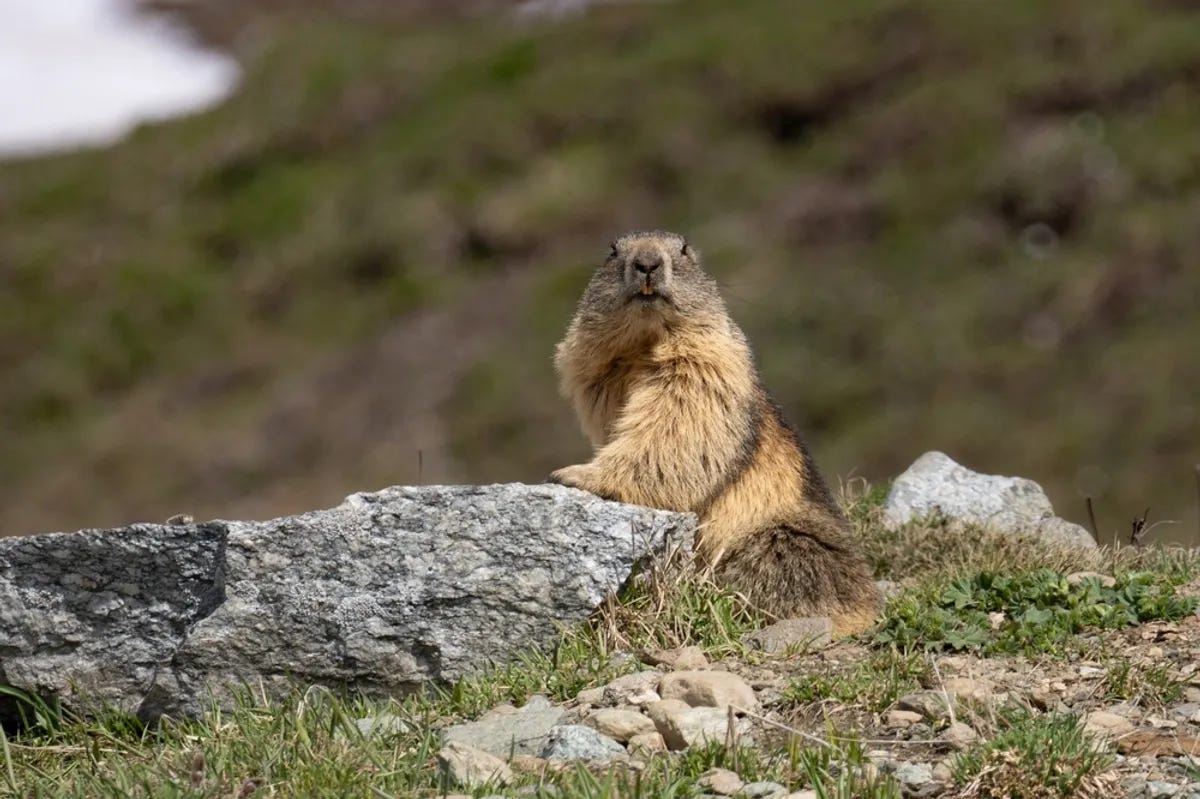
The preprint, posted on Research Square on 15 October 2026 and not yet peer reviewed, is by Ona Redon and J. Carlos Díez (Universidad de Burgos) and César Laplana (Universidad de Alcalá). They examined every specimen of Castor fiber (Eurasian beaver) and Marmota marmota (alpine marmot) from the excavations of 1987 to 1991 and 2006: 171 beaver specimens from at least 12 individuals and 60 marmot specimens from at least nine. Four of the 231 carry cut marks the authors consider confidently human, three on beaver and one on marmot. Carnivore tooth marks appear on 22. The authors infer a palimpsest, a deposit written over by several agents, with carnivores and natural deaths as the main inputs and Neanderthals as an occasional contributor. They call the exploitation occasional and not systematic, and I find that well supported, because the paper reports no recurrent butchery pattern, no burning and no strong age selection.


