

Two human figures about 9 cm tall are visible, faintly, on the wall of the La Rochelle rock shelter near Carolina, in the Mpumalanga Highlands of South Africa. Each is a patch of bare rock surrounded by red paint, with a halo of fine specks around the denser areas. The authors read the pair as stenciled rock art: paint blown or splashed over a template that was then removed. The shelter has a concrete floor, wooden pews and an improvised pulpit, and it seems to host the occasional church service still. The figures have no date and no parallel anywhere in the region.
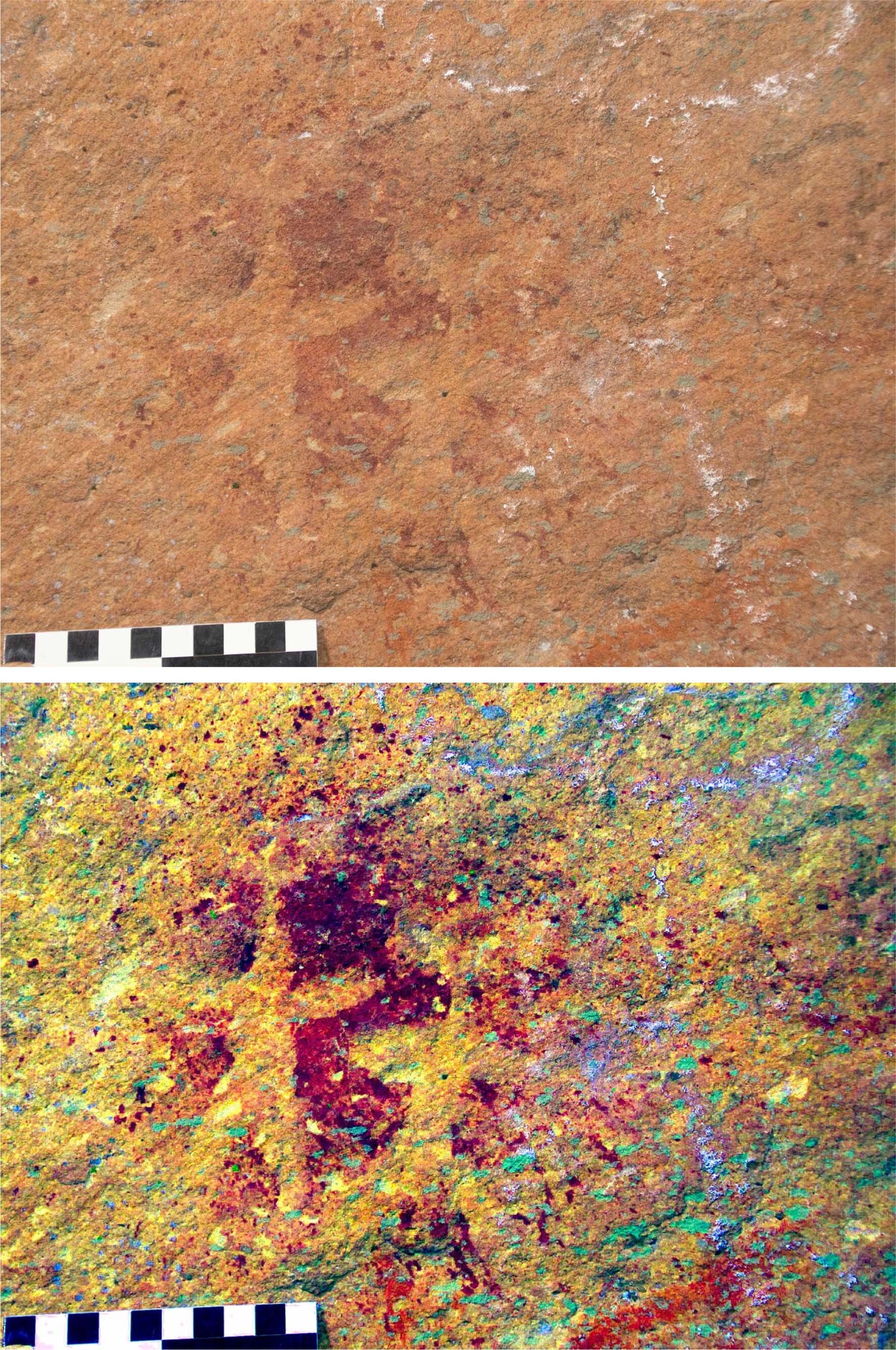
People who know southern African rock art carry a fairly firm belief about its techniques. The art is abundant and varied, but most hunter-gatherer painting is fine brushwork and most farmer and pastoralist painting is done with fingers, with handprints, finger dots and printed motifs as occasional extras. Stenciling, which is common elsewhere in the world, was not on that list. This paper adds it, on the evidence of one panel. That adds a technique to the regional repertoire without revising what we think the art means, and the authors say plainly that they cannot tell us what it means.
What is the stenciled rock art at La Rochelle?
David G. Pearce (Rock Art Research Institute, University of the Witwatersrand) and Kiah Johnson (Department of Archaeology, University of Cambridge) describe the figures in a Field and Technical Report titled “First report of stencilled rock art in Mpumalanga, South Africa,” in the South African Archaeological Bulletin 81(224): 20–26, 2026.1 They argue that two figures at the shelter, known locally as La Rochelle or Klein Buffelspruit, were made as stencils, a technique with no published record in southern Africa. The paper’s own wording is more careful than that sounds: the find is apparently unique, as far as the authors are aware. The rest of this post asks how secure the identification is, because the date, the maker and the meaning are all open.


