

On the decorated panels of the Secteur des Chevaux in Chauvet Cave (Ardèche, France), the limestone beneath some charcoal marks glows orange under ultraviolet light, with an emission peak centered around 580 nm. The drawings date to about 37 ky cal. BP, according to the earlier chronology work the paper cites (Quiles et al., PNAS 2016).1 The authors think the orange glow may record heat: a charcoal with a hot or burning tip, dragged across a wall whose calcite was altered by the contact. They call this a hypothesis, and so will I.
The glow turned up in a study aimed at something less dramatic, which is finding the thin film of calcite that has grown over the drawings. Most of us picture cave art as pigment on bare rock, and we think of calcite as a threat, either a crust that hides the art (at the Grande Grotte of Arcy-sur-Cure an opaque layer completely masked Paleolithic paintings until restorers abraded it) or a complication for dating. The Chauvet team asks whether a translucent veil might behave like varnish instead, and whether you can find it without touching the wall.
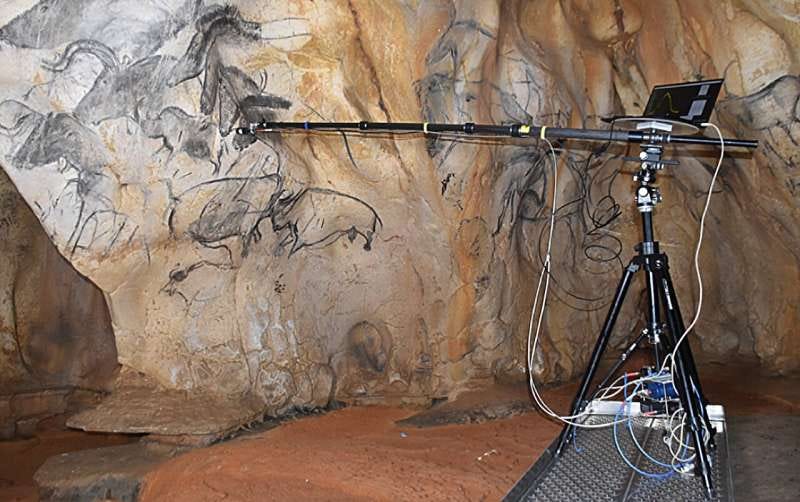
Yohan Boulard, Philippe Walter and colleagues report in ACS Omega (2026, 11, 60980−60990)2 that ultraviolet fluorescence spectroscopy can tell speleothem calcite (calcite deposited by dripping or flowing water) from the limestone bedrock, even though both are chemically calcite. They collected 60 spectra in the cave, each from a spot of about 1 mm², with the operator standing up to 2.5 m from the wall. Their reading is that a translucent calcite veil covers the drawings on the Horses panel, that the veil varies a lot in the Alcove of the Lions, and that the orange glow may be a trace of hot charcoal. The first claim is the method’s main result, the second is a useful mapping result, and the third is a guess.


