

Three samples of charred material came up from 8.2 metres down at the Las Minillas copper mine, near Granja de Torrehermosa in Badajoz, southern Spain, when the excavation team drilled through the debris filling the ancient mining trench. Their calibrated radiocarbon ages fall between 1048 and 817 BC at 95% confidence, so a fire burned deep in these workings during the Late Bronze Age.
The account most of us carry for Late Bronze Age copper in western and northern Europe runs through the Austrian Alps, Wales and the Italian Alps, mines with long excavation histories and plenty of dates. Southern Iberia sits on one of the largest copper concentrations in Europe, and its importance as a supplier has long been suspected but hard to prove, because so few of its mines had reliable dates. Until now only 11 radiocarbon dates from five Iberian mines supported Late Bronze Age mining, and six of those, from Chinflón, are flagged in the paper as old, poor-quality measurements with large uncertainties.
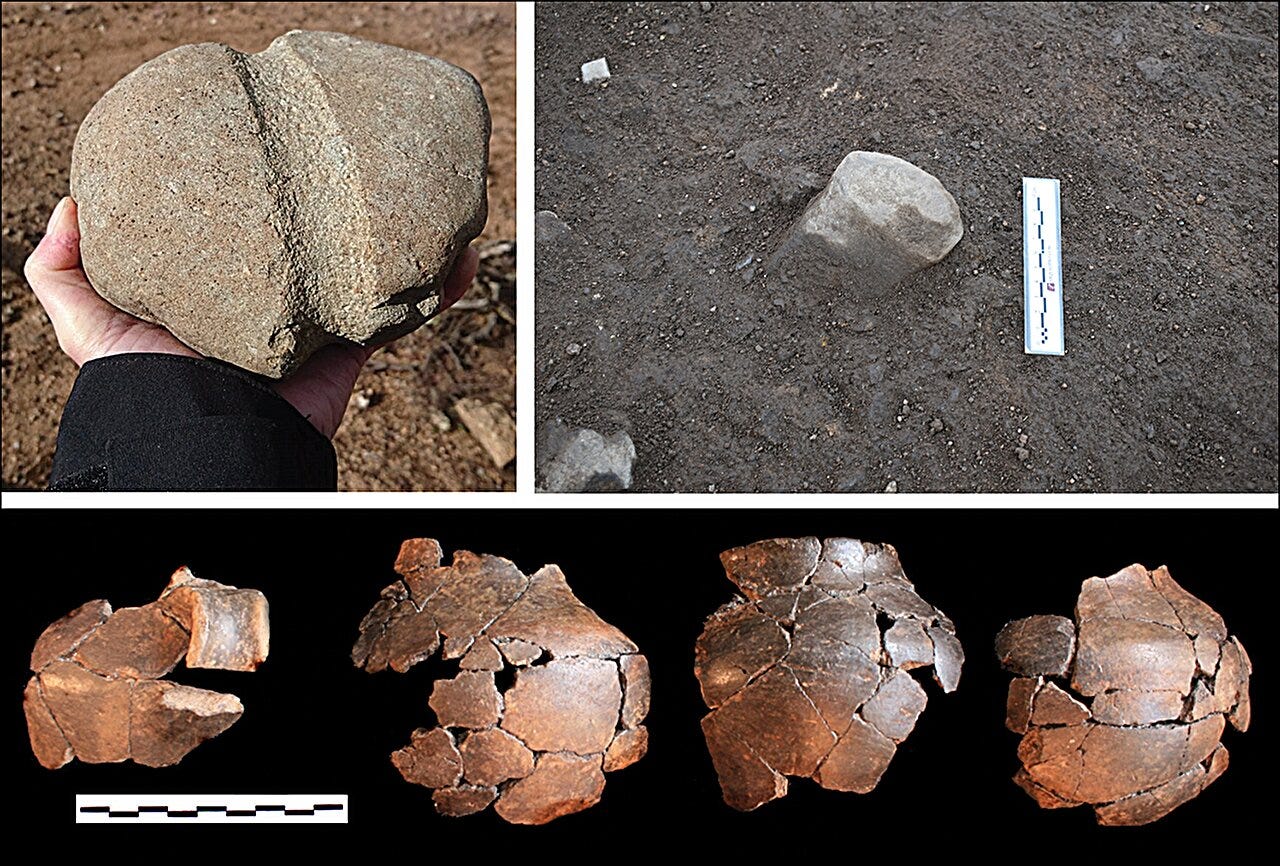
Juan Latorre-Ruiz of Durham University, Mark A. Hunt Ortiz of the University of Seville, Zofia Anna Stos-Gale of the University of Gothenburg and seven co-authors report 17 new radiocarbon dates from Las Minillas in Antiquity (2026).1 Nine come from the mining trench and its drill core, eight from a habitation area, and together they span roughly 1350 to 750 BC. The team also documented 892 stone tools, including 735 grooved hammers, and found that 11 of more than 300 Scandinavian Late Bronze Age bronzes are isotopically and chemically consistent with Las Minillas ores, slags and metal droplets. The question this post asks is how much a single well-dated mine can support when the claim being made is about a whole region.


