

Three teeth came from different parts of Stajnia Cave. One turned up in layer A, the topmost deposit, a thin band of Holocene soil largely scraped away during the medieval period. One came from layer D2, deep in the sequence, where the richest Middle Paleolithic materials accumulated. The third was pulled from layer C4, somewhere between. They belong to two children and an adult. And they carry identical mitochondrial DNA.
That identity is what opens this story, because it isn’t supposed to happen that way. Teeth from stratigraphically distant contexts should reflect distinct individuals from distinct periods. The fact that they don’t tells you something about the cave, and something about the people.
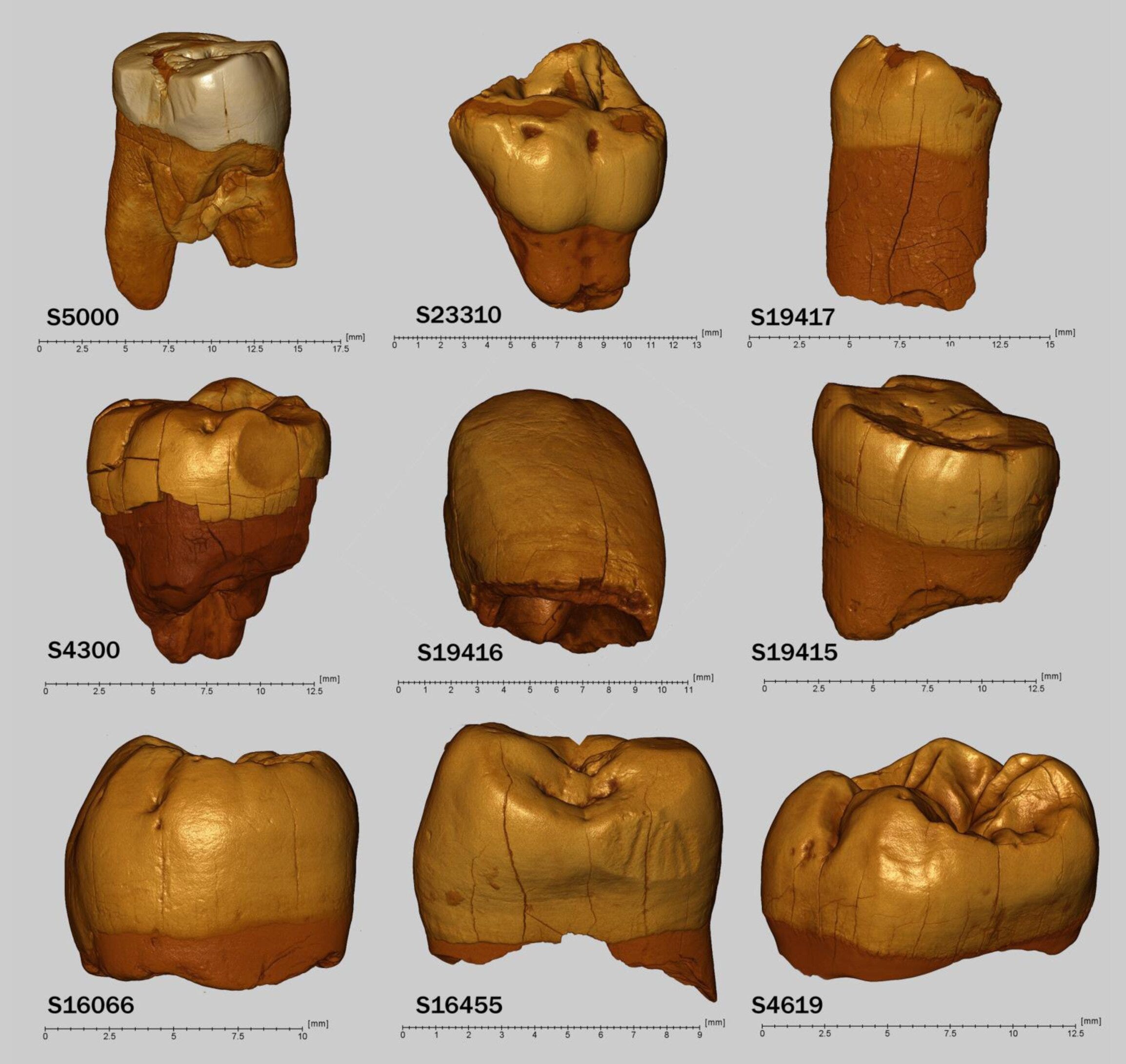
Stajnia is a narrow limestone cavity in southern Poland’s Kraków-Częstochowa Upland, excavated between 2007 and 2010. The deposit runs about 1.5 meters deep and contains fifteen lithostratigraphic layers, laid down during the Last Glacial. Post-depositional processes — frost action, partial sediment collapse, medieval disturbance of the uppermost levels — have moved things around considerably. When researchers first began recovering human teeth from different units, questions arose about whether they represented a single occupation or many, spanning different periods. Some teeth might predate the known Stajnia Neanderthal, specimen S5000. Some might postdate it.
The answer, according to a study just published in Current Biology1 by Andrea Picin and colleagues, is that the teeth represent a minimum of seven and possibly eight individuals, all assigned by molecular dating to Marine Isotope Stage 5 — somewhere between roughly 120,000 and 92,000 years ago. This is now the oldest multi-individual Neanderthal genetic assemblage characterized in Central Europe. And those three teeth with matching mitochondrial DNA? They are not evidence of different periods. They are evidence of mixing. The cave has been churned, and what the stratigraphy presents as sequence is, in part, a spatial shuffle of the same population.
The team sequenced complete or near-complete mitochondrial genomes from all eight specimens, including four that had never been genetically analyzed before. Radiocarbon dating was attempted on several, but the site poses problems. Two teeth yielded unreliable finite dates: residual consolidants applied during or after excavation contaminated the collagen, producing results that look finite but aren’t. One specimen returned an age beyond the detection limit, which is the more trustworthy result — it means the sample is older than radiocarbon can measure. In the absence of reliable direct dates, the team relied on molecular branch shortening, a method that uses the rate at which mutations accumulate along mtDNA lineages to infer when a lineage diverged. The estimates cluster the Stajnia individuals in MIS 5, consistent with the paleoenvironmental context. Ice sheet expansion during MIS 4 would have made southern Poland effectively uninhabitable, so the younger tails of the probability distributions, which extend slightly into that period, are archaeologically implausible.
The three teeth with identical mtDNA are worth pausing on. Two belong to juveniles — a child roughly 4.5 years old and another around 6.5 — and one to an adult. The morphological evidence suggests the two juveniles might be the same individual, their remains separated by post-depositional mixing, or closely related individuals who shared the same maternal line. The adult could represent a distinct but maternally related person. Whether this is one individual’s remains scattered across the site, or relatives who occupied the cave across generations, cannot be resolved from mitochondrial data alone. Mitochondria are inherited through the maternal line only. You can see that people were related through their mothers. You cannot see their fathers, their full siblings from different mothers, or the broader social structure they inhabited.


