

The hematite is what stops you. In the far corner of a limestone cave above the Asón River valley in northern Spain, excavators working in 2010 encountered a sediment layer that glittered. Bright red, spangled with iron-oxide crystals, it marked a burial chamber that nobody had disturbed in 19,000 years. Inside, the bones of a middle-aged woman lay in a tight fetal position, coated in ochre that had been carried from an outcrop 25 kilometers away on the Cantabrian coast. Someone had made that trip specifically for her.
Archaeologists named her the Red Lady of El Mirón, and she has become the symbolic center of a research project that began in 1996 and has kept producing at a rate that surprises even the people running it. The co-directors, Lawrence Straus of the University of New Mexico and Manuel González Morales of the Universidad de Cantabria, have now published a synthesis of their findings in the Journal of Anthropological Research,1 covering nine major cultural periods and more than 40,000 years of continuous human occupation at the site.
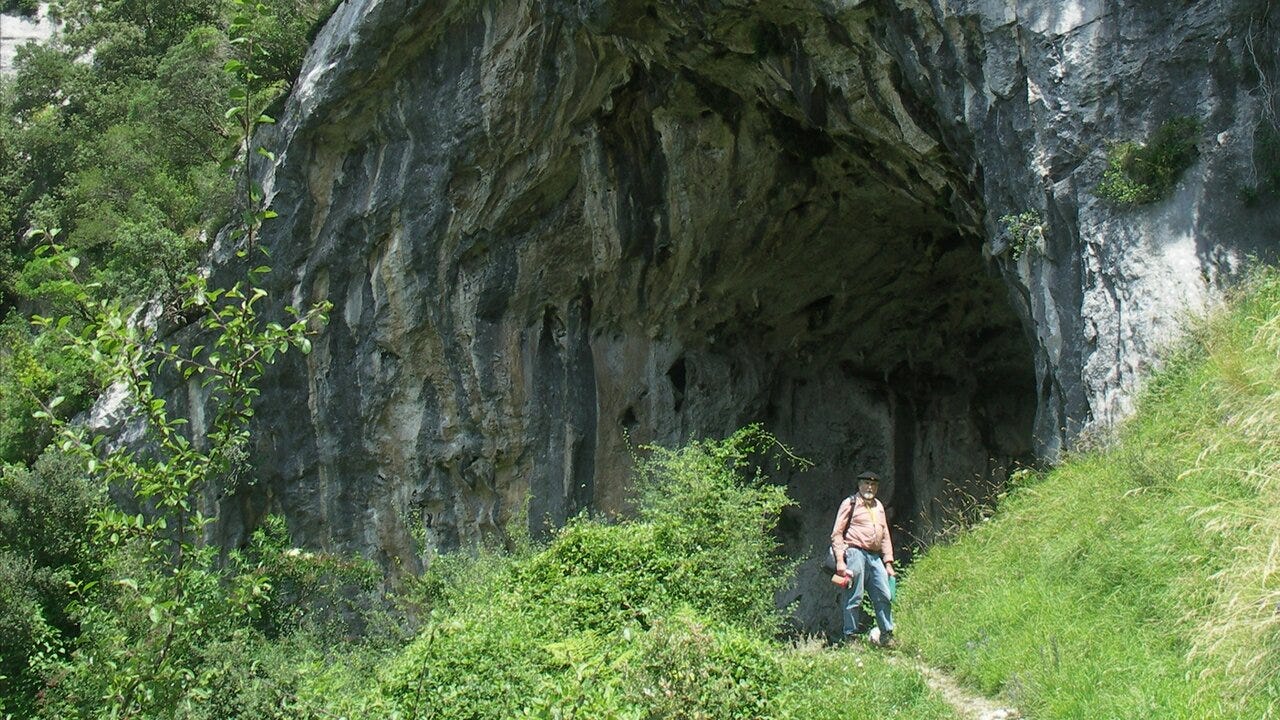
El Mirón is not rare because it is old. Plenty of European caves have deep Paleolithic sequences. What makes it unusual is the completeness and the continuity. The stratigraphy runs from the last traces of the Neanderthals through the Bronze Age, through 102 radiocarbon dates obtained via accelerator mass spectrometry. Nine distinct archaeological periods are stacked in its sediments: Middle Paleolithic, Early Upper Paleolithic, Gravettian, Solutrean, Magdalenian, Mesolithic, Neolithic, Chalcolithic, and Bronze Age. The cave’s vestibule is wide and sunlit, a genuine living space rather than a cramped shelter, and people returned to it across radically different climatic conditions, from the coldest phases of the last glacial maximum to the warmer early Holocene. Straus calls it a “persistent place,” borrowing a term from archaeologist Sarah Schlanger: a location so useful across different periods that successive populations, across millennia and sometimes across species, kept coming back.


