
Grave 311 held an eighteen-year-old whose teeth didn’t match their bones.
That mismatch is the whole story, so it’s worth sitting with it before anything else. A second molar forms in early childhood, between roughly three and eight years old, and once it’s mineralized it stays chemically frozen at that age forever. Bone collagen is different. It keeps remodeling throughout life, so it mostly records the years just before death. In this one skeleton, the two tissues told opposite stories. The dentine carried a strong signal of C4 plants, almost certainly millet, the kind of signature you’d expect from a diet common across parts of southeastern Europe. The bone collagen showed nothing of the sort, just the C3-dominated cereal diet, rye and buckwheat, typical of everyone else buried in medieval Vilnius. Strontium and oxygen values from the enamel pointed the same direction as the childhood carbon signal, away from the Vilnius region entirely, toward baselines more consistent with present-day Ukraine or southern Poland.
Put plainly: this person grew up somewhere far to the south, moved to Vilnius sometime in adolescence, and adjusted their diet to match. They died there, buried according to strict Christian custom, with no grave goods at all.
That’s a striking amount of individual biography to pull out of a skeleton. But the reason it matters goes beyond one traveler’s life story. Lithuania was, famously, the last pagan state in Europe. Grand Duke Jogaila didn’t formally adopt Catholicism until 1387. Before that, the standard picture is of a country still cremating its dead, still worshipping outside the Christian framework that had already swallowed the rest of the continent. Grave 311 belonged to a cemetery that shouldn’t, by that picture, have existed yet.
The cemetery is on Bokšto Street in Vilnius’s old town, part of a district medieval chroniclers called the Civitas Ruthenica, the Ruthenian city. Archaeologists excavated more than 500 intact graves there over eight years, and the burial customs are unambiguously Christian: bodies laid supine, oriented east to west, cross pendants and enkolpions turning up in some graves, cremation entirely absent. Radiocarbon dating places the cemetery’s use across roughly 150 years, spanning the second half of the thirteenth century through the fourteenth, meaning this Orthodox Christian community was burying its dead in a formally pagan city for a century and a half before Catholicism ever arrived.
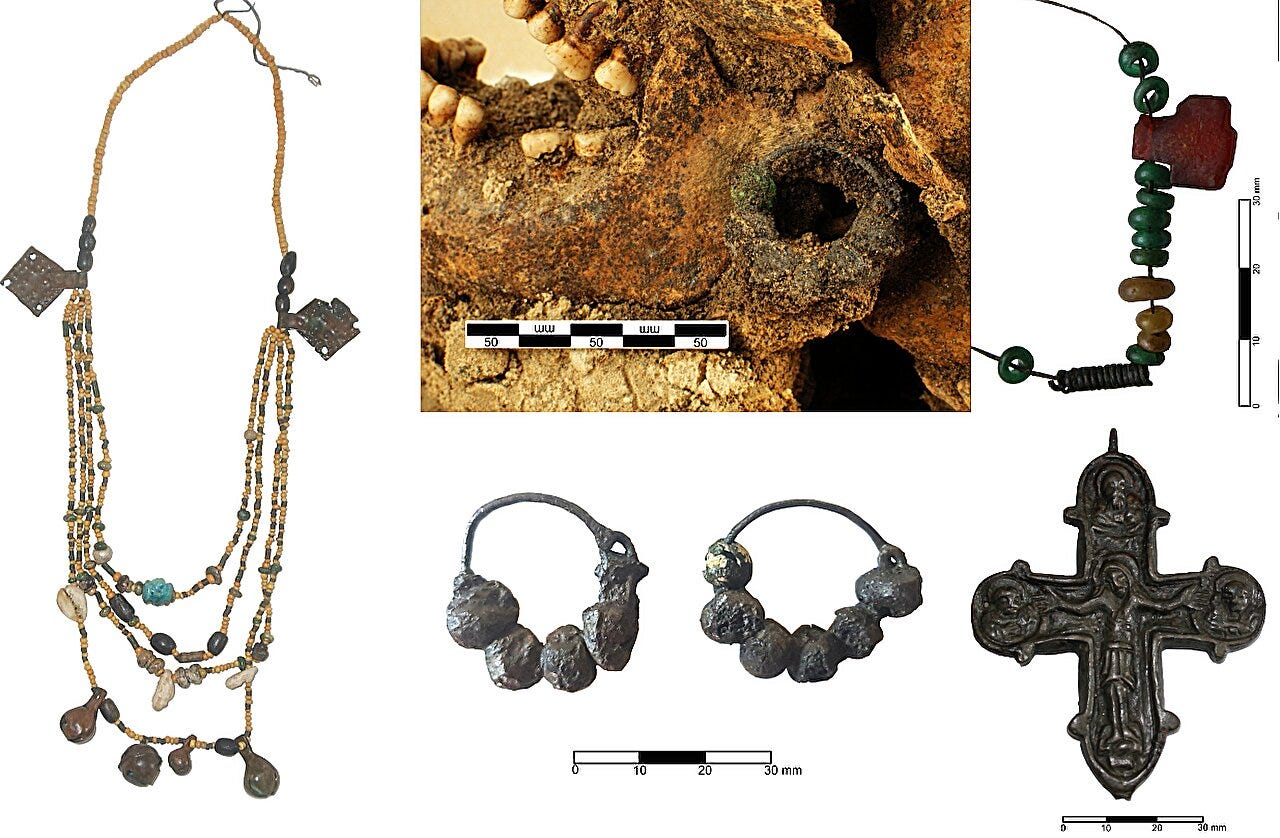
That much was already known from the archaeology. Byzantine-style jewelry, the chaplets, the decorative headpieces made from ornaments stitched to leather and cloth, closely resembled fashions from Halych-Volhynia, a region of the former Kievan Rus’ now split between western Ukraine and southern Poland. The material culture argued for a connection. What it couldn’t do was prove that any given skeleton had actually made that journey rather than simply adopted the style secondhand. That’s the gap isotope analysis is built to close, and it’s why a research team1 led by Giedrė Motuzaitė Matuzevičiūtė sampled bone, dentine, and enamel from 15 individuals, layering carbon and nitrogen data against strontium and oxygen ratios and comparing everything to a local baseline built from modern plants collected around Vilnius.
A city sorted by sex
Once the isotope data came back, a pattern emerged that the grave goods alone hadn’t shown: mobility in this population was heavily gendered.
Every sampled female returned isotope values consistent with growing up locally. Not one showed the kind of childhood signature that would suggest an origin outside the Vilnius region. Several of these women were buried with grave goods, cowrie shells, glass pendants, the kinds of items that don’t fit neatly with strict Christian burial custom and read more as holdovers from older, non-Christian traditions. The team’s interpretation is that these were local women who converted, plausibly through marriage into Orthodox households, carrying older material habits into new religious ones without fully shedding them.
The men look different. Two individuals, from graves 139 and 226, had strontium ratios that fell outside the Vilnius plant baseline but matched values from Kernave, roughly 34 kilometers northwest and Lithuania’s earlier capital, hinting at movement between the two settlements rather than international migration. A third individual, from grave 214, sat close to grave 311’s outlier values, potentially another migrant from the south, though with a weaker signal. And grave 311 itself is the clearest case in the dataset: distinct in carbon, nitrogen, oxygen, and strontium all at once, an eighteen-year-old who almost certainly wasn’t born anywhere near the Baltic.
There’s a curious postscript. A woman buried in grave 312, sharing the same burial pit as grave 311, turned out to be a dietary outlier herself, not as extreme, but her carbon values also pointed toward some C4 plant consumption, unusual for someone otherwise reading as local. Shared burial pits in Christian cemeteries often indicate family relationships, one interment placed above another. The authors flag this as a possible kin connection, something only ancient DNA work could confirm, but if true it would mean an immigrant household, not just an immigrant individual, took root in Vilnius and stayed.
None of this settles why people were moving. The paper lays out several plausible drivers without picking one: dynastic ties between Lithuanian dukes and Halych-Volhynia rulers that would have opened trade and diplomatic channels, Orthodox Ruthenians becoming vassals as the Grand Duchy expanded southeast and absorbed their home territories, merchants drawn by the same open invitations Grand Duke Gediminas sent across Europe in 1323, or displacement from the Black Death, which swept through the region between 1346 and 1353 and, notably, hit Eastern and Northern Europe less severely than the rest of the continent. Vilnius may simply have been a place people fled toward.
What the isotopes can’t do, and the authors are careful about this, is pin an origin more precisely than “somewhere south, plausibly Ukraine or southern Poland.” Strontium baselines overlap heavily across Eastern Europe, and with only 15 individuals sampled out of more than 500 graves, grave 311 reads less like an anomaly and more like a fluke of discovery. If one immigrant surfaced by chance in a sample this small, the real number moving through the Civitas Ruthenica over a century and a half was almost certainly larger.
Vilnius spent the thirteenth and fourteenth centuries as Europe’s last openly pagan capital. It was also, this data suggests, already running an Orthodox Christian neighborhood populated in part by people who’d walked there from hundreds of kilometers away, and by local women who married into that world and adjusted their faith without entirely letting go of their own. Two things can be true about a city at once. This one just took eight centuries and a mass spectrometer to prove it.
Motuzaitė Matuzevičiūtė, G., Jonaitis, R., Kaplūnaitė, I., Brindzaitė, R., Morvan, M., Snoeck, C. & Jankaskas, R. 2026. Multiproxy analysis reveals migration and potential origins of the first Christians in medieval Vilnius. Antiquity 100(413). https://doi.org/10.15184/aqy.2026.10389


