
Somewhere beneath the floors of a Bronze Age harbor city on Cyprus, excavators found the bones of pigeons. Not one or two. Dozens. Many were burned, consistent with cooking or deliberate disposal after a meal. Some belonged to juveniles that had never left the nest. And when researchers analyzed the chemical signatures locked in 37 of those bones, they found something that required some explaining: the pigeons had been eating almost exactly the same food as the people.
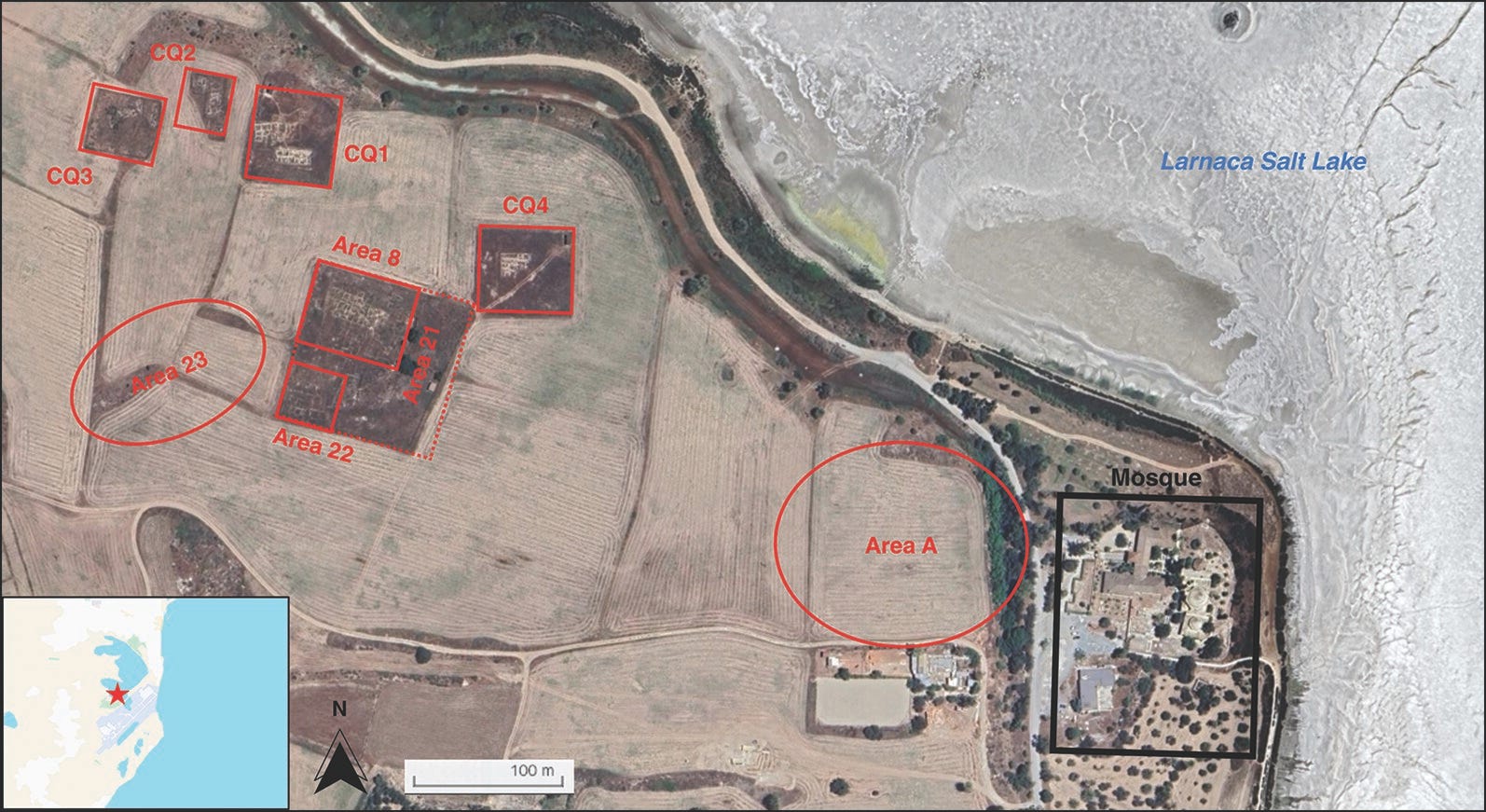
That is the central finding of a study published in Antiquity1 by Anderson L. Carter, Canan Çakırlar, and colleagues at the University of Groningen and collaborating institutions. The site is Hala Sultan Tekke, on the southeastern coast of Cyprus, occupied during the Late Bronze Age from roughly 1650 to 1150 BCE. The birds are Columba livia — the rock dove, ancestor of every pigeon currently working a city sidewalk.
The isotope signature matters because it is hard to explain away. Stable carbon and nitrogen values in bone collagen reflect what an animal ate over its lifetime. Wild birds forage opportunistically; their isotope values scatter widely. The pigeons at Hala Sultan Tekke did not scatter. Their dietary range was tighter than that of any other species in the regional comparison dataset — tighter even than cattle, which were actively herded and managed. Using a statistical measure of dietary breadth called the corrected standard ellipse area, the team found that pigeons had the most constrained niche of all taxa sampled: a value of 1.26, compared with 1.75 for humans and 1.80 for cattle. In ecological terms, these were animals occupying a narrow, managed dietary slot.
The nitrogen values told a more specific story. The mean nitrogen isotope value for the main pigeon grouping sat at around 8.82 per mille, placing these birds above known scavenging populations like dogs (8 per mille) and foxes (8.26 per mille) and overlapping almost exactly with the human samples drawn from comparable Cypriot Bronze Age sites (9.92 per mille). Whatever these birds were consuming, it was consistent, protein-enriched relative to a purely wild diet, and closely tied to what humans were eating. The team’s interpretation is that the pigeons were living inside the city and eating its waste — grain spillage, scraps, and possibly deliberate supplemental feed from people who were managing them.
“Either way,” writes senior author Çakırlar, “this very likely means that they were domesticated or on their way to being domesticated.”
The presence of juvenile bones at multiple contexts across the site reinforces this picture. Fledgling Columba liviabones in an urban deposit are not what you get from wild birds passing through. They confirm that the pigeons were breeding within the settlement itself.
What Domestication Actually Means Here
The word “domesticated” is doing real work in this study, and the authors handle it with appropriate caution. Bone morphology cannot resolve the question for Columba livia. The species is exceptionally plastic: size varies enormously depending on climate, diet, and management practices. A population raised primarily for fertilizer production in a desert environment, like the Byzantine-period pigeons documented at Shivta and Saadon in the Negev by Marom and colleagues, stayed small even when clearly domesticated and housed in towers. Apply body-size criteria there and you would miss them entirely. The same metric that works reasonably well for cattle or pigs breaks down almost completely for pigeons. The Hala Sultan Tekke team measured 154 long bones and found all fell within the size range for C. livia, but the assemblage is not clearly distinguishable from a wild population on those grounds alone.
What the isotopic and contextual data offer instead is evidence for a commensal relationship that had already tipped toward management. The authors describe this as consistent with the “commensal pathway” to domestication — a process by which animals gradually move into the human niche over many generations, initially attracted by food waste or shelter, and eventually subject to deliberate management. Rock doves naturally nest in rocky outcrops and cliff faces. The ashlar masonry attested at Hala Sultan Tekke suggests the city had multi-story buildings with sheer facades that could have functioned as adequate substitutes.
The relevant comparison for dating purposes is Nea Helos, a Hellenistic site in Greece where the earliest previously identified assemblage of morphologically domesticated pigeon bones was recovered, dated to roughly the fourth through first centuries BCE. The Hala Sultan Tekke material predates that by somewhere between nine hundred and a thousand years. A 2023 genomic study identified modern domestic pigeons as most closely related to wild populations from the Middle East, pointing toward at least one domestication event in that region — consistent with the Cypriot evidence but not specifically pinpointed to it. Carter and colleagues are explicit that Hala Sultan Tekke does not represent the origin of pigeon domestication. It represents the earliest direct biomolecular evidence for a commensal human-pigeon relationship that we currently have.
The Feast
Most of the pigeon bones — 82 percent by minimum number of individuals — came from a single area of the site, City Quarter 1. Within it, a significant concentration was recovered from two interconnected rooms, numbered 70 and 83. These had been flagged during excavation as a cultic space. They contained a large stone structure functioning as a table or altar, burnt deposits of animal remains from multiple species, ceramic vessels representing at least three different production traditions (local Cypriot, Mycenaean, and Canaanite), Egyptian faience beads, gold leaf, a Mycenaean figurine, and carbonized botanical remains including olive, grape, and cereals. The excavators classified these as feasting deposits.
Feasting in Bronze Age Cyprus was not incidental. It was structurally embedded — politically, socially, and in mortuary practice. The finds from rooms 70 and 83 have the material profile of repeated formal events: multiple episodes of burning, tableware from across the Mediterranean, architecturally demarcated space. Pigeon bones appear not only in that cultic core but also in wells that served as refuse pits near tomb areas, and in at least one tomb deposit directly. The birds were showing up across the entire social register of the site’s ritual life.
Just over half of all the C. livia specimens showed contact with fire. The most parsimonious explanation is that the birds were cooked and eaten, then their bones discarded in the ritual space or burned as part of the offering itself. In birds of this body size, butchery marks are not necessary for consumption and are not expected to be preserved even when the animal was processed — so the absence of cut marks does not complicate the picture.
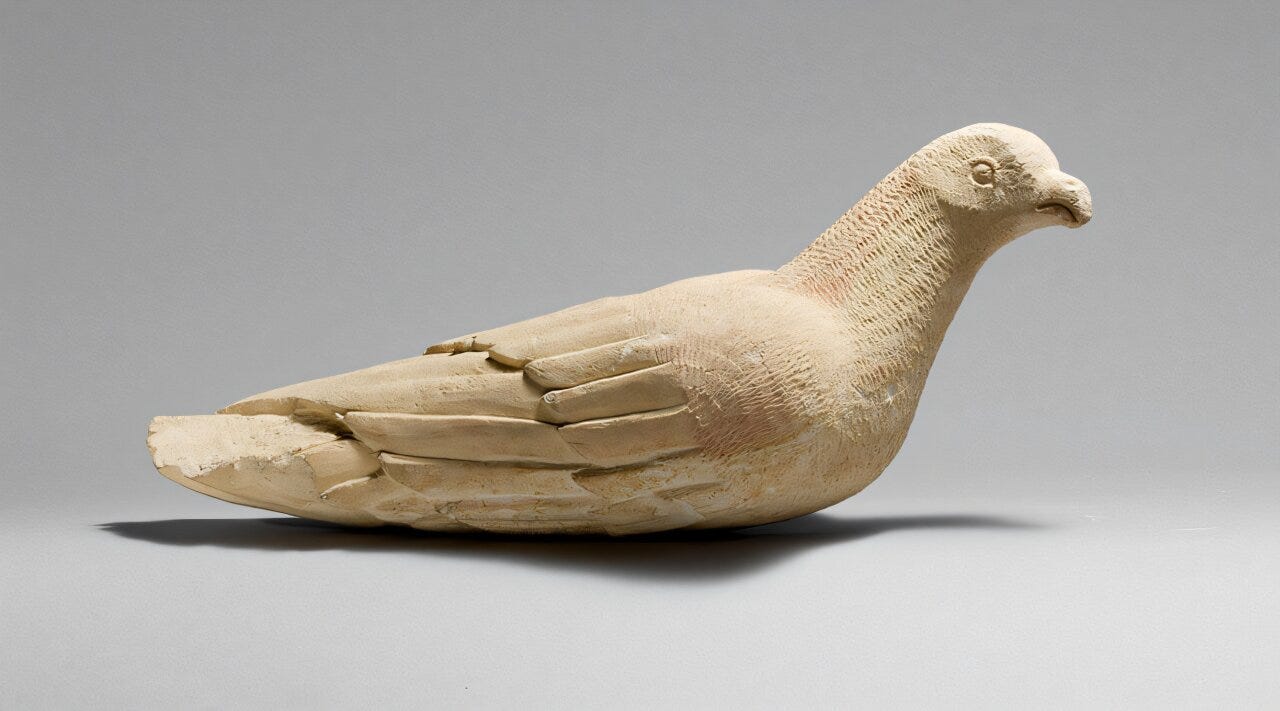
Whether any of this had a direct connection to the cult of Aphrodite, with whom pigeons are closely associated in classical Cypriot tradition, remains an open question. Pigeon and dove figurines appear on Cyprus from the Middle Bronze Age onward, and the island was identified in antiquity as Aphrodite’s birthplace. Her affinity for the birds is well-documented in artistic representations from across the Mediterranean. The paper acknowledges this interpretive framework while noting that no temple or sanctuary has been identified at Hala Sultan Tekke specifically. The cultic deposits are real. Their precise theological affiliation is not resolved.
Three individuals in the isotope dataset sat apart from the main grouping, with lower nitrogen values overlapping with wild herbivores rather than with the human range. The authors raise the possibility that these birds came from a different setting — possibly Trypes, a rural site under Hala Sultan Tekke’s administrative control, identified as a probable granary and livestock supplier. Whether they were brought to the city specifically for consumption, or represent pigeons with a more independent relationship to the human environment, the bones do not say.
Hala Sultan Tekke was destroyed twice around 1200 to 1150 BCE and then abandoned, its bay having silted up and severed what had been one of the most active trading connections in the eastern Mediterranean. The destruction coincided with the Bronze Age collapse that ended dozens of cities across the region. The pigeons almost certainly outlasted the city. Columba livia is remarkably good at that.
Further Reading
Hernández-Alonso, G. et al. (2023). Redefining the evolutionary history of the rock dove, Columba livia, using whole genome sequences. Molecular Biology and Evolution 40. https://doi.org/10.1093/molbev/msad243
Marom, N. et al. (2018). Pigeons at the edge of the empire: bioarchaeological evidences for extensive management of pigeons in a Byzantine desert settlement in the southern Levant. PLoS ONE 13. https://doi.org/10.1371/journal.pone.0193206
Carter, A.L., Reese, D.S., van Bommel, R., van der Meer, M.T.J., & Çakırlar, C. (2026). Uncovering the lives of rock doves (Columba livia) in Late Bronze Age Hala Sultan Tekke, Cyprus. Antiquity 100(412). https://doi.org/10.15184/aqy.2026.10351


