
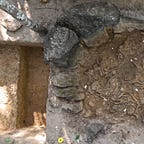
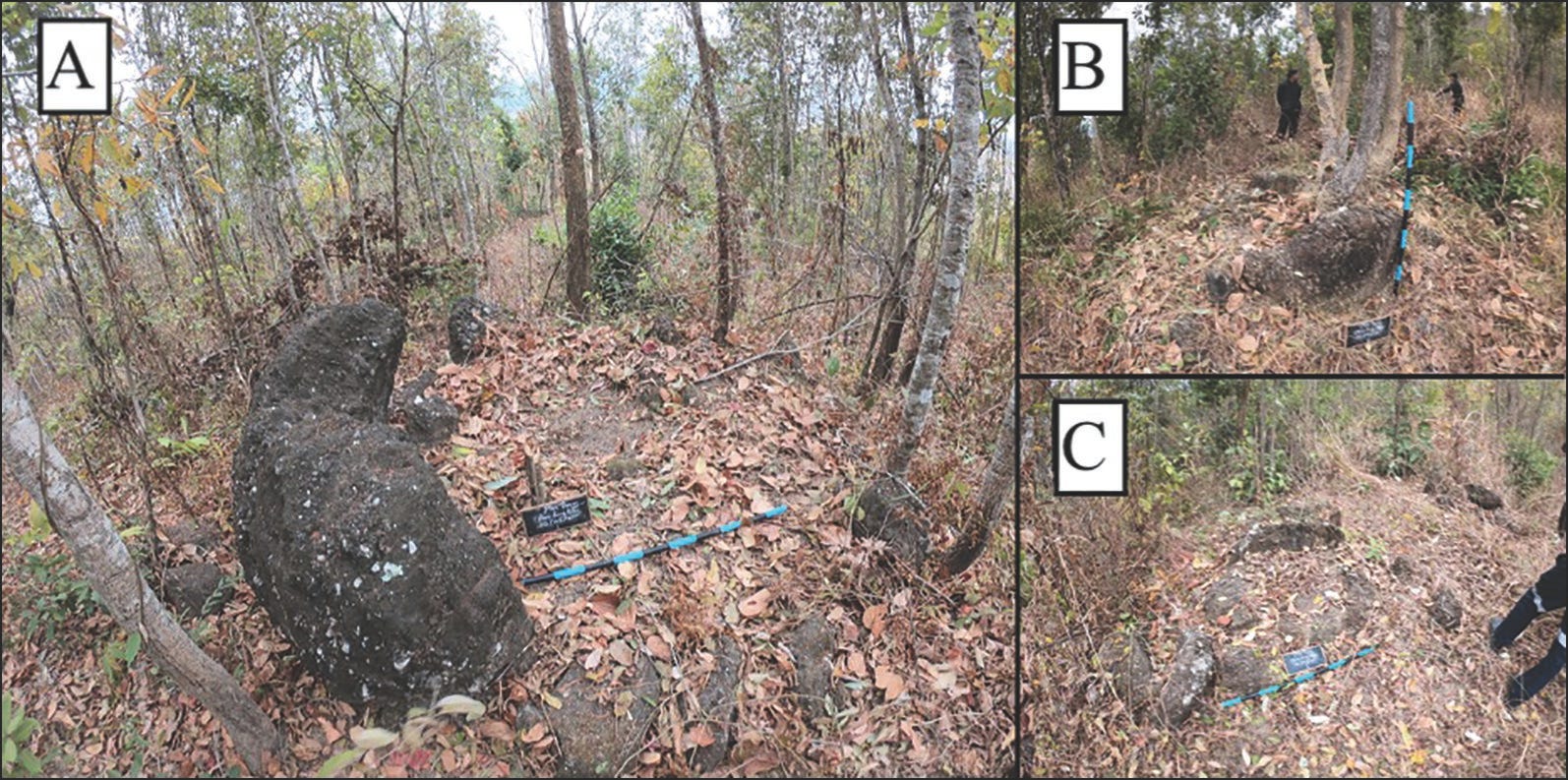
Jar 1 at Site 75 sat in forest roughly 70 kilometers northeast of Phonsavan, on the Xieng Khouang Plateau in northern Laos. It was already in poor condition when researchers found it: the sides partially collapsed, the interior open to the elements. But the base was intact, and within the remaining walls, the original sediment deposits had been preserved. Over three field seasons between 2022 and 2024, a team led by Nicholas Skopal of James Cook University excavated1 it completely.
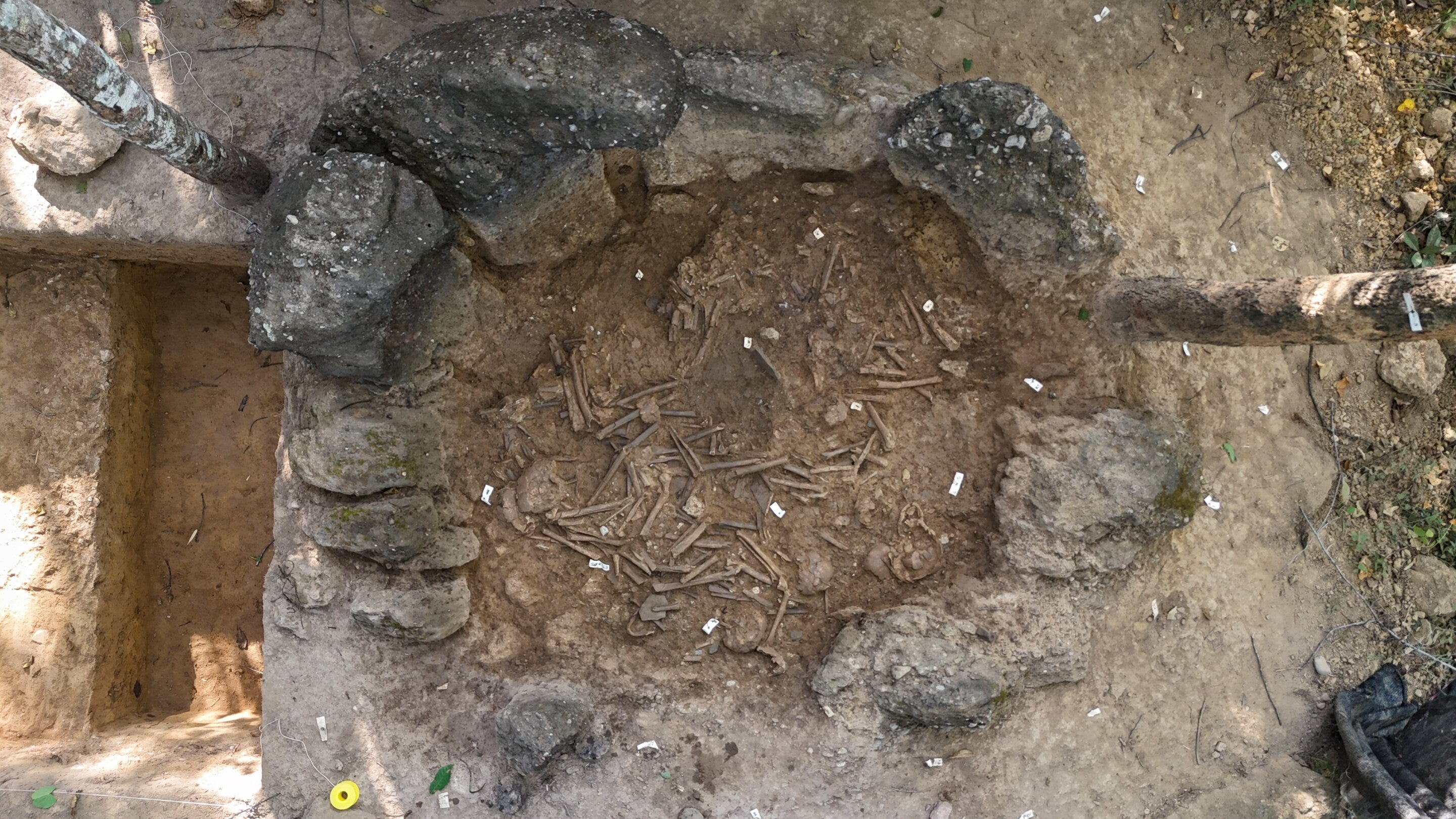
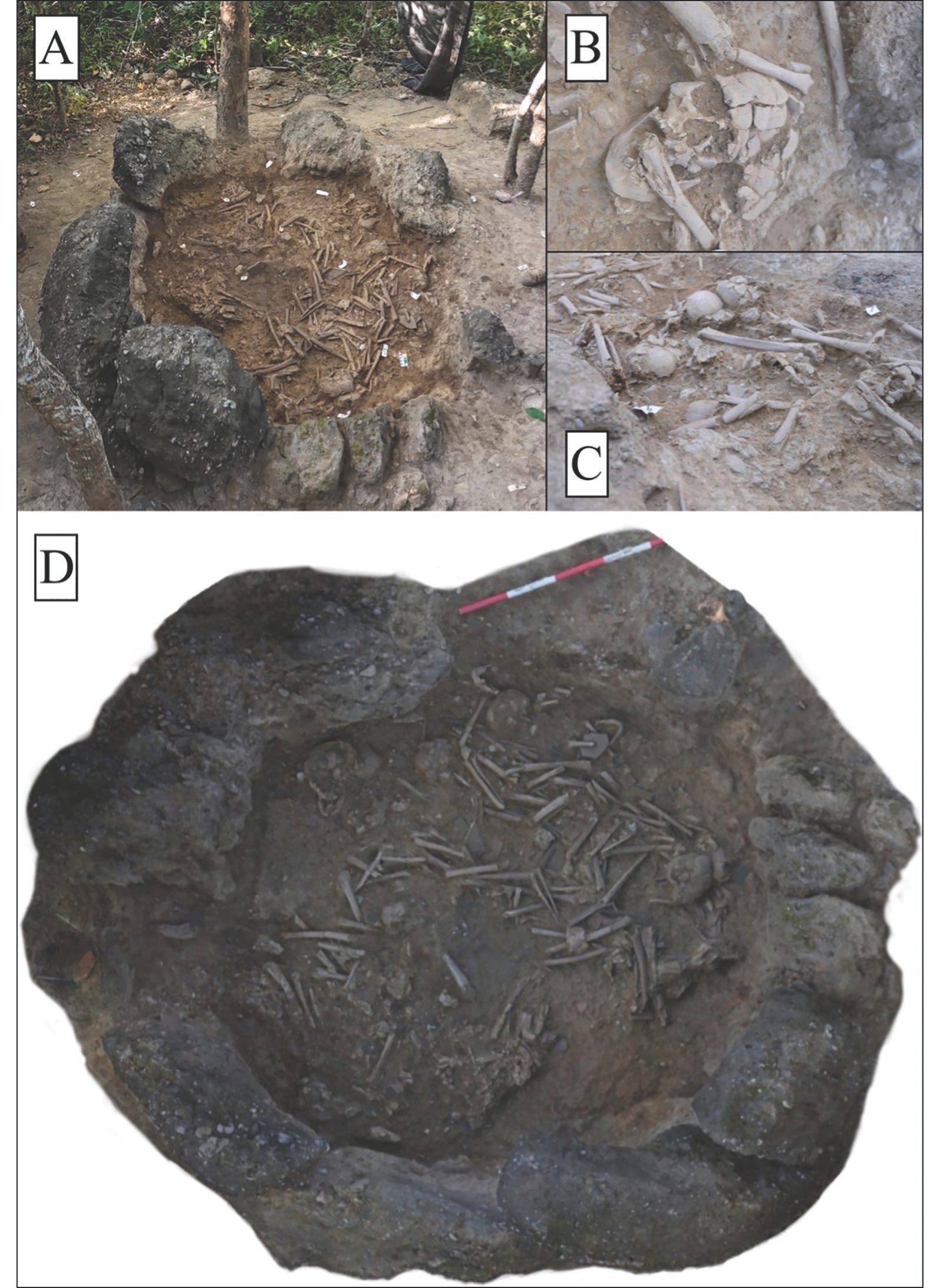
What they found was dense. Bones packed without obvious vertical structure, skulls clustered toward the jar’s edges, long bones bundled together. When the osteologists worked through the assemblage, counting from the most commonly repeated skeletal elements, they arrived at a minimum of 37 individuals. The highest count came from dentition: 469 observed teeth, producing an MNI of 37. The youngest was approximately 18 months old. Adults of varying ages were present throughout.
“The big jar we’ve found is unique,” Skopal told reporters, “and I’ve seen a lot of jars.”
That uniqueness matters. Hundreds of large stone vessels are scattered across more than 120 known sites on the Xieng Khouang Plateau. The most studied concentration is near Phonsavan, the so-called Plain of Jars, where some jars reach three meters in height and weigh several tons. The first systematic survey was done by French archaeologist Madeleine Colani in the 1930s. She rejected the idea that the vessels were storage containers and proposed a funerary role. A local legend holds that giants used them to brew rice wine. Scholarship since Colani has leaned toward mortuary use, but the physical evidence has been thin. A few jars contained ash and burned bone fragments. Some had burial pits dug nearby. Most were empty, which made the funerary hypothesis difficult to confirm with any confidence. If each jar was a tomb, why did so few of them hold human remains?
Jar 1 makes that question answerable, and the answer involves movement.
A Multistep Death
The critical detail about the bones inside Jar 1 is their disarticulation. Most joints had already separated before the remains were placed inside. The bones had not come from bodies laid directly into the jar. They came from bodies that had decomposed somewhere else first. This is secondary burial: the deliberate reinterment of already-processed skeletal material after an initial phase of decomposition away from the final deposit.
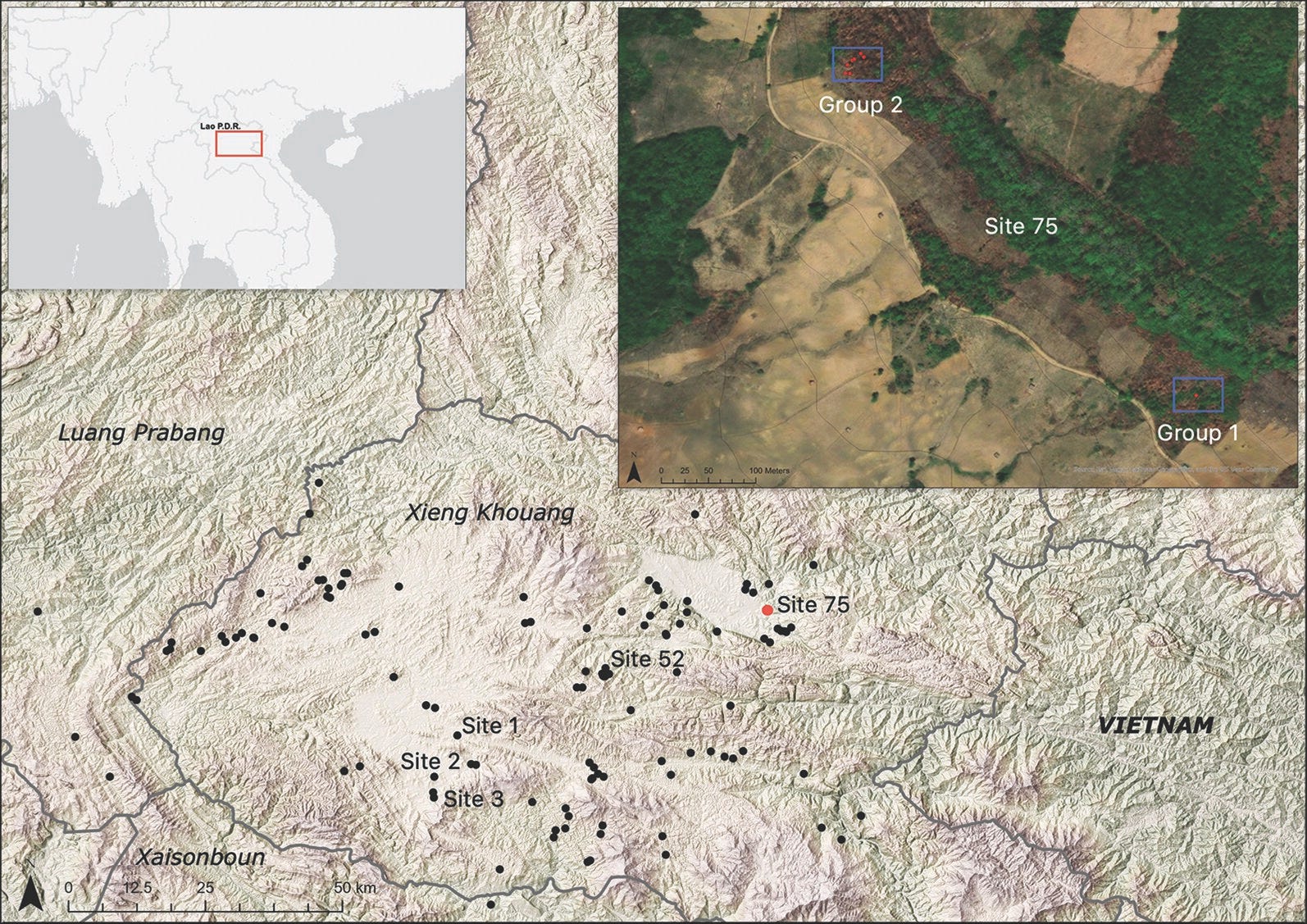
The paper’s most consequential observation follows from this. About 500 meters west of Jar 1, the team found a second cluster of seven smaller stone jars. None of them contained human remains. The ceramics found near these smaller vessels are consistent with the assemblage from Jar 1’s surrounding context, suggesting the two locations were used at the same time by the same community. The working hypothesis is that the smaller jars served as the initial stage: a newly dead person would have been placed in one, the flesh allowed to separate from the bone, and then the cleaned skeletal remains transferred to the large jar.
Skopal described the logic to Science News:
“Maybe they used those [smaller] stone jars to ‘distill’ the bodies, so when someone died, they might have put the body in there so all the flesh came off. Then they took the bones and they put them in this big jar, so it’s almost like a crypt.”
But the process may not have ended there. The team noted a discrepancy between the minimum individual count from dental remains and the lower count derived from cranial and postcranial elements alone. Bones appear to be missing. Some may have been selectively removed from Jar 1 after deposition, possibly for reinterment at a habitation site or place of worship. Stone slabs found inside the jar are comparable to those used as markers for secondary bundle burials at other Plain of Jars sites. Comparable practices of secondary processing and relocation of skeletal remains are documented across northeast India, Myanmar, Thailand, and Vietnam during the Iron Age and Historical periods. The large jar, on this reading, was not the end of the journey. It was a stage in an ongoing process.
The radiocarbon dates establish how long that process ran. Eight bone and tooth samples returned results spanning approximately cal AD 890 to 1160, a range of roughly 270 years. Charcoal from pottery deposited in an adjacent trench dated to cal AD 890 to 1020, consistent with the early end of the skeletal dates. The jar was not filled in a single event. Generations of a family, or an extended kin group, returned to it repeatedly.
“The number of individuals also suggests the jars were owned by family or extended family groups,” Skopal noted in the press release accompanying publication. “They likely served as places where ancestral rites were performed over generations.”
Four skulls were found with their mandibles still in close association, a small departure from the general pattern of disarticulation. The jaw is typically among the first elements to separate during decomposition. Their preservation together raises the possibility that in some cases, a recently dead or only partially processed individual was placed inside the jar directly, perhaps with greater ceremony. The osteological analysis is ongoing.
One other detail is worth holding onto. At least two individuals show deliberate tooth ablation: the intentional removal of specific teeth during life. One person lost both upper lateral incisors; another lost both lower central incisors. Tooth ablation is documented widely across prehistoric and historical mainland Southeast Asia and southern China, where it appears associated with social identity and life transitions. Its presence at Site 75 places this community within a broad pattern of shared bodily practice across the region.
What the Beads Know
Twenty glass beads came out of the jar during wet-sieving of the sediments. Orange, turquoise-blue, dark blue, black, red-over-orange. Twelve were selected for chemical analysis by laser ablation mass spectrometry at the Field Museum in Chicago, and the results upend any assumption that the Xieng Khouang Plateau was a remote backwater.
Nine of the beads matched a mineral soda-high alumina composition produced in eastern South India, a glass type that circulated across South and Southeast Asia from roughly the end of the first millennium BC through the eleventh century AD. Two beads had a soda plant-ash composition whose chemistry aligns most closely with Mesopotamian glass, the type that appears at Southeast Asian sites dating from the eighth or ninth century through the eleventh century AD, before later sites begin yielding Egyptian glass instead. The team notes that the temporal overlap between the Mesopotamian glass signature and the radiocarbon dates from the jar is consistent. One dark-blue bead had a potash-rich composition more commonly dated to 300 BC through AD 300, most likely from southeastern China or northern Vietnam. The team treats it as a curated antique, a much older object that had been kept, traded, or passed down.
No glassmaking tradition is known from the Lao highlands. These beads arrived from elsewhere, through exchange networks that extended from the Laotian interior to the Indian subcontinent and the Near East. They are not rare luxury goods in the way that term sometimes gets misused in archaeology; they are trade goods, the kind of thing that moved in bulk along commercial routes. Their presence in a burial jar in upland Laos means the people using that jar were connected to those routes.
The timing sharpens the point. The period cal AD 890 to 1160 sits within an era of expanding commercial connectivity across Asia. The Song Dynasty in China was actively intensifying long-distance trade. The Khmer Empire was at its height. The Dali Kingdom in Yunnan extended into parts of northern Laos. The Đại Việt and Champa kingdoms controlled Vietnam. The Pagan Kingdom held Myanmar. All of these states were embedded in overland and maritime exchange networks that moved goods, technologies, and cultural practices across vast distances. The team proposes that the jar sites may have sat at nodal points along routes connecting East and Southeast Asia, the plateau elevated enough to serve as a waypoint, the communities there integrated into the wider system. The Mesopotamian beads in Jar 1 are physical evidence for the highland end of that connectivity.
Miriam Stark, an anthropologist at the University of Hawaii not involved in the study, told Science News that the collective mortuary assemblage was exactly what she had hoped to see discovered. But she pressed on the gap that the data still cannot close:
“I do wonder, where did these people live?”
No settlements associated with the Plain of Jars tradition have ever been found. No houses, hearths, or refuse deposits. The entire archaeological record of these communities consists, almost entirely, of what they did with their dead. The jar sites are the only material evidence of who they were, and most of those sites are empty.
Skopal, N., Pradier, B., Bounxayhip, S., Cooper, C., Dussubieux, L., Devantier-Thomas, T.G., Pilgrim, T., Van Berkel, S., Demko, D., Valentin, F., Skopal, J., Baker, D., Florin, S.A., Posth, C., & Clark, G. (2026). The death jar: a new mortuary tradition at the Plain of Jars, Lao PDR. Antiquity. https://doi.org/10.15184/aqy.2026.10352


