

A horse skull excavated from a Neolithic settlement at Salzmünde, in what is now Saxony-Anhalt, Germany, carries a gene for tobiano coat coloring. Tobiano is a variety of pinto patterning found only in domesticated horses. The Salzmünde skull has been radiocarbon dated to between 3368 and 3101 BCE. Botai, the Central Asian hunter-gatherer site in Kazakhstan where the most-cited early evidence for horse domestication comes from, produced horses with that same marker around the same time. Two different horse populations, more than 3,000 kilometers apart, both already exhibiting a genetic trait that exists nowhere in wild horse populations.
This is the kind of detail that sits awkwardly inside a prevailing narrative, and a new review paper published today in Science Advances1 by David Anthony, Martin Trautmann, and Volker Heyd intends to press on the awkwardness. Their argument, built from archaeozoology, ancient DNA, osteology, and a careful reading of what the genetics literature actually says versus what it has sometimes claimed, is that horse domestication did not happen at 2200 BCE. It was well underway centuries, possibly millennia, earlier.
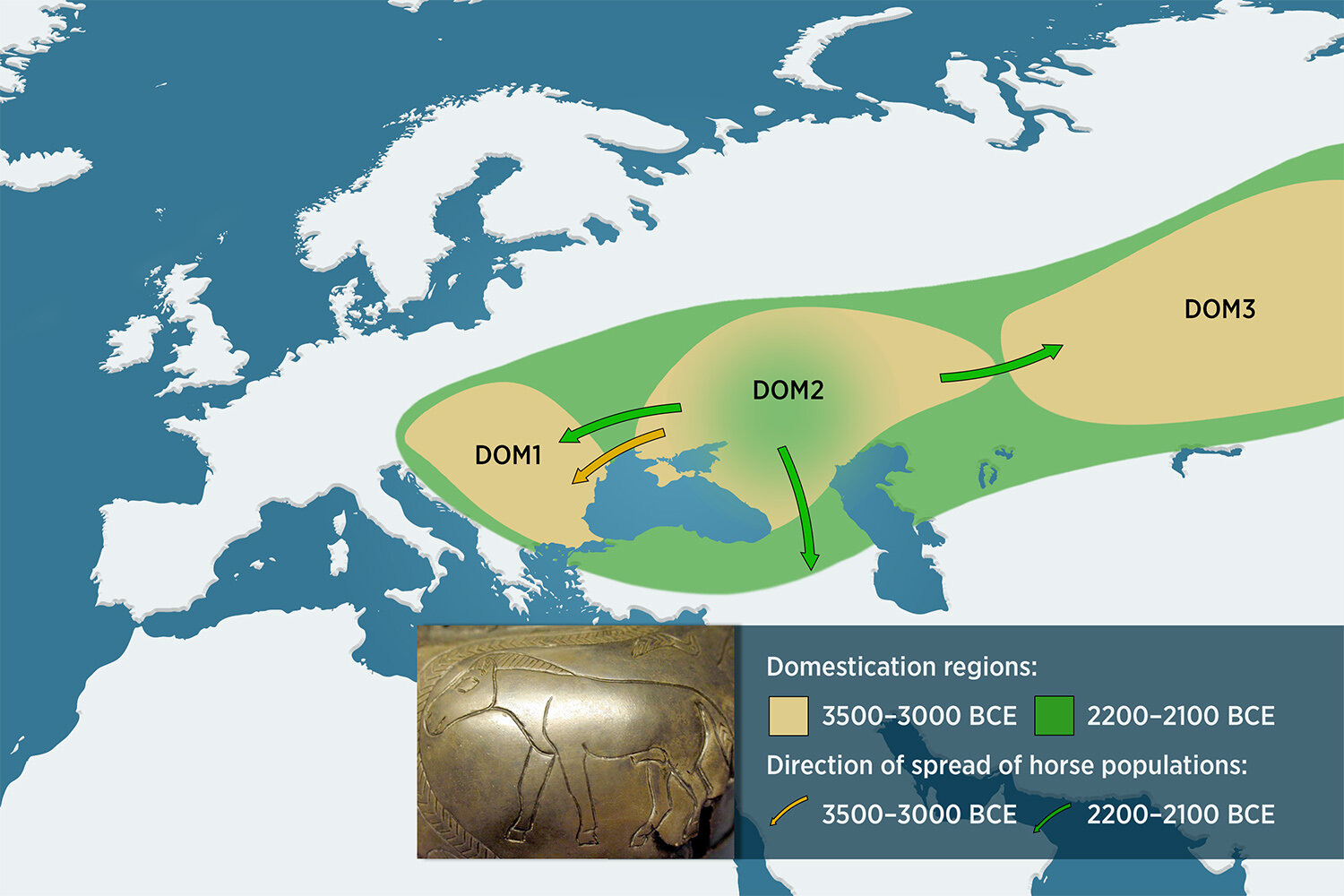
The papers they are responding to are significant. Between 2021 and 2025, a series of high-profile studies from equine genetics teams led by Ludovic Orlando and William Taylor argued that domestication, in any meaningful sense, should be equated with the emergence of favorable mutations in a horse lineage called DOM2, concentrated between roughly 2200 and 2100 BCE. One mutation, at the GSDMC locus, is associated with back endurance and front leg strength during riding. Another, at ZFPM1, relates to fear and anxiety responses, potentially making horses calmer around humans. When these mutations spread and DOM2 horses rapidly replaced other horse populations across Eurasia after 2200 BCE, the geneticists argued, that was domestication. What came before was taming, at best.
Anthony and colleagues do not dispute that this genetic transformation happened, or that it mattered. What they dispute is the interpretive move of treating a specific genetic signature as the definition of domestication, and then reasoning backward from its absence in earlier populations to conclude that horses were not yet domesticated, not yet ridden, and not yet integrated into human economies in ways that would qualify as domestic.


