
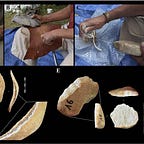
At the Middle Paleolithic site of Payre in the Ardèche, something is off about the rhinoceros remains. Of all the Stephanorhinus material recovered there, 91% consists of isolated teeth. The rest of the skeleton is mostly absent. For other large animals at the same site, the pattern looks entirely different: broken bones, cut marks, evidence of marrow extraction and butchery. But for rhinoceros, it is mostly just teeth.
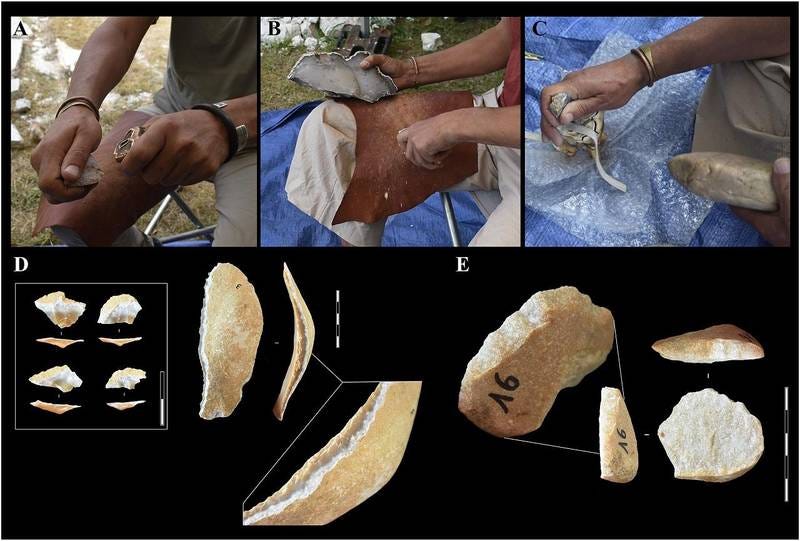
That asymmetry was the starting point for a new study published in the Journal of Human Evolution,1 led by Alicia Sanz-Royo and Juan Marín, which set out to ask whether Neanderthals were deliberately collecting rhinoceros teeth for reasons that had nothing to do with eating.
The answer, after a combination of fossil analysis and hands-on experimentation, appears to be yes.
The team examined rhinoceros teeth from twelve Middle Paleolithic sites in Spain and France, alongside paleontological collections from Luxembourg, Spain, and France. The goal was to build a reference baseline: what do rhinoceros teeth look like after tens of thousands of years in sediment? What marks do carnivores leave? What does compaction do? What does abrasion do? What does simply being alive and chewing hard plants do?
Of the twelve sites examined, only two produced teeth with a specific and recurring damage pattern that did not fit any of those natural explanations. At El Castillo in Cantabria and Pech-de-l’Azé II in the Dordogne, 25 teeth from El Castillo and four from Pech-de-l’Azé II showed marks concentrated on the occlusal surface: notches with angular scars, scaled areas where enamel had flaked away in overlapping fractures, shallow pitting depressions in the dentine, and thin oblique striations. Most of the modified El Castillo specimens came from the Mousterian Alpha level. Upper teeth showed more intensive modification than lower ones.
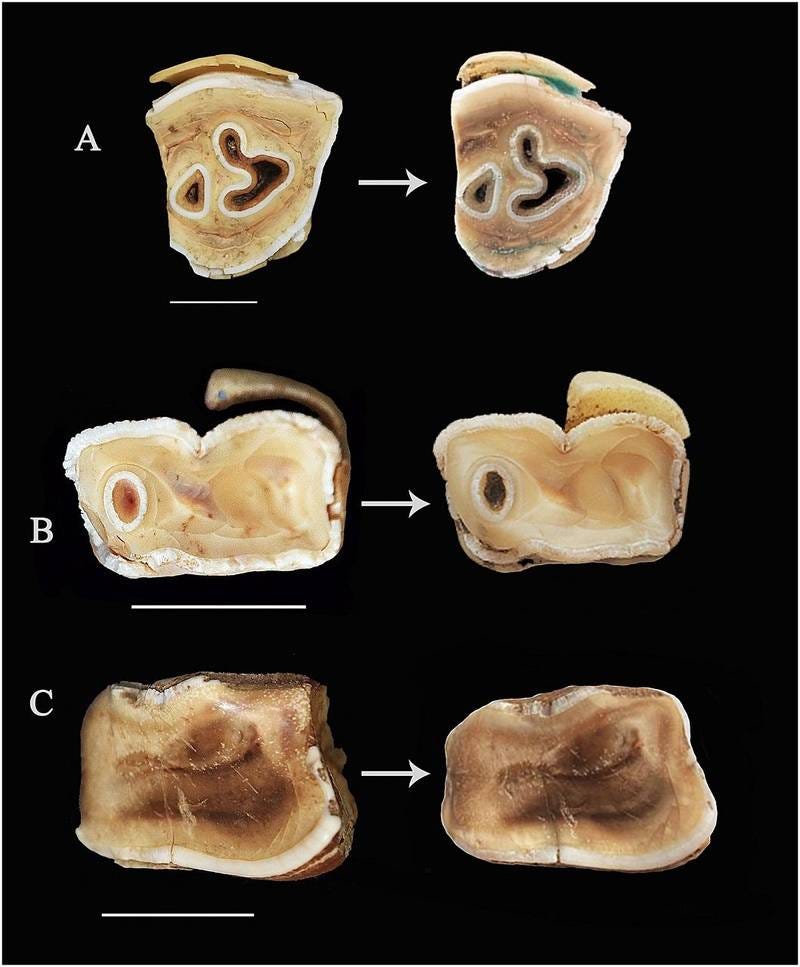
None of the paleontological collections, not Wasserbillig, not Oetrange, not Cova del Rinoceront, not Plumettes, showed anything comparable.


