
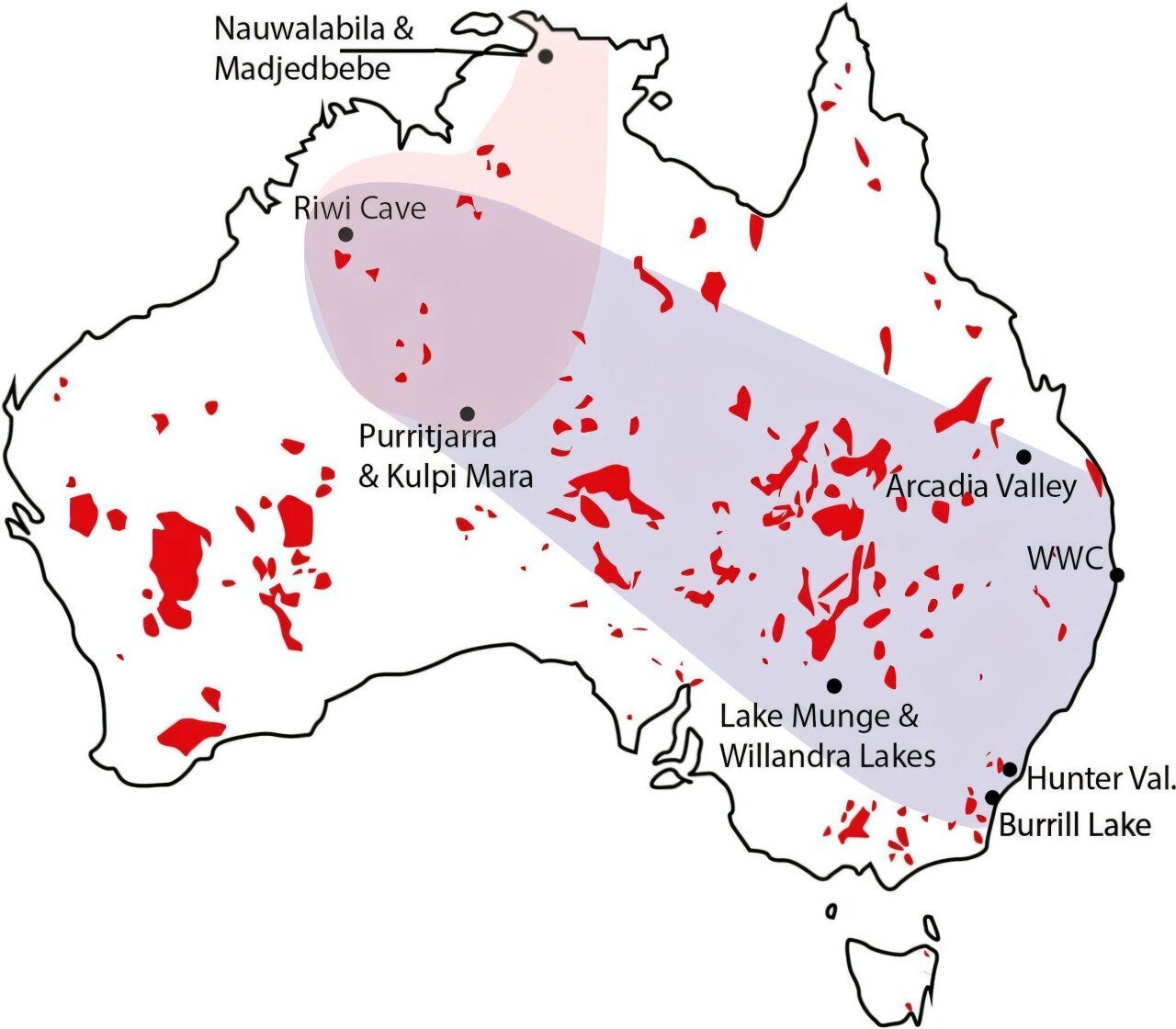
At the base of a sandstone rockshelter in Deaf Adder Gorge, along the upper South Alligator River in Australia’s Northern Territory, excavators in 1981 recovered something that didn’t quite fit the story anyone was telling about early Australian technology. The site is Nauwalabila I. It contained a substantial chert assemblage and almost no silcrete. That was unusual. Silcrete is the rock that defines Australia’s heat treatment record. Across the continent, in sequences stretching back at least 40,000 years, it is silcrete that gets cooked. Chert was treated as a secondary concern, occasionally mentioned in passing for northern and northwestern sites, never examined systematically.
Patrick Schmidt and Peter Hiscock went back to that collection. They analyzed1 502 chert artefacts from the site, looking for a specific signature: roughness contrast between adjacent knapping surfaces on the same piece. Pre-heating knapping produces relatively rough removal negatives. Once a piece is heated and re-knapped, the new scars are smoother, because heat treatment closes pore space and changes how fractures propagate through the material. A piece showing older, rougher removal scars crosscut by younger, smoother ones is diagnostic. It tells you the stone was shaped, then heated, then shaped again. That sequence, especially the re-knapping after heat exposure, is what distinguishes intentional pyrotechnology from accidental burning.
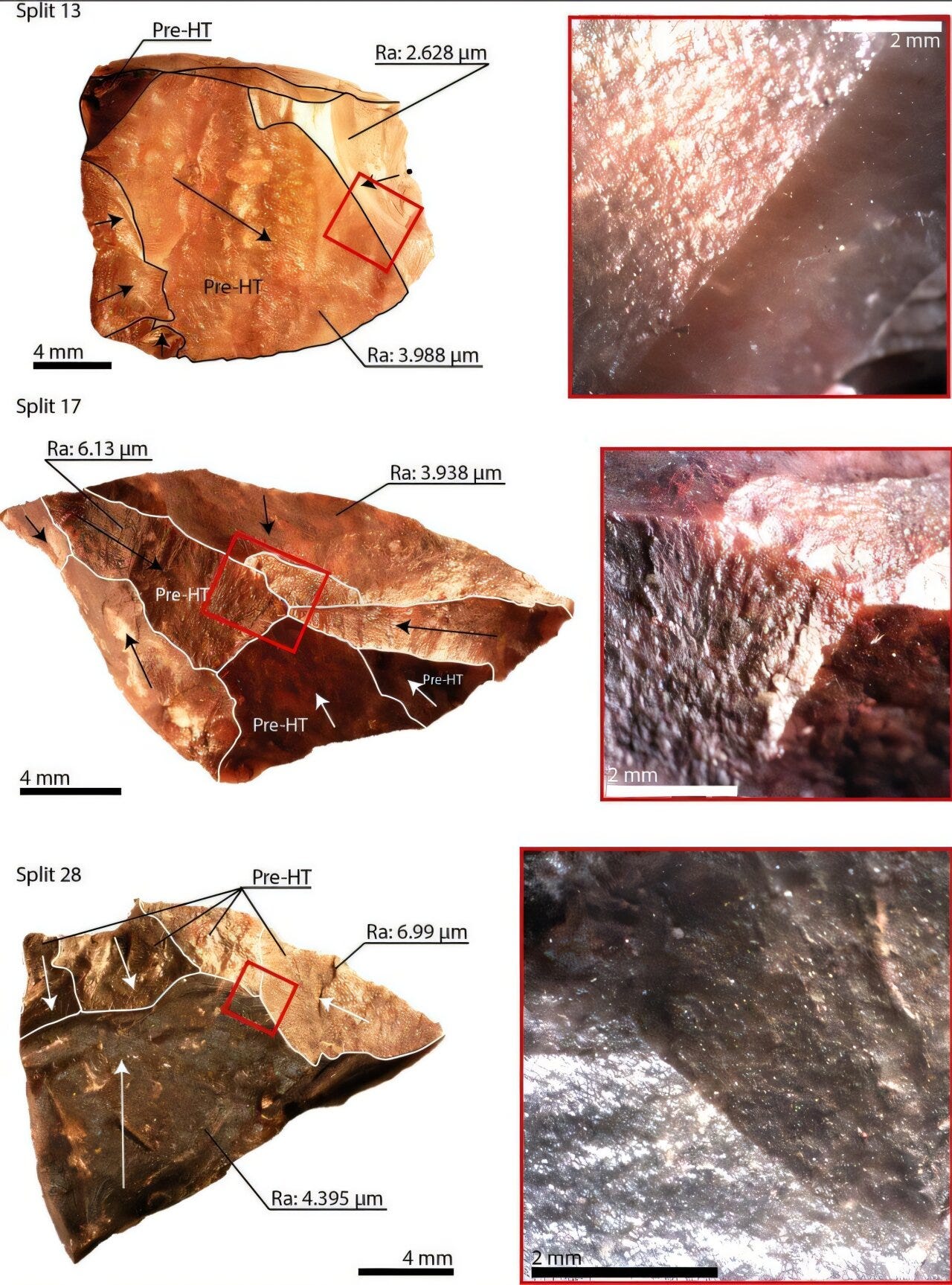
Seventy of the 502 artefacts — 14 percent — showed this roughness contrast. The team confirmed their visual assessments using replica tape analysis: compressible foam pressed against knapping surfaces, scanned to extract roughness average (Ra) values. Pre-heating surfaces averaged 5.69 μm; post-heating surfaces averaged 3.61 μm, a difference of roughly 2 μm. That matches Ra differences documented on heat-treated chert from other parts of the world, giving the method independent support. In all 15 cases where both visual and quantitative assessments were made, they agreed.
The two oldest diagnostic pieces came from spits 70 and 72, more than 240 cm below the surface. Their stratigraphic positions correspond to OSL dates of 53.4 ± 5.4 and 60.3 ± 6.7 ka BP. Schmidt and Hiscock are careful here — the basal chronology of Nauwalabila I is actively debated, with disagreement over the extent of termite disturbance and whether sand grains and artefacts are in depositional association. They decline to make claims beyond 50 ka. But in the most conservative interpretation, the evidence for systematic chert heat treatment at the site dates to at least 45–40 ka, and likely to more than 55 ka.
The nearest comparison anywhere in the world is the East Asian Dyuktai at roughly 25 ka, and the European Solutrean at around 22 ka. The Australian evidence is almost twice as old as either.
The surprise isn’t just the age. It’s the rock type.


