

The skull sitting in the museum case looks different from yours. Lower. Longer. The brow ridge juts forward, the occipital bone rounds out at the back into a shape called a bun. Everything about the exterior signals difference, and for over a century that difference has been read as cognitive distance. Neanderthals, the reasoning went, had bigger skulls but smaller cerebellums, narrower frontal lobes, a brain built for brute competence rather than symbolic thought. They made tools, sure, but they couldn’t really think like us. And when Homo sapiens arrived, our superior cognition did what superior cognition does.
That story has been eroding for decades. Now a study1 by Indiana University cognitive scientist P. Thomas Schoenemann and his colleagues has taken a direct measurement of its central premise — and the numbers don’t hold.
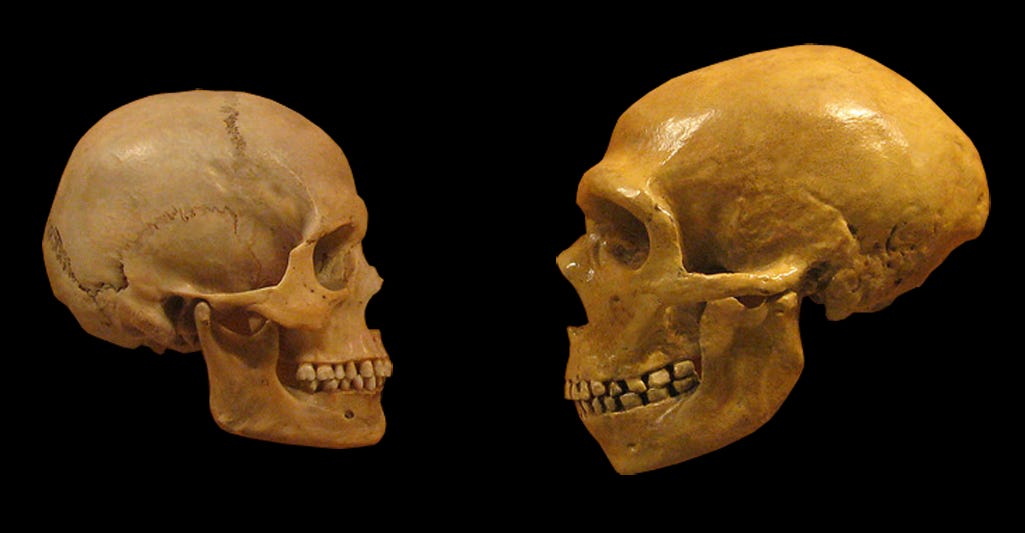
The specific target is a 2018 study2 that compared endocranial reconstructions from four Neanderthals and four early Homo sapiens, dividing the brain into 13 major regions and measuring their volumes. The authors of that study noted that despite having larger total cranial capacity overall, Neanderthals appeared to have smaller cerebellums than their contemporary sapiens. The cerebellum sits at the back of the brain and is involved in motor control, attention, and emotional regulation, among other things. The finding circulated widely. It seemed to put some neuroanatomical flesh on the old cognitive inferiority argument.
What the 2018 study didn’t do was ask how those differences compared to the variation that exists among living people. Schoenemann’s team did.


