

At Tres Bonetes, a site perched at the edge of where the Pampas dissolve into Patagonia along the Atlantic coast of Argentina, two people were buried roughly 6,000 years ago. Nothing about their location or burial context immediately distinguishes them from other people living in the region. But their DNA does. When researchers extracted genomic data from their remains, the two individuals didn’t cluster genetically with their nearest geographic neighbors in the central Pampas. They looked more like people from southeastern Patagonia, hundreds of kilometers to the south.
That was one of the first surprises in a study that accumulated many. Published in Current Biology1, the research by Kim-Louise Krettek, Cosimo Posth, and colleagues presents genome-wide data from 52 ancient individuals spanning six millennia in what the team defines as the central Southern Cone — the territories of present-day Argentina and Uruguay, roughly between 25° and 40° south latitude. The findings don’t simplify the population history of this region. They complicate it, productively.
Before this study, the picture of the Middle Holocene Pampas was comparatively tidy. Previous ancient genomic work had established that the oldest individuals known from the central Pampas — dating to around 7,700 and 6,800 years ago — shared a broadly similar ancestry that seemed characteristic of the region. The implicit assumption was that the Pampas, during this period, was home to a relatively continuous population.
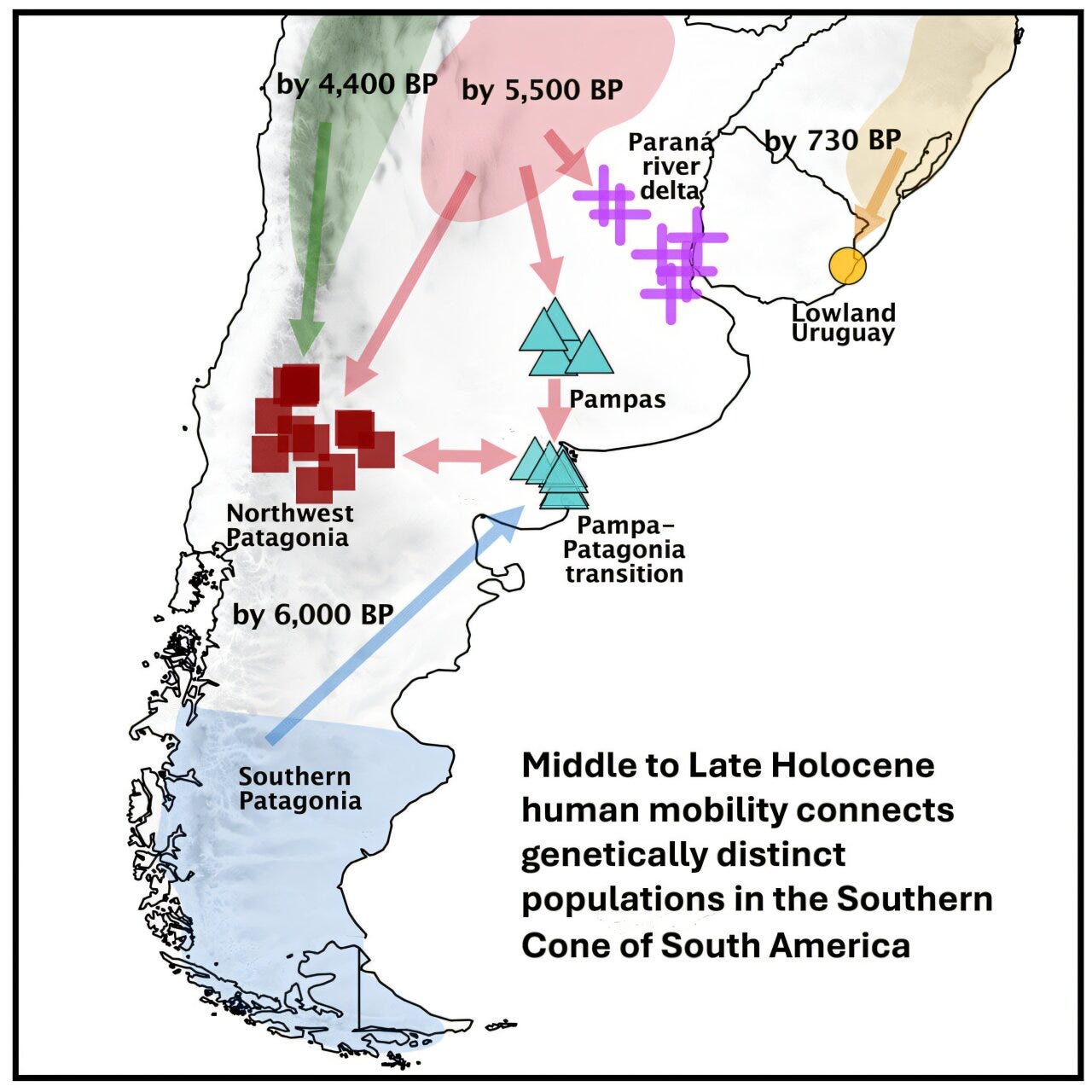
The new data reject this cleanly. The team identifies at least three genetically distinct ancestries present in the Pampas during the Middle Holocene, the period roughly between 8,200 and 4,200 years ago. One matches the older Pampas profile. A second, evident in the Tres Bonetes individuals, is more closely related to populations from the eastern part of southern Patagonia — specifically groups associated with terrestrial rather than marine subsistence, suggesting the ancestors of these individuals came from the interior of the southern cone rather than the coast. A third ancestry, arriving in the southern Pampas by around 5,500 years ago, is the most puzzling of all.
Krettek and colleagues call it “an ancestry of unknown geographic origin.” That phrasing isn’t evasion — it’s precision. The ancestry can be tracked through its allele frequencies, quantified in its proportion over time, and shown to increase through the Late Holocene. But its source population has no clear proxy in the current dataset. It doesn’t match any well-sampled ancient or modern population well enough to identify where it came from before it appeared in the Pampas.
What the team can say is this: the ancestry was already present in the southern Pampas at least 5,500 years ago, possibly earlier. By around 4,000 years ago its representation in the central and southern Pampas had grown substantially. It didn’t replace what was there before — the data don’t support a complete population turnover — but it became dominant, carrying through the entire Late Holocene. When European contact disrupted the region’s Indigenous populations, people still carrying this ancestry were living in the southern Pampas. A recent study of Middle- to Late-Holocene genomes from central Argentina identified an ancestral lineage that similarly had no known geographic source, detected in the central Pampas by around 3,300 years ago. The overlap with Krettek and colleagues’ findings hints that the mystery ancestry may have arrived in the southern Pampas from central Argentina as early as the Middle Holocene — but tracing it further back remains an open problem.


