

The question of why early Homo sapiens populations were so fragmented across Africa has attracted serious research attention for the past decade. The dominant framework invokes climate: shifting rainfall belts, expanding deserts, and periodic green corridors that alternately connected and isolated groups across the continent. Climate clearly mattered. But a new study published in Science Advances1 argues that something else was also drawing lines on the map — something biological, persistent, and until now largely invisible in the deep human past.
Malaria.
A team led by Margherita Colucci at the Max Planck Institute of Geoanthropology, working with colleagues at Cambridge and several other institutions, has reconstructed the potential transmission risk of Plasmodium falciparum-induced malaria across sub-Saharan Africa from 74,000 to 5,000 years ago. When they compared that reconstruction against an independent estimate of where hunter-gatherer populations actually lived, based on the spatial distribution of archaeological sites, they found a consistent negative relationship. Areas with high malaria transmission potential were areas humans avoided, or failed to persist in, decade after decade and millennium after millennium. Low-risk zones tracked human occupation. High-risk zones did not.
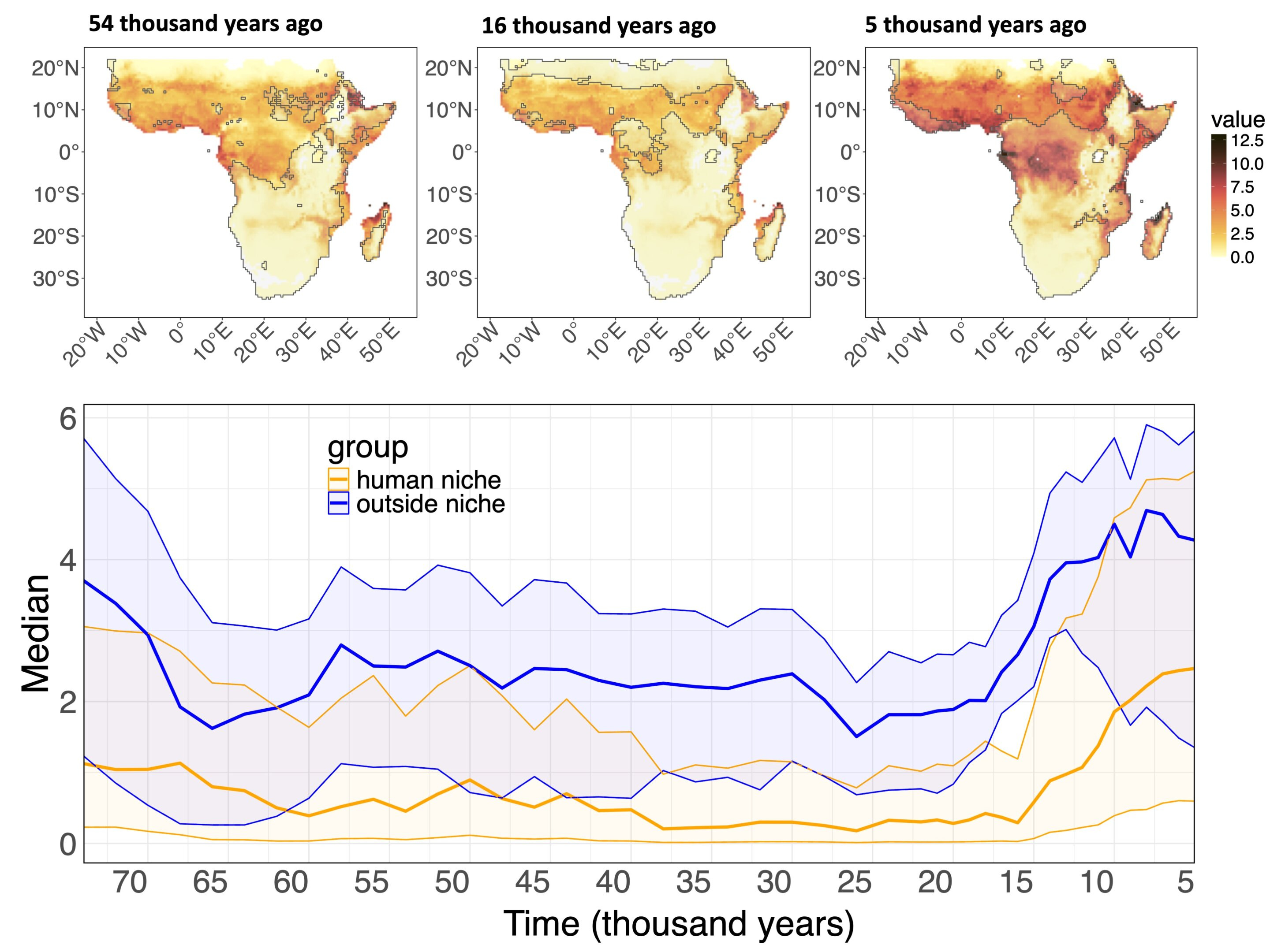
That pattern held across the entire 69,000-year window they examined. It didn’t depend on which mosquito species were included in the models, or which threshold was used to define high malaria pressure. The signal was robust.


