

The deciduous teeth are the tell. In the faunal assemblages from Cova Eirós, a cave in the foothills of the Cantabrian mountains in Galicia, Ursus spelaeus had long dominated the counts. Over half of the morphologically identified specimens in some levels were cave bear, making it easy to think of the place as primarily theirs. But teeth, and specifically milk teeth, the deciduous dentition of cubs, accumulate in caves where bears denned and died. They are abundant. They are identifiable. They are not necessarily telling you anything useful about what the hominins who also used the site were eating.
A new study by Hugo Bal-García and colleagues, published in the International Journal of Osteoarchaeology,1 applies ZooMS to 114 previously unidentifiable bone fragments from the Mousterian and early Upper Paleolithic levels at Cova Eirós. The results shift the picture considerably. Cave bear drops. Horse rises. And the dietary range of both the Neanderthals and anatomically modern humans who occupied the site turns out to be wider than the morphological record suggested.
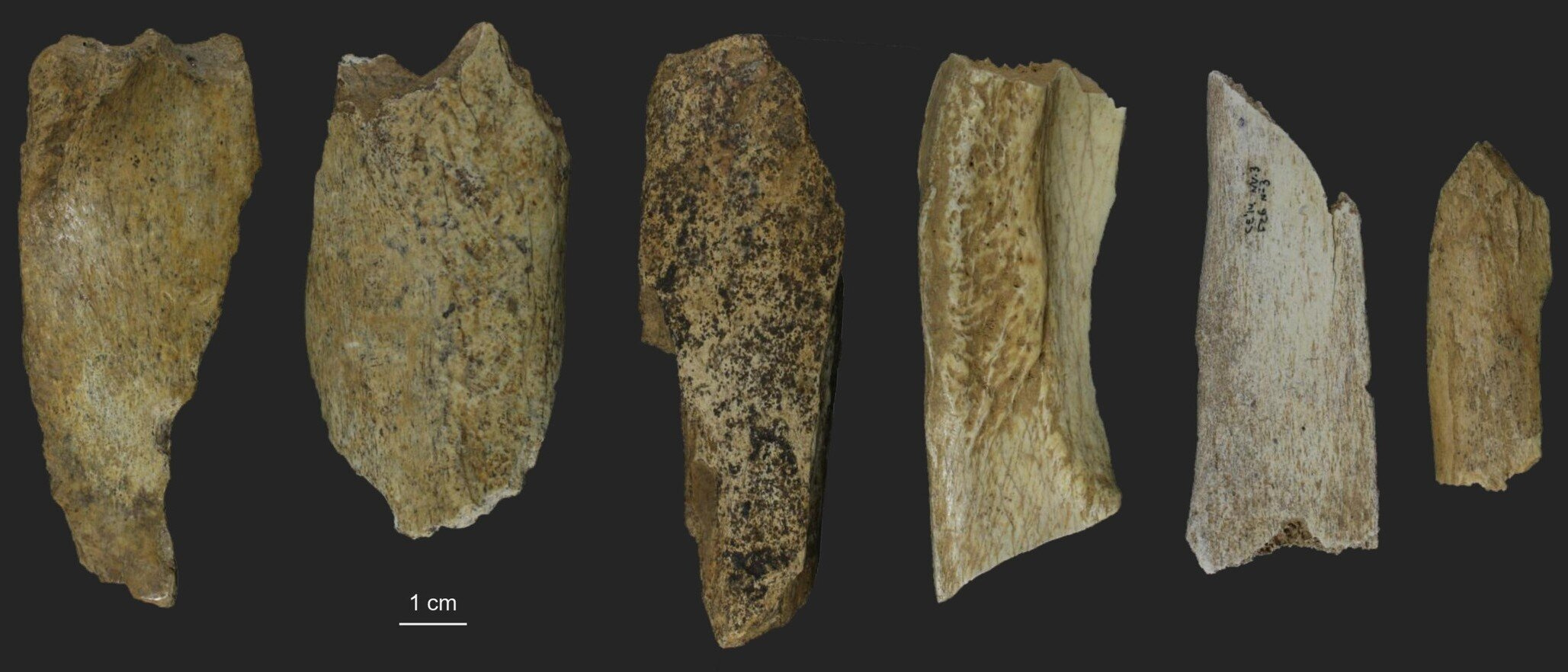
The site spans a long sequence. The Mousterian levels here date to somewhere between roughly 60 and 39 thousand years ago, followed by Aurignacian occupation around 36 to 35 thousand years ago, the initial arrival of anatomically modern humans in this part of Iberia. It is one of the few places in the northwest of the peninsula where this transition can be studied in a single stratigraphic sequence, making the faunal record here relevant not just locally but for broader questions about how different hominin groups used similar environments in overlapping time periods.
ZooMS works on the collagen that survives in bone long after any other molecular information has degraded. Type-I collagen produces a distinctive mass fingerprint when processed correctly: the protein is extracted from a small bone chip, digested enzymatically, and the resulting peptides are compared against a reference library by mass spectrometry. Different mammal groups produce different peptide mass patterns. The method can typically resolve identifications to genus or family level, sometimes to species, and it can be applied to fragments that are morphologically uninformative, the broken shaft of a long bone, a rib splinter, the kind of material that ends up in the indeterminate pile and stays there.
At Cova Eirós, somewhere between 70 and 90 percent of the faunal material typically fell into that pile.


