
When T. Whitworth described a set of human cranial fragments from Turkana, Kenya, in 1960,1 he found himself stuck. The skull was thick-walled. The forehead sloped. The mandible was heavy-built in a way that recalled older, more archaic specimens. But there was also a chin. A proper chin, the bony projection below the lower teeth that counts as one of the diagnostic markers of Homo sapiens.
Whitworth was honest about the contradiction. He noted the archaic features, noted the modern one, and didn’t resolve them into a clean interpretation. The fossil got filed away. It was described again in 19662 under the name Kabua 1, mentioned in subsequent surveys, and mostly left alone. Sixty years later, a team led by Abel Marinus Bosman3 has given it the quantitative analysis it never received, combined with new uranium-series dating. The picture that emerges is strange in an instructive way.
Kabua 1 is probably a Homo sapiens. But it is one that carries enough archaic-looking morphology to resist easy classification, and that difficulty, the team argues, is itself meaningful.
What the fragments preserve
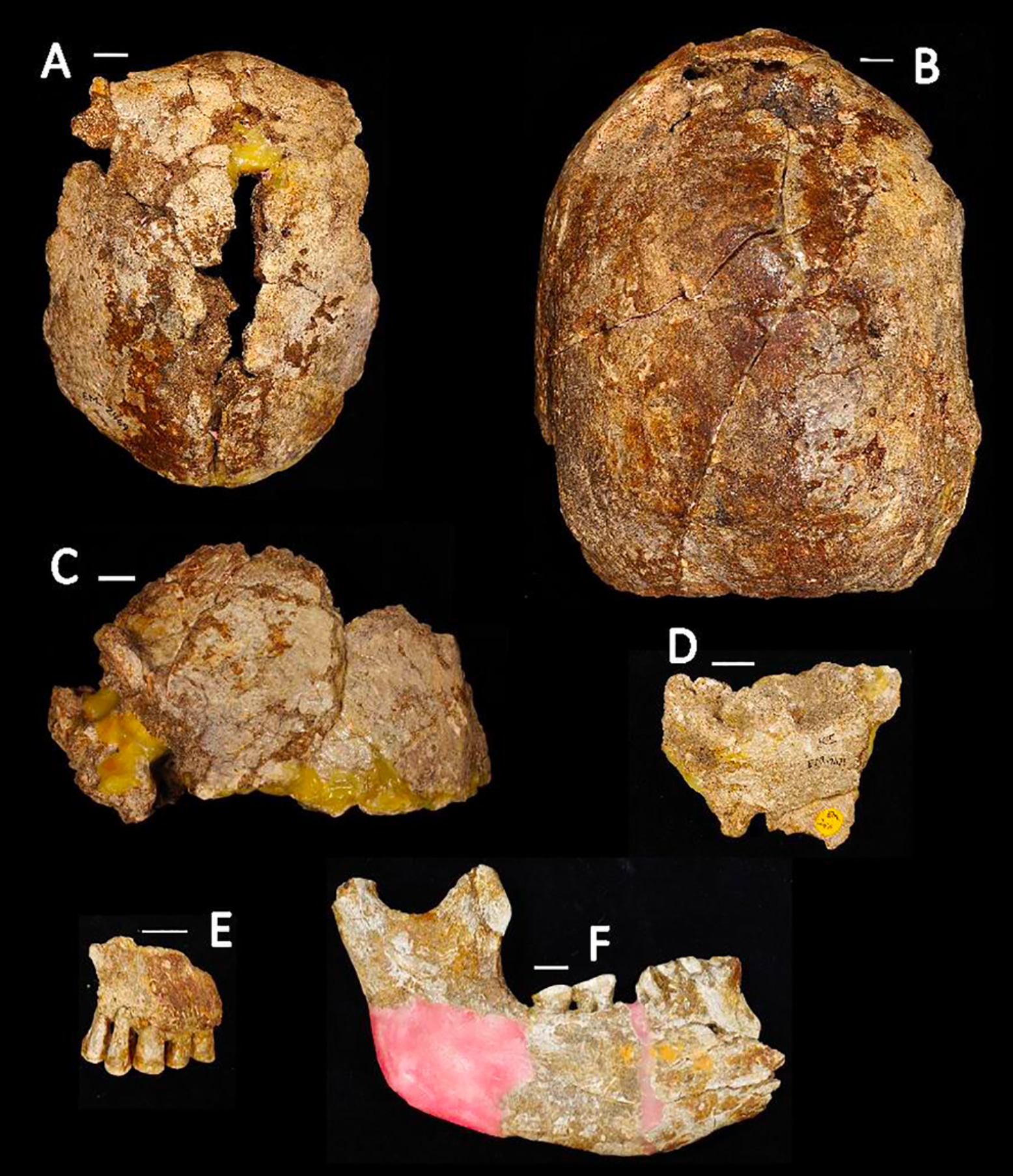
The Kabua 1 material, held at the Natural History Museum in London, is fragmentary: pieces of the frontal, parietal, occipital, and temporal bones, along with maxillary and mandibular fragments and several teeth. Working from microCT scans, Bosman and colleagues produced4 six separate virtual reconstructions, each guided by a different reference cranium ranging from the Middle Pleistocene fossil Kabwe 1 (sometimes called Broken Hill) to recent Maasai individuals. The approach is deliberate. Because Kabua 1 is incomplete and taphonomically distorted, any single reconstruction encodes assumptions about the missing parts. Six different references give a distribution of possible morphologies rather than a single answer, which the team describes as analogous to priors in a Bayesian framework. It is a more epistemically honest way to handle fragmentary material.
The reconstructions were compared against a broad sample: Middle Pleistocene Africans and Eurasians, Neanderthals, Late Pleistocene H. sapiens, and 109 recent African H. sapiens crania from eastern and southern Africa. The analysis focused on the neurocranium, because neurocranial globularity, the roundedness and anteroposterior shortness of the braincase, is one of the most diagnostically useful markers distinguishing derived H. sapiens from more archaic hominins.
In the principal component analysis, the first axis captures the difference between elongated, low vaults and rounded, globular ones. Neanderthals and Middle Pleistocene hominins cluster toward the elongated end. Derived H. sapienscluster toward the globular end. All six Kabua 1 reconstructions fall within the H. sapiens range on this axis.
The second principal component complicates things. The Kabua reconstructions score low on it, overlapping with Middle Pleistocene hominins and Neanderthals as well as some H. sapiens. What this reflects, concretely, is a short nuchal plane, a less vertical frontal bone, and a mediolaterally narrow vault. The reconstruction based on the Ngaloba cranium sits closest to the Middle Pleistocene African group in morphospace, near where the fossil Saldanha overlaps with H. sapiens variation. The reconstruction based on Skhul 5 sits at the opposite extreme, exhibiting a markedly globular neurocranium.
The classification analyses add a further layer of nuance. Linear discriminant analysis classifies five of the six reconstructions as Middle Pleistocene African, and only the Skhul 5-based one as H. sapiens. The machine learning methods, which are more robust to the non-normal distribution of the data and less sensitive to sample size imbalances, are more mixed. As the H. sapiens reference sample grows, the reconstructions increasingly classify with that group, with the Ngaloba-based reconstruction the persistent holdout. The authors are appropriately cautious about the LDA result: LDA is designed to maximize between-group variance and can produce artificial separations, and the Middle Pleistocene African grouping lumps specimens with quite different degrees of relatedness to derived H. sapiens.
The overall picture is that Kabua 1 has a broadly H. sapiens neurocranium in terms of globularity but retains features that, taken together, pull it toward a more archaic morphological zone. It is not a Neanderthal. It is not Kabwe. But it is not a specimen that would dissolve without trace into a sample of recent Africans.
The date and what it means
Getting a reliable age for Kabua 1 has proved difficult, and the new uranium-series results don’t fully resolve that difficulty. They do establish a conservative minimum.
Uranium-series dating of fossil bone works because uranium migrates into bone from groundwater after burial. The ratio of uranium isotopes to decay products gives an indication of how long that process has been running. The complication is that uranium can also leach back out, or a second wave of uranium can overprint the first. Each of these events scrambles the signal. Three samples from Kabua 1 were dated: one from the biparietal-occipital fragment, one from a tooth in the mandible, and one from the temporal bone.
The tooth has undergone at least three distinct uranium mobilization events, including leaching, making any age derived from it unreliable. The temporal fragment gives an apparent minimum age of around 114,000 years, but there is evidence that a past leaching event may have affected this figure too. The biparietal-occipital sample gives a minimum age of 64.4 ± 5.4 ka. The team judges this the most conservative and defensible figure, because the pattern of uranium isotope ratios in that sample is most consistent with a simple accumulation history unaffected by leaching.
This is a minimum age. The actual date of death could be older, potentially considerably older. But at least 64,000 years old places Kabua 1 in the Late Pleistocene, broadly contemporaneous with the populations that would eventually spread beyond Africa.
What diversity looks like before the bottleneck
The reason Kabua 1 matters is not just that it is another Late Pleistocene African fossil. It is that it adds to a pattern.
Several other Late Pleistocene African fossils show a similar mismatch between what age would predict and what morphology delivers. Iwo Eleru from Nigeria, dated to around 14,000 years ago, has morphology that looks more archaic than it should given its age. Lukenya Hill in Kenya and Ishango in what is now the Democratic Republic of Congo, both around 20,000 to 25,000 years old, show comparable features. Hofmeyr from South Africa, dated to roughly 36,000 to 38,000 years ago, has a continuous supraorbital torus, a brow ridge, which is vanishingly rare in derived H. sapiens. Nazlet Khater 2 from Egypt, from around the same period, has a face and mandible with proportions that recall Middle Pleistocene hominins far more than they resemble recent Africans.
These fossils come from different times and different parts of the continent. They do not cluster into a single variant population. What they share is the preservation of morphological features that most straightforward models of H. sapiens origins would predict should have been largely gone by their respective dates. In each case, the overall assignment to H. sapiens is not seriously contested, but the details resist easy explanation.
Two broad frameworks exist for thinking about this. One holds that H. sapiens origins were pan-African: our species emerged as a continent-wide process of population fragmentation and coalescence, with derived traits arising in different regions and spreading through periodic gene flow. Under that model, morphological diversity across Late Pleistocene Africa is expected, because populations were partly isolated and some archaic-looking features represent survivals of deep population structure. The competing view holds that derived H. sapiens originated in a specific region and spread with varying degrees of replacement, and that individuals with more archaic morphology either belong to lineages that eventually went extinct without contributing to living people, or represent the tail ends of variation within a broadly modern species that our comparative frameworks don’t fully capture. Both positions currently have genetic and morphological evidence in their favor.
What Kabua 1 does, with its new date and new analysis, is take its place in the growing series of fossils that make the African Late Pleistocene look unexpectedly variable. The team places it alongside Hofmeyr and Nazlet Khater as examples of Late Pleistocene H. sapiens that combine a broadly modern neurocranial shape with features that, in isolation, would look considerably older.
There is a structural reason to expect this kind of diversity. Living populations outside Africa descend from a relatively small founding group, and multiple successive founder effects compress morphological variation. Living Africans are already more variable, craniometrically, than non-Africans. The Late Pleistocene fossil record suggests the full historical range was wider still. With a small fraction of that variation preserved in bone and most of it lost, we are probably only beginning to map what H. sapiens actually looked like during the period when the species was exclusively African.
How much of that variation is ancestral to anyone living today, and how much belongs to lineages that terminated without genetic descendants, is a question that morphology alone cannot answer. Ancient DNA from Kabua 1 would help, but extraction from a specimen of this age from an equatorial environment is unlikely to succeed. For now, Kabua 1 returns to the record with a more secure identity than it had before, which makes it more useful and, in some ways, more puzzling.
Whitworth, T. 1960. “Fossilized human remains from Northern Kenya.” Nature 185: 947–48.
Whitworth, T. 1966. “A fossil hominid from Rudolf.” South African Archaeological Bulletin 21: 138–50.
Bosman, A.M., L.T. Buck, H. Reyes-Centeno, M. Mirazón Lahr, C. Stringer, R. Grün, Q. Shao, and K. Harvati. 2026. “The morphological affinities of the fossil cranium from Kabua, Kenya.” Journal of the Royal Anthropological Institute(N.S.). DOI: 10.1111/1467-9655.70137
Bosman, A.M., L.T. Buck, H. Reyes-Centeno, et al. 2019. “The Kabua 1 cranium: virtual anatomical reconstructions.” In Modern Human Origins and Dispersals, edited by Y. Sahle, H. Reyes-Centeno, and C. Bentz, 137–70. Tübingen: Kerns Verlag.


