
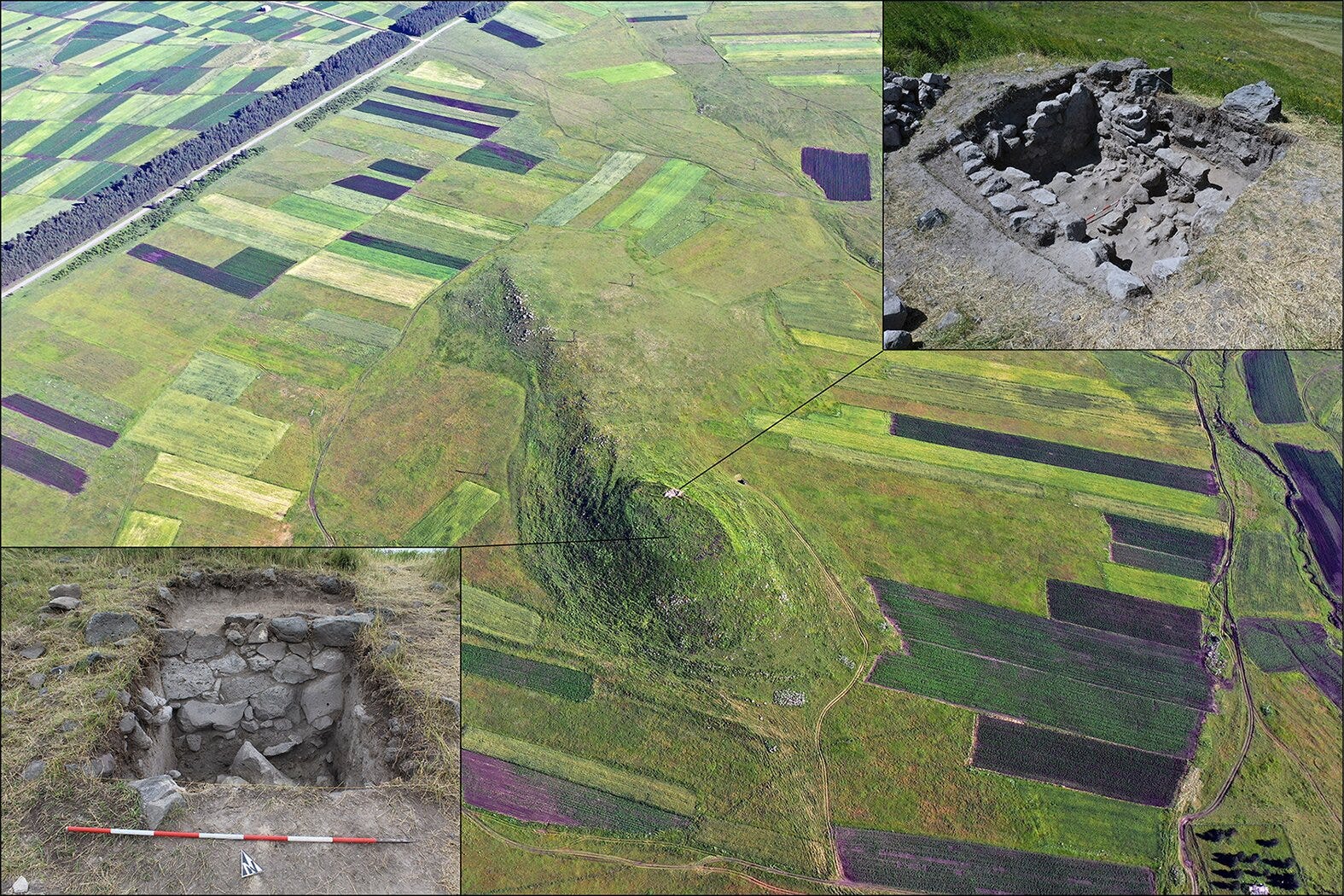
The mound at Baraleti sits near the center of the Javakheti Plateau, and its name tells you something right away. Natsargora means “hill of ashes.” Not a metaphor. When excavations began in 2023, researchers from the Samtskhe-Javakheti Project found out why: layer after layer of burning events, each folded into the next across roughly three thousand years of occupation. People kept coming back to this place, and they kept burning things down, or finding it burned, and building again.
That kind of stratigraphy does not happen by accident. It takes a place that matters.
The Javakheti Plateau is a high-altitude grassland tucked into the southern Georgian highlands, between the Greater Caucasus range and the borders of Turkey and Armenia. It sits at elevations that make sustained agriculture difficult. It has been largely off the radar of systematic archaeological survey. Since 2017, a joint Georgian-Italian initiative called the Samtskhe-Javakheti Project has been changing that. Eight years of fieldwork, combining remote sensing, GPS mapping, and GIS-based analysis with targeted excavations, have produced1 a picture of the plateau as something quite different from the empty frontier it has usually been treated as. The team has documented more than 168 archaeological sites ranging from Bronze Age settlements to medieval monasteries.
The sheer number is striking. The more interesting question is what kind of occupation these sites actually represent.
Fortresses That May Not Have Been Fortresses
Much of the earlier scholarly attention on this region focused on the plateau’s most visible features: the “Cyclopean” fortifications, large-scale stone enclosures with walls built from blocks of almost absurd dimensions. The conventional assumption was that these were defensive citadels, military architecture serving the needs of settled populations under threat.
The SJP’s survey data complicates this. Several of the megalithic enclosures, when examined closely, appear to have operated not as permanent military installations but as temporary refuges. A 2022 study2 of the Abuli and Shaori complexes by Licheli and colleagues proposed that mobile pastoralist groups used such structures seasonally, as secure points during their movements through the highlands or during periods of instability. Cyclopean walls, on this reading, were less about holding territory than about having somewhere reliable to retreat to.
The difference matters. A landscape of defensive citadels implies a settled population defending fixed resources. A landscape of seasonal refuges implies something more fluid: herders moving between altitudes, their architecture a response to mobility rather than sedentism, the plateau functioning as an intermediate zone rather than a destination.
Sites like Abulis Gora and Saro-1 support a picture of long-term but episodic use. Occupation was not continuous; it was recurrent. People returned to the same ground across centuries, which implies deep familiarity with the landscape, knowledge of where to find water and shelter and stone, transmitted across generations. The necropolises near Bertakana and Lake Tabatskuri make this point in a different register. Funerary traditions do not persist at the same location for that long without a community that keeps returning.
What the Ash Preserves
At Baraleti Natsargora, the occupation sequence runs from the Early Bronze Age through the Iron Age, roughly 3500 to 500 BCE. The recurrent burning episodes are both literal and interpretively useful. Each marks a break. Each rebuilding marks a renewal. The defensive wall uncovered in excavation, along with traces of partition walls and clay installations consistent with domestic use, suggests the site functioned as a fortified settlement during its peak phases.
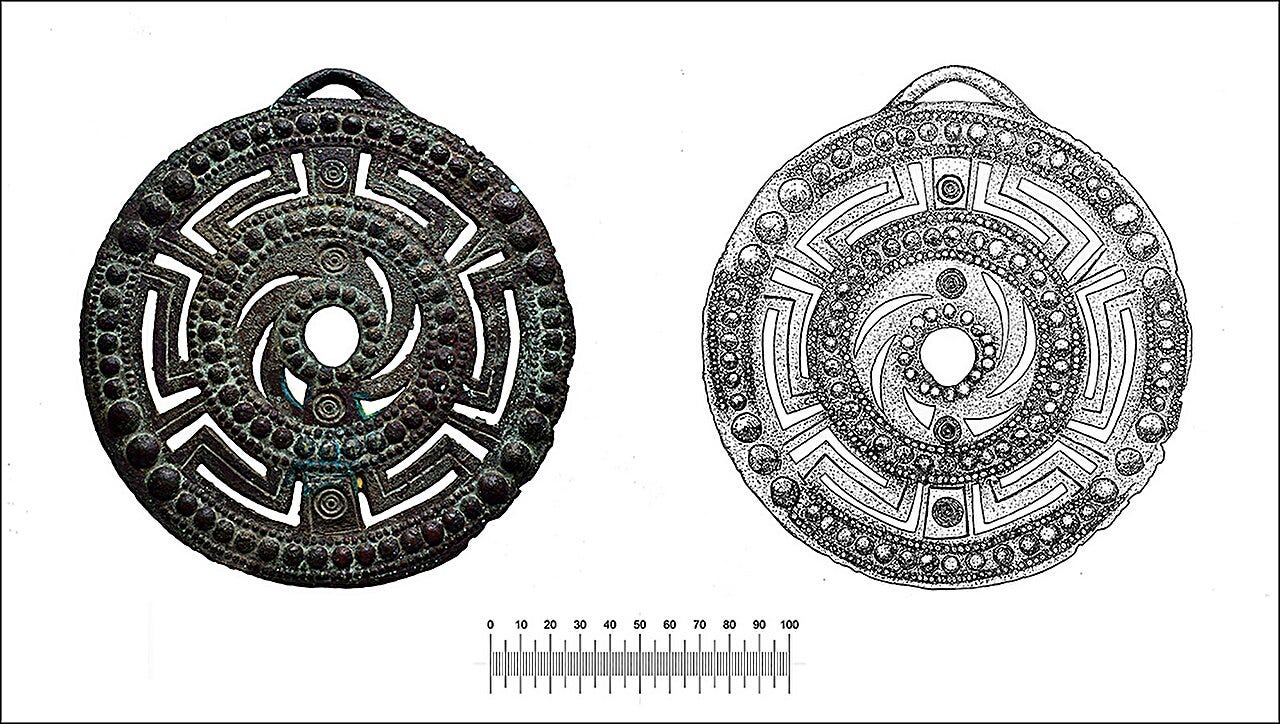
A bronze solar disk came from the vicinity of Baraleti during earlier surveys. It is a carefully made object: concentric bands of raised knobs, angular incised motifs, regularly spaced perforations around its rim. Objects like it have been found across southern Georgia, and the pattern of association is consistent. They appear in burials, and they appear disproportionately in female graves. The Baraleti disk now sits in the Akhalkalaki Museum, and while its precise findspot within the site remains uncertain, the weight of regional evidence suggests it accompanied someone into death.
What a solar disk meant to the people who made it and buried it is harder to say. The iconography connects to a wider tradition of solar imagery in the protohistoric South Caucasus and across the steppe. Whether it functioned as an identity marker, a symbol of status, a ritual object, or something that resists those categories is a question the object itself cannot answer. The pattern of female association is at least worth sitting with.
At Meghreki Fortress, a few kilometers to the east, the team found something more unexpected than bronze metalwork. Inside domestic structures provisionally dated to the Late Iron Age and Achaemenid horizon, roughly the sixth to fourth centuries BCE, were fired clay plaques carrying incised and painted geometric designs. Red, white, and dark blue pigments. The visual effect would have been striking in a room lit by firelight.
Painted clay plaques of this kind are not a standard feature of South Caucasian domestic assemblages. Parallels exist at Digasheni and Amiranis Gora, but the density and context at Meghreki stand apart. The interpretation being advanced is that decorated plaques marked ritualised or high-status domestic spaces. Not a temple. Not a public monument. A room in a house. The line between the symbolic and the everyday, at Meghreki, ran through the walls of ordinary buildings.
This is worth pausing on. Meghreki’s occupation runs from the Kura-Araxes culture in the Early Bronze Age through to the medieval period, a span of over four thousand years, with the Iron Age as its most intensive phase. Across that time, the architecture shifted, the material culture shifted, the political situation around the plateau shifted. But people kept building at the same spot, and at one particular moment they put painted clay panels on the walls. Whether that moment marked an intensification of ritual practice, a new form of social display, or an outside cultural influence that found local expression is open. The Achaemenid horizon connection is suggestive. Achaemenid influence reached the South Caucasus unevenly and was absorbed in different ways at different scales. A highland settlement in Georgia would not have taken it in straightforwardly.
What the SJP is building, across eight years and 168 sites, is a framework for a region that has been treated as peripheral for too long. The Javakheti Plateau turns out to have been a crossroads: a zone where highland and lowland traditions met and overlapped, where mobile groups and settled communities negotiated the same terrain, where symbolic objects traveled with people and sometimes outlasted them. The ash at Baraleti has been accumulating for five thousand years. There is still a lot to read in it.
Further Reading
Gambashidze, I. 1999. Samtskhe in the middle of the 2nd millennium BC (according to archaeological materials from the Borjomi Gorge). Unpublished Ph.D. dissertation, Archaeological Research Center, Tbilisi.
Orjonikidze, A. 1988. “The Early Bronze Age settlement of Digasheni I.” Dziebani 1(1): 15–22.
Dan, R., Chilingarashvili, T., Vitolo, P., Chogovadze, T., Cesaretti, A., Gasparro, O., Laurita, F., Bonfanti, A.S., Fausti, E., Galanti, F., & Licheli, V. 2026. “Layers of stone and ash: new perspectives from the Samtskhe-Javakheti archaeological project.” Antiquity. DOI: 10.15184/aqy.2026.10331
Licheli, V. et al. 2022. “Cyclopean fortresses, royal cities or mountain shelters? The Abuli and Shaori complexes in southern Georgia in the light of recent archaeological investigations.” Ancient Civilizations from Scythia to Siberia 28: 148–76. DOI: 10.1163/15700577-20221402


