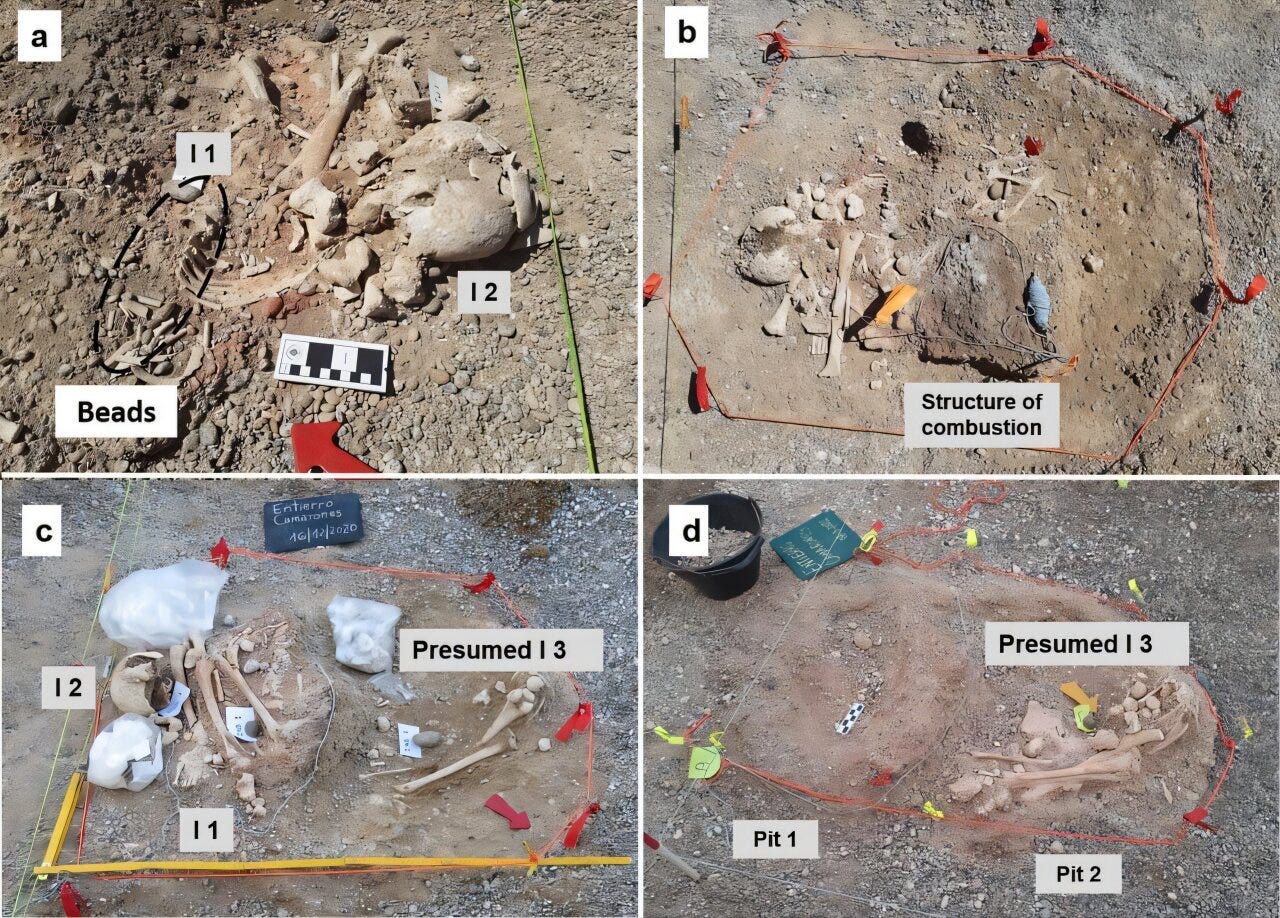
In October 2020, a homeowner in the small coastal village of Camarones, on Argentina’s Patagonian Atlantic coast, was building a house when the excavator turned up human bones. The local police were called. A heritage law in Chubut province requires it. The police, in turn, notified archaeologists from the Instituto de Diversidad y Evolución Austral (IDEAus-CONICET), who arrived to find something no one had expected to find in the middle of a residential neighborhood: a burial from the Early Holocene.1
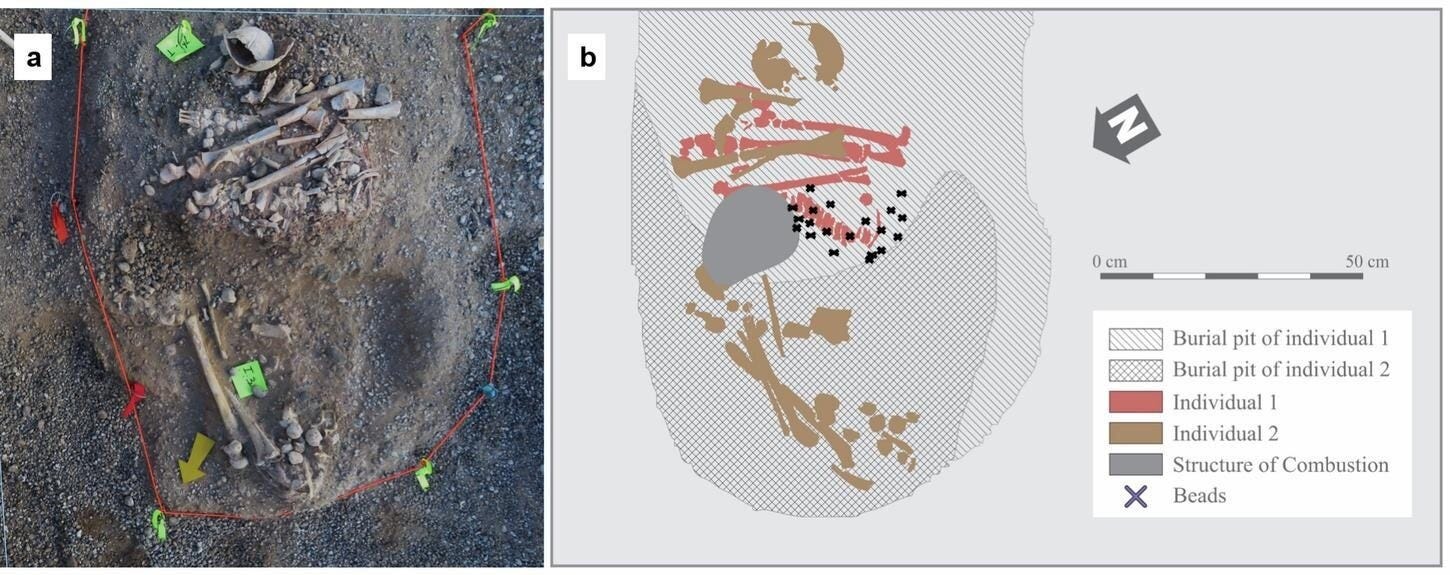
Two individuals. Both children. One died at roughly 8 or 9 years old, the other at around 14. The radiocarbon dates that came back from the laboratory were stark. Individual 2, the older child, dated to between 10,798 and 10,302 calibrated years before present. Individual 1, the younger, to between 10,210 and 9,878 cal BP. That gap of roughly 400 years between the two burials meant the same spot had been used twice across generations. Someone returned.
Before this discovery, the earliest known burial on the Patagonian Atlantic coast was La Arcillosa 2 in northern Tierra del Fuego, at approximately 5,205 uncalibrated BP. The Camarones children predate that by nearly five millennia. Prior archaeological research in the immediate area had only pushed occupation back to between 6,000 and 600 BP. The Camarones burials don’t just revise the local sequence. They collapse it.