
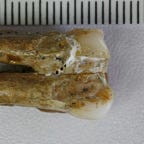
A tooth recovered from Zhoukoudian cave near Beijing in the early 1950s has been sitting in storage for decades. It belongs to a Homo erectus individual who died roughly 420,000 years ago, during a period when the world held at least four distinct human lineages simultaneously. H. sapiens had not yet emerged. Neanderthals were consolidating in the west. A poorly understood group we now call Denisovans was somewhere in Asia. And H. erectus -- the oldest hominin to have left Africa, a species that had already been roaming across three continents for well over a million years -- was still out there, still occupying the limestone hills north of what is now Beijing.
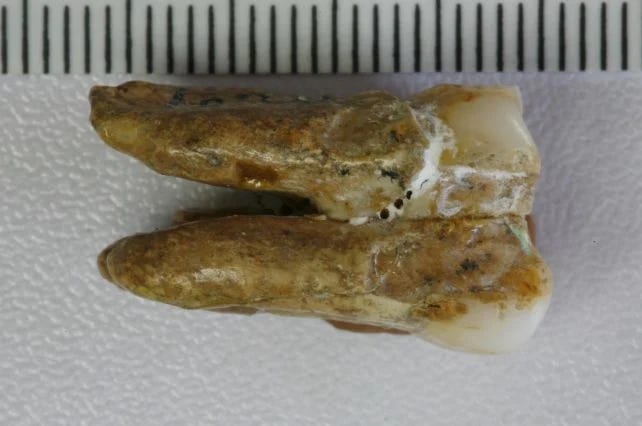
That tooth, and five others like it from two additional sites across China, have just yielded the first informative molecular data ever recovered from Homo erectus. The results, published this month in Nature1 by a team led by paleogeneticist Qiaomei Fu of the Chinese Academy of Sciences’ Institute of Vertebrate Paleontology and Paleoanthropology, connect these 400,000-year-old individuals to the Denisovans -- and, through them, to people alive today.
The breakthrough didn’t come from DNA. It couldn’t. Ancient DNA degrades quickly; even under ideal preservation conditions, retrievable sequences rarely survive beyond a few hundred thousand years, and the specimens from Zhoukoudian, Hexian in Anhui Province, and Sunjiadong in Henan Province are far older than what DNA analysis can reach. Instead, Fu’s team turned to proteins.
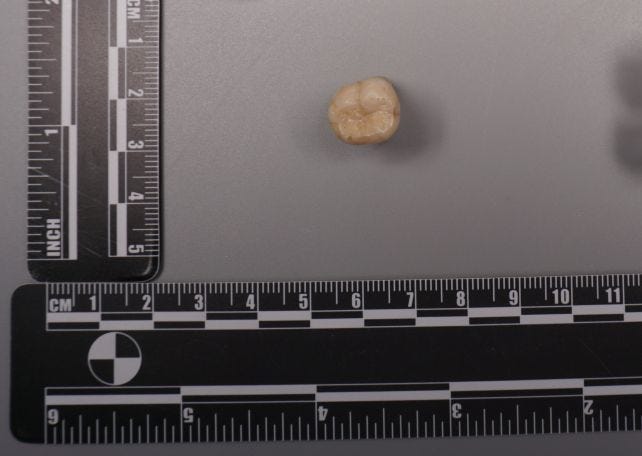
Proteins survive longer than DNA because they are structurally sturdier, and because tooth enamel -- the hardest tissue in the vertebrate body -- protects them especially well. Enamel is a mineral matrix, and proteins trapped inside it can persist for millions of years in fragmentary form. They are not genetic material themselves, but they are produced by genes and carry the signature of the genetic variants that shaped them. As University of Copenhagen biochemist Enrico Cappellini, who was not involved in the study, put it in comments to Science: proteins are,
“a direct expression of genes, so in a sense they carry genetic information. It’s the best proxy for DNA.”
Retrieving those proteins from a prized and irreplaceable fossil is a different kind of problem. Most paleoproteomic studies drill or cut into bone or tooth to extract a powdered sample -- destructive work that curators of important specimens understandably resist. Fu’s team used a method called acid etching: the tooth is wrapped in a waterproof film, a patch of enamel just a few millimeters square is exposed, then briefly treated with acid. The technique removes just enough material for analysis while leaving the specimen physically intact except for slight surface discoloration. The teeth from Zhoukoudian, Hexian, and Sunjiadong emerged with their morphology preserved.
What came out of that process was a catalog of 11 ancient enamel proteins covering hundreds of amino acid positions. Across all six individuals, from all three sites, the team identified two amino acid variants in a single protein: ameloblastin, which plays a key structural role in enamel formation.
Two variants, two stories
The first variant, designated AMBN(A253G), has never been seen before in any other hominin or primate. It wasn’t in the 1.77-million-year-old H. erectus tooth from Dmanisi, Georgia -- the only previous specimen to yield H. erectusproteins, though those had been too degraded to reveal informative variants. It wasn’t in Homo antecessor from Atapuerca. Not in Neanderthals, not in Denisovans, not in any modern human population. The variant appears to be specific to this population of Middle Pleistocene H. erectus from East Asia.
That exclusivity makes it useful. Fossils attributed to H. erectus across Asia are morphologically variable enough that researchers have sometimes disagreed about their relationships. The Hexian specimens, in particular, look morphologically closer to Indonesian H. erectus than to those from Zhoukoudian, and some researchers had proposed they might be more closely related to Denisovans. The AMBN(A253G) variant settles that debate. It appears in both Hexian teeth, just as it does in the Zhoukoudian and Sunjiadong teeth, clustering all six individuals together in a Bayesian phylogenetic tree with 100% posterior probability. Hexian belongs to H. erectus.
The second variant is where things get complicated. AMBN(M273V) had already been identified in Denisovans. The known Denisovan specimens include Denisova 3 from the cave in Siberia that gave the group its name, the “Dragon Man” skull from Harbin, the Penghu mandible from Taiwan’s seafloor, and a molar from Laos -- geographically scattered, morphologically distinct from Neanderthals and modern humans, linked almost entirely through ancient DNA and protein analysis rather than anatomy. When the Altai Neanderthal genome was analyzed, researchers found that the Denisovan lineage had received between 0.5% and 8% of its genome from a “super-archaic” hominin whose ancestors had diverged from the common lineage of Neanderthals, Denisovans, and modern humans more than a million years ago. They also found that roughly 15% of those super-archaic DNA regions later introgressed from Denisovans into populations in Asia and Oceania.
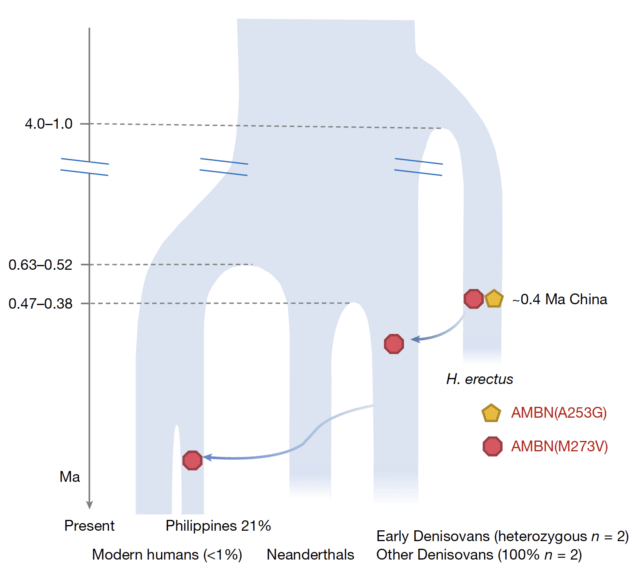
The AMBN(M273V) variant fits this pattern. It is absent from most modern human populations but present at 21% frequency in the Philippines, 1.17% in India, and 0.71% in Papua New Guinea -- exactly the populations expected to carry the highest proportions of Denisovan ancestry. It is homozygous in the more recent Denisovan specimens, Denisova 3 and Penghu 1, but heterozygous in two older Denisovans, the Harbin individual and Denisova 25 (dated to roughly 200,000 years ago). That pattern -- heterozygous earlier, homozygous later -- is consistent with an allele that entered the Denisovan lineage from outside and increased in frequency over time.
Fu’s team argues that the “outside” is H. erectus. The variant appears in all six H. erectus individuals across three sites spanning both northern and southern China. Its genomic region shows greater sequence divergence between modern Africans and Denisova 3 than between Africans and the Altai Neanderthal -- a signal that the region is older than the Neanderthal-Denisovan split, consistent with origin in a more diverged group. Denisovans diverged from Neanderthals approximately 380,000 to 470,000 years ago. The H. erectus specimens are dated to roughly 400,000 years ago. The timing, the geography, and the allele frequency pattern all point in the same direction: H. erectus populations in East Asia encountered Denisovans around or before this period, and something passed between them.
“Their shared habitats create opportunities for interactions,” Fu and colleagues write in the paper.
The scenario they reconstruct goes: H. erectus populations in East Asia, the same individuals whose teeth now sit in Beijing, Hefei, and Luoyang, passed the AMBN(M273V) variant to Denisovans through interbreeding, probably more than 400,000 years ago. Denisovans carried it forward, homozygosity increasing over time as it became more established in the population. Modern humans moving out of Africa and through Asia perhaps 50,000 years ago encountered Denisovans, interbred, and acquired it. A small proportion of people alive today -- primarily in island Southeast Asia and the Pacific -- carry a protein variant in their tooth enamel whose ancestry traces back to Homo erectus on the Chinese mainland almost half a million years ago.
What remains genuinely uncertain
Not everyone finds the causal chain fully convincing. Yale geneticist Diyendo Massilani, speaking to Science, noted that the study provides no direct evidence of admixture: each group could theoretically have evolved the M273V variant independently, through convergent mutation rather than shared ancestry. He characterized the admixture interpretation as hypothetical.
Kirsty Penkman at the University of York, a geochemist who specializes in ancient proteins and was not involved in the research, pushed back on that concern. Enamel proteins are structurally constrained -- they cannot mutate extensively without losing their function. A shared variant in an enamel protein is therefore less likely to represent independent evolution than a shared variant in a less constrained region of the genome might be,
“A biomineral protein can’t mutate too much,” she told Science, “because then it stops doing its job.”
The honest answer is that proteins cannot resolve this question the way genomic data can. Full H. erectus genome sequences would make the case definitively, but those sequences don’t exist and may never be recoverable. The DNA in these specimens is gone. What Fu’s team has done is work with what survives. John Hawks at the University of Wisconsin-Madison, also not involved in the study, made a point worth taking seriously,
“Scientists used to call this ‘the muddle in the Middle Pleistocene,’” he told LiveScience, “and now we know that muddling is just mixing.”
But he also raised a deeper question that the study implicitly surfaces: whether paleoanthropologists have been too loose with the label Homo erectus, grouping together fossils from the Middle Pleistocene in China that may actually represent Denisovan relatives or other populations not yet identified. The protein data confirms that the six specimens from Zhoukoudian, Hexian, and Sunjiadong belong together. It says less about where the boundaries of H. erectus as a category ultimately fall.
That is, for now, where the field sits. A small patch of acid-etched enamel, a handful of proteins, and two amino acid variants are the most informative molecular data ever extracted from a species that spent nearly two million years shaping the inhabited world. As Penkman put it: fewer than 20 hominins have ever yielded analyzable protein sequences. Each new specimen adds something. This study adds six at once -- and what they add is the outline of an encounter, written in the crystalline architecture of a tooth.
Further Reading
Welker, F., et al. (2020). The dental proteome of Homo antecessor. Nature, 580, 235–238.
Prüfer, K., et al. (2014). The complete genome sequence of a Neanderthal from the Altai Mountains. Nature, 505, 43–49.
Hubisz, M.J., Williams, A.L., & Siepel, A. (2020). Mapping gene flow between ancient hominins through demography-aware inference of the ancestral recombination graph. PLoS Genetics, 16, e1008895.
Tsutaya, T., et al. (2025). A male Denisovan mandible from Pleistocene Taiwan. Science, 388, 176–180.
Fu, Q., et al. (2025). The proteome of the late Middle Pleistocene Harbin individual. Science, 389, eadu9677.
Fu, Q., Wu, Z., Bennett, E.A., Xing, S., Ji, Q., Dong, Z., Rao, H., Gu, X., Dang, Y., Xing, J., Zhou, K., & Feng, X. (2026). Enamel proteins from six Homo erectus specimens across China. Nature. https://doi.org/10.1038/s41586-026-10478-8


