
Skull bone isn’t a single material. Slice through it and you find three distinct layers stacked like a sandwich: a dense outer table, a spongy diploë in the middle, and a dense inner table facing the brain. The proportions of these three layers, not just the total thickness, carry information about how a species built its skull and, potentially, about where it sits on the evolutionary tree.
That’s the premise behind a new paper in the Journal of Human Evolution,1 describing three previously unstudied parietal fragments from Gran Dolina, the cave site in Spain’s Sierra de Atapuerca where Homo antecessor was first defined back in 1997. The fragments carry the unglamorous names ATD6-115, ATD6-128, and ATD6-401, and until now nobody had measured what’s going on inside them, layer by layer, in an adult individual of this species.
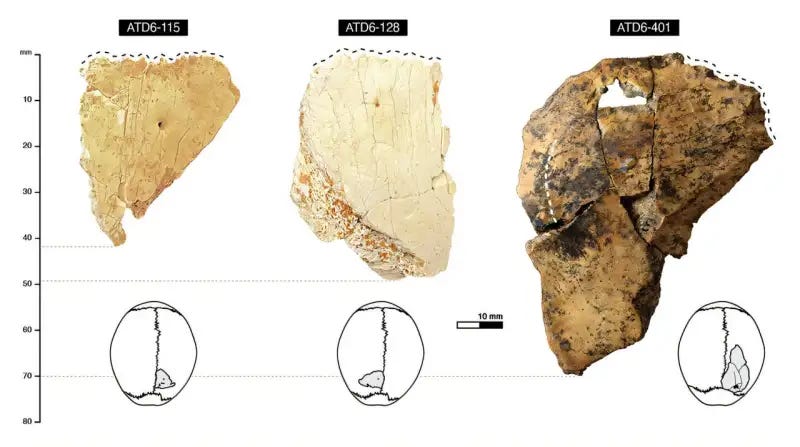
That gap mattered. The only prior quantitative look at H. antecessor parietal anatomy came from a 2017 study of a juvenile specimen. Juvenile skulls are still growing, still thin in places that will thicken with age, so they’re a shaky basis for comparing a species against adult Neanderthals or adult Homo erectus. Adult data was the missing piece, and now there’s some.


