
A bone tells you something. A bone with cut marks tells you quite a bit more.
At FwJj 80, a site within the Koobi Fora Formation in northern Kenya, researchers recovered and analyzed1 more than a thousand fossilized bone specimens dating to roughly 1.6 million years ago. The assemblage sits within what geologists call the KBS Member — a stratigraphic interval that has produced significant early Homo fossils over the decades but has, until now, yielded very little in the way of faunal material suitable for detailed zooarchaeological analysis. Most of what we knew about early Homo foraging behavior at Koobi Fora came from the younger Okote Member, some 40,000 to 200,000 years later. FwJj 80 changes that.
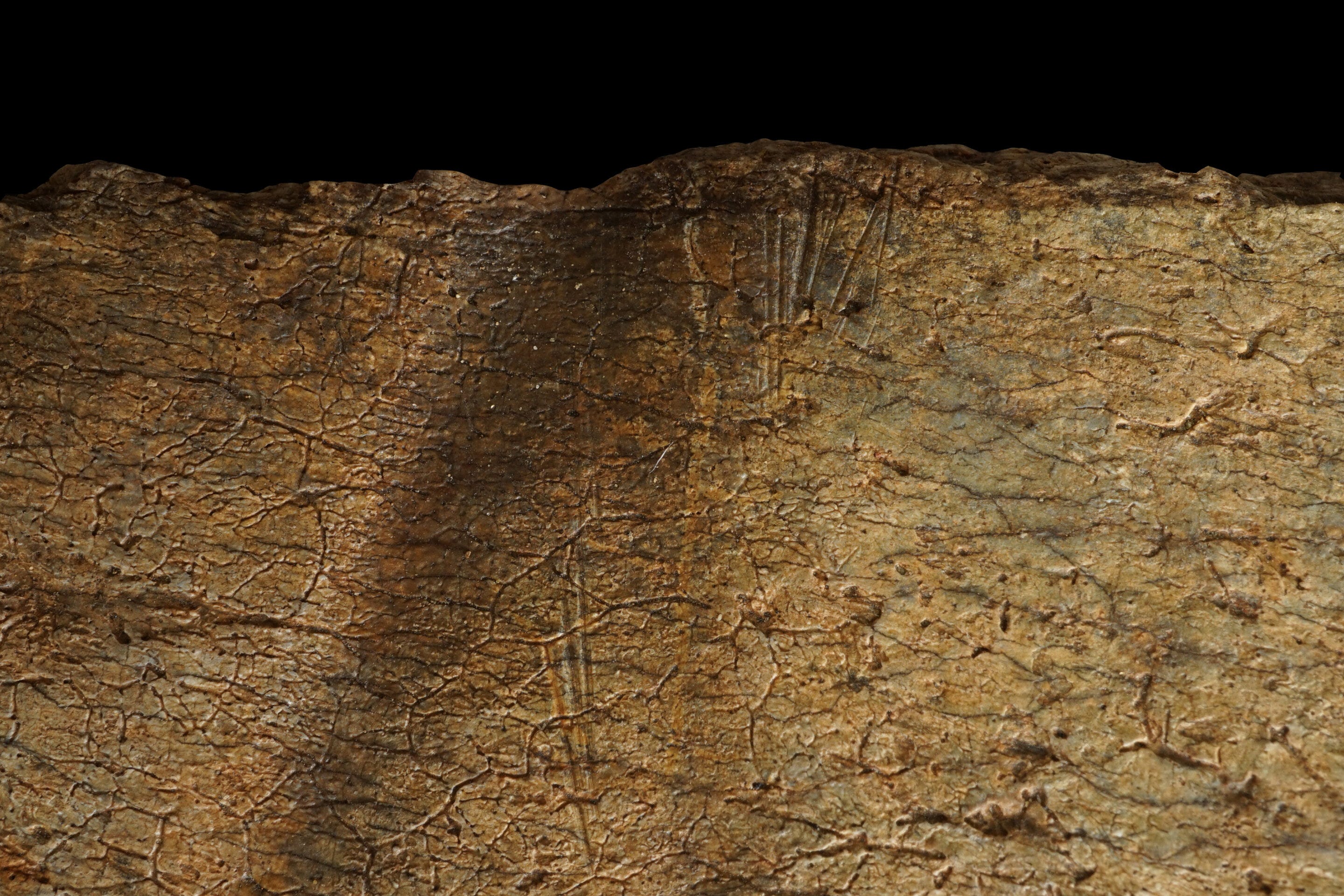
The bones are predominantly from antelopes and other grazers. Examined under high-powered magnification, many bear microscopic scratches and percussion marks consistent with stone tool use: cut marks from butchery, hammerstone damage from marrow extraction. The spatial patterning of those marks matters. Sharp cut marks positioned toward the midshaft of limb bones — where muscle attaches in greatest bulk — indicate that whoever was processing these carcasses got to them early, before carnivores had stripped the meat. The team’s analysis found minimal evidence of carnivore tooth marks in primary positions, which would suggest the reverse sequence: a predator kills, eats first, and hominins arrive at the leftovers.
That sequence, early hominin access followed by intensive processing, matches what has been documented in the Okote Member at Koobi Fora. It also matches the pattern at FLK Zinj in Tanzania, dated to around 1.84 million years ago, and at Kanjera South in Kenya, which pushes the record back to roughly 2.0 million years. Three sites, three different environments, spanning nearly half a million years. The consistency is what the researchers find significant.


