

Ninety percent of people favor their right hand. That figure holds across cultures, continents, and as far back as the fossil record allows us to see. No other primate species comes anywhere close. In most monkey and ape species, individuals may develop strong personal preferences, but at the population level, left- and right-handers balance out. Homo sapiens is the one exception: almost uniformly, relentlessly, inexplicably right-handed.
The inexplicably part has long been the problem. There is no shortage of proposed explanations. Language lateralization, tool use, social organization, diet, brain size, habitat. Pick your hypothesis; there are papers defending each of them. What has been missing is a framework rigorous enough to test them all at once, across enough species, while controlling for the fact that closely related species share traits simply because of shared ancestry. A study published in PLOS Biology1 by Thomas Püschel, Rachel Hurwitz, and Chris Venditti does exactly that.
Their dataset spans 2,025 individuals across 41 anthropoid species. Their method is a Bayesian phylogenetic comparative meta-analysis, which is the kind of approach that lets you ask, genuinely, whether a trait is unusual given where a species sits on the tree of life, and which variables actually explain it. When they applied this framework, H. sapiens stood out immediately as a statistical outlier. Not slightly unusual. Dramatically, conspicuously outside the range the model would predict. Then, when two variables were added to the model, brain size and the ratio of arm length to leg length, humans stopped looking anomalous. Their handedness became statistically predictable.
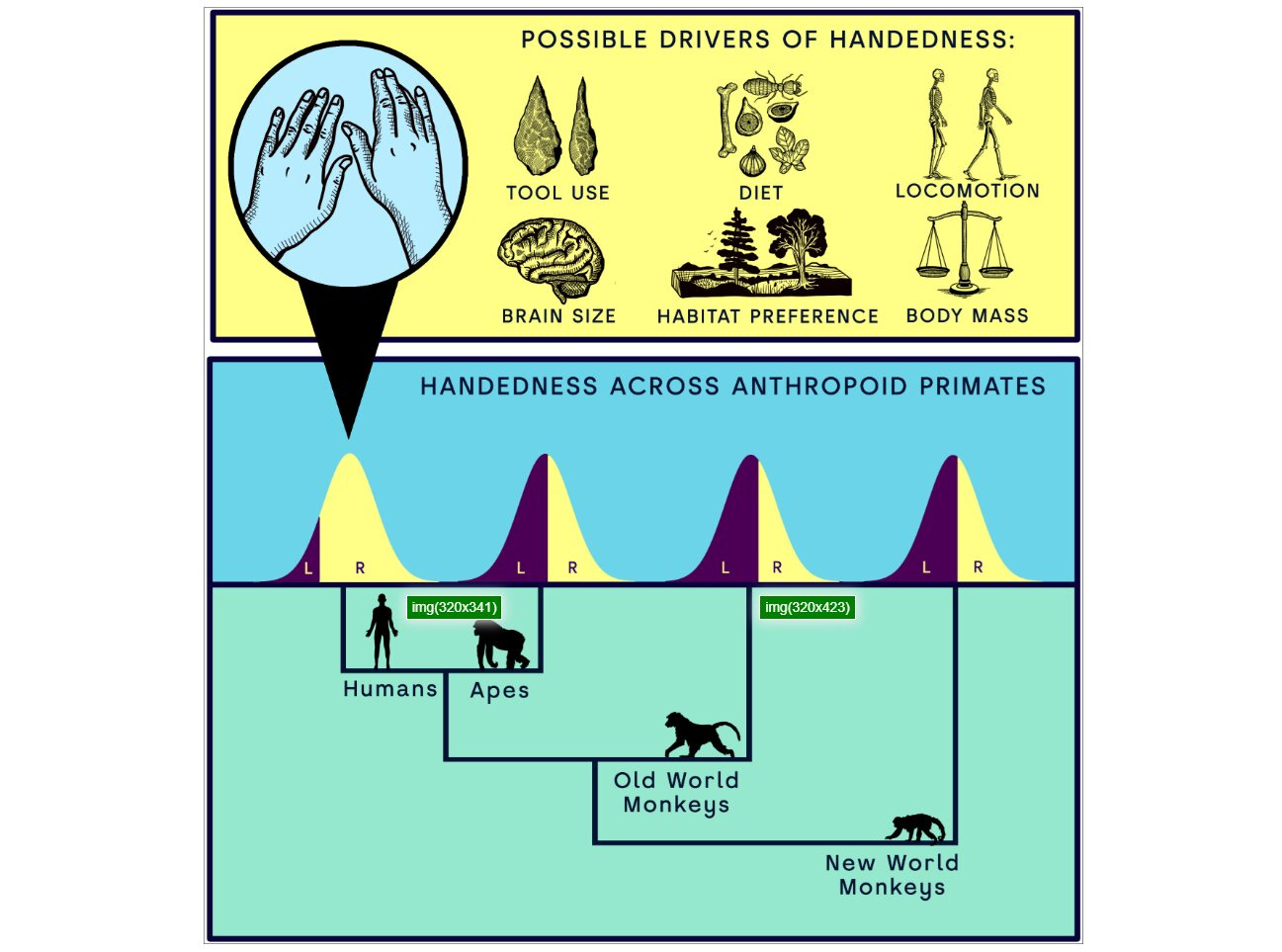
That arm-to-leg ratio, called the intermembral index, is a standard anatomical proxy for locomotion. Humans have an unusually low value because our legs are so much longer than our arms. That is a signature of bipedalism. Among other primates, a low ratio correlates with a leftward hand bias; among hominins, the freeing of the upper limbs from locomotor function appears to have done something very different. The hands, no longer needed for weight-bearing and quadrupedal movement, became available for an entirely new range of fine, asymmetric behaviors. The selective pressure to favor one hand, and favor it consistently, intensified.


