

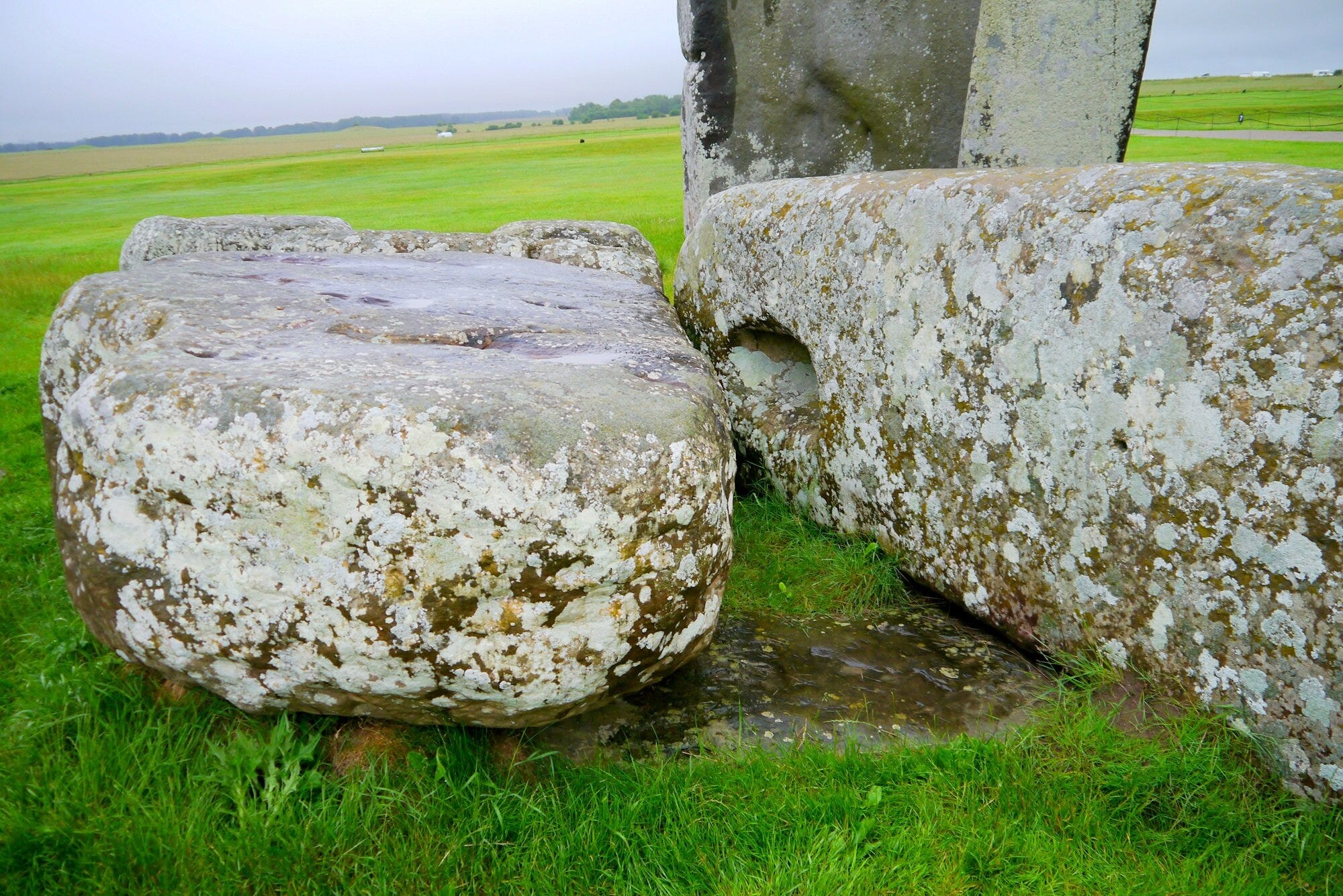
On Salisbury Plain, under two fallen sarsens, lies the Stonehenge Altar Stone, a sandstone block 4.9 m long and estimated at six tonnes. One of the sharpest new arguments about its origin rests on a mineral that makes up about 0.02 percent of the area of thin sections cut from three of its fragments (a thin section is a slice of rock ground fine enough to study under a microscope). That mineral, chrome spinel, is very scarce in the Old Red Sandstone of northeast Scotland, the region a 2024 paper in Nature named as the stone’s source. The Old Red Sandstone is a Late Silurian to Devonian sequence of largely non-marine sediments.
Readers who have followed this story probably hold a simple version of it. H.H. Thomas assigned the stone to West Wales in 1923, that view stood for over 90 years, and then mineral dating moved it to northeast Scotland. The new paper keeps the correction about Wales and puts the Scottish answer in doubt, without offering a replacement.
The study, by Duncan Pirrie, an emeritus professor at the University of South Wales, and 12 coauthors, appears in the Journal of the Geological Society,1 and its conclusion is negative. No examined outcrop of the UK’s Old Red Sandstone shares the Altar Stone’s full set of features, and many outcrops in the Orcadian Basin (the Old Red Sandstone basin that takes in Caithness, Orkney and the Moray Firth) could not have supplied it. “So far, none of the locations examined have the same set of characteristics as the Altar Stone,” Pirrie said in a statement released with the study.
The authorship gives me more confidence in the critique. Richard Bevins, an honorary professor in the Department of Geography and Earth Sciences at Aberystwyth University, signed the 2024 Nature paper by Clarke and colleagues, as did coauthors Rob Ixer and Nick Pearce, so part of this team is testing a conclusion it helped publish.


