

A one-year-old buried at Karashoky had a two-meter-tall kurgan, a hole drilled in the skull after death, and XXY chromosomes nobody could have known about at the time. The child was interred inside a mound 32 meters across, under gold objects placed for a life that had barely started. That burial only makes sense once you know who the child’s grandfather was.
His name, if he had one anyone recorded, is lost. What survives is a designation: AKB001. He was over 55 when he died, buried at Akbeit under three meters of earth and 25 meters of diameter, his skull also trepanned after death, gold objects at his side. A new ancient DNA study in Science Advances1 has traced his descendants across three cemeteries and at least three generations, and in doing so has answered a question that Scythian archaeology has been circling for decades: was elite status among the Iron Age nomads of the Eurasian steppe earned, or was it inherited.
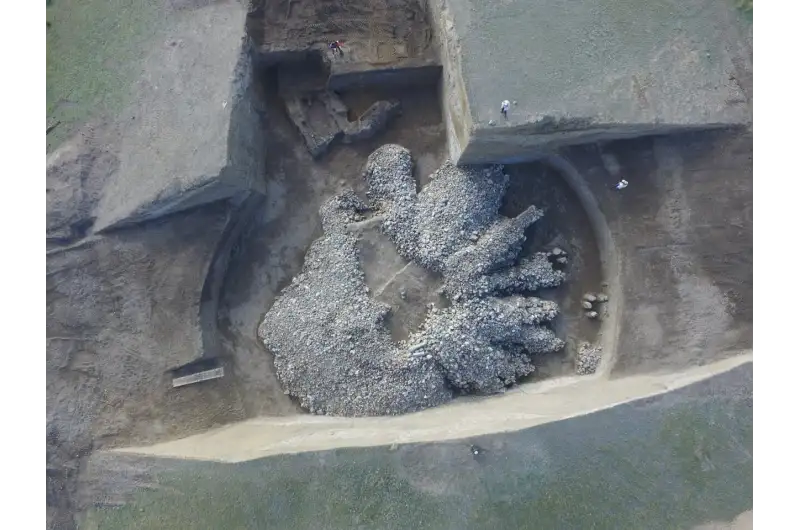
The steppe between the Altai Mountains and the Black Sea filled up with these mounds through the first millennium BCE. Herodotus called the people who built them Scythians. Persian and Indian sources called the eastern branches Saka. They shared no writing system, but they shared a visual language, recumbent stags, felines, mountain goats rendered in gold and bronze, and they shared a habit of burying some of their dead with a violence of wealth that has no real precedent in the Bronze Age that came before. Some kurgans rise less than a meter and hold nothing but a body and maybe a knife. Others rise twelve meters, contain wooden burial chambers, horse sacrifices, thousands of gold ornaments, and evidence that someone drilled into the skull after death, likely to slow decomposition long enough for a body to travel to its final resting place. The gap between those two kinds of graves has always been read as proof of steep social inequality. What it couldn’t tell you was how you got into the rich half.
The team, led by Ayshin Ghalichi and colleagues at the Max Planck Institute for Evolutionary Anthropology and Kazakhstan’s Institute of Genetics and Physiology, sequenced genome-wide data from 85 Iron Age individuals, 38 classified as elite by a strict archaeological standard (kurgan size, gold, horse burials, dromos passageways, trepanation) and 47 as non-elite. Forty-five of those genomes were newly generated. One of them belonged to a name most people who follow Kazakh archaeology already know.


