

The Zuojiang River cuts through karst country in southwestern Guangxi, and for over 260 kilometers its limestone cliffs carry faded red figures: dancers with bent knees and raised arms, bronze drums, ring-handled daggers, animals rendered as simple silhouettes. More than eighty sites make up what’s known as the Huashan rock art, painted sometime between the Spring and Autumn Period and the Han dynasty, roughly 770 BCE to 220 CE. Radiocarbon dating of stalactite growth above and below the paintings puts the art itself at 2,370 to 2,115 years old, and the site has been on UNESCO’s World Heritage List since 2016.
What’s strange about Huashan isn’t the imagery. It’s that any of it is still there.
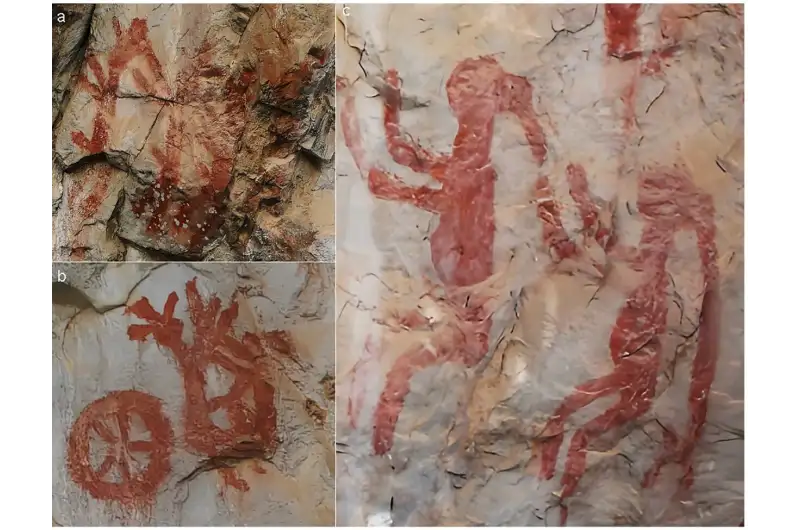
Guangxi is subtropical monsoon country. Chongzuo City, which contains most of the rock art belt, gets over 1,200 millimeters of rain a year, summer temperatures past 40°C, and two or three typhoons annually. The paintings sit on open cliff faces, dozens of meters above the ground or the river, with no overhang, no shelter, nothing but exposed rock. Paint on stone in that kind of climate should have washed away or flaked off centuries ago. Instead, much of it is still firmly attached to the cliff face, and a team of researchers led by Meng Wu and Pengcheng Hu wanted to know why.
Their answer, published in the Journal of Archaeological Science,1 involves a substance nobody had previously identified as a component of the paint: blood.


