

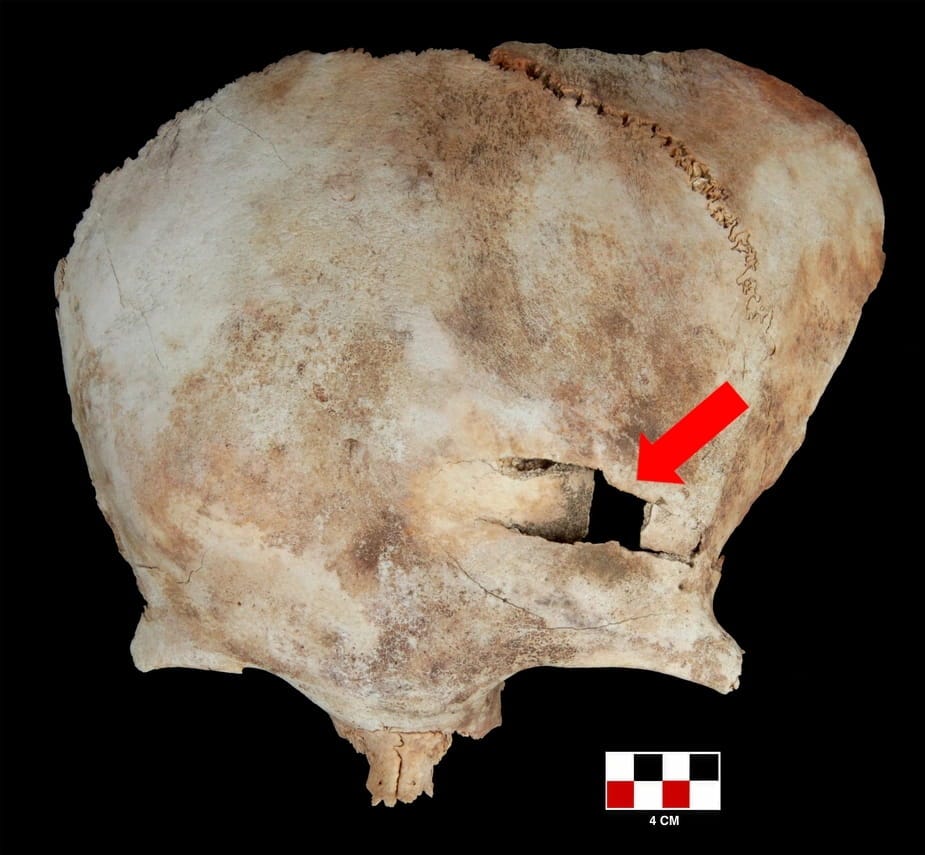
Chornancap Burial 48 comes from the lower Lambayeque Valley on Peru’s north coast and dates to the Chimú period, around 1375 to 1490 CE. The left side of the forehead carries a fracture from a blunt blow, and its edges show no healing, which bioarchaeologists (specialists in human remains from archaeological sites) call perimortem: the injury happened at or near the time of death. A new study of violence in ancient Peru uses this skull to illustrate what its authors counted as interpersonal violence. Among 1,519 skeletons from the valley preserved well enough to examine, spanning more than 3,000 years, they found 25 with skull injuries of that kind.
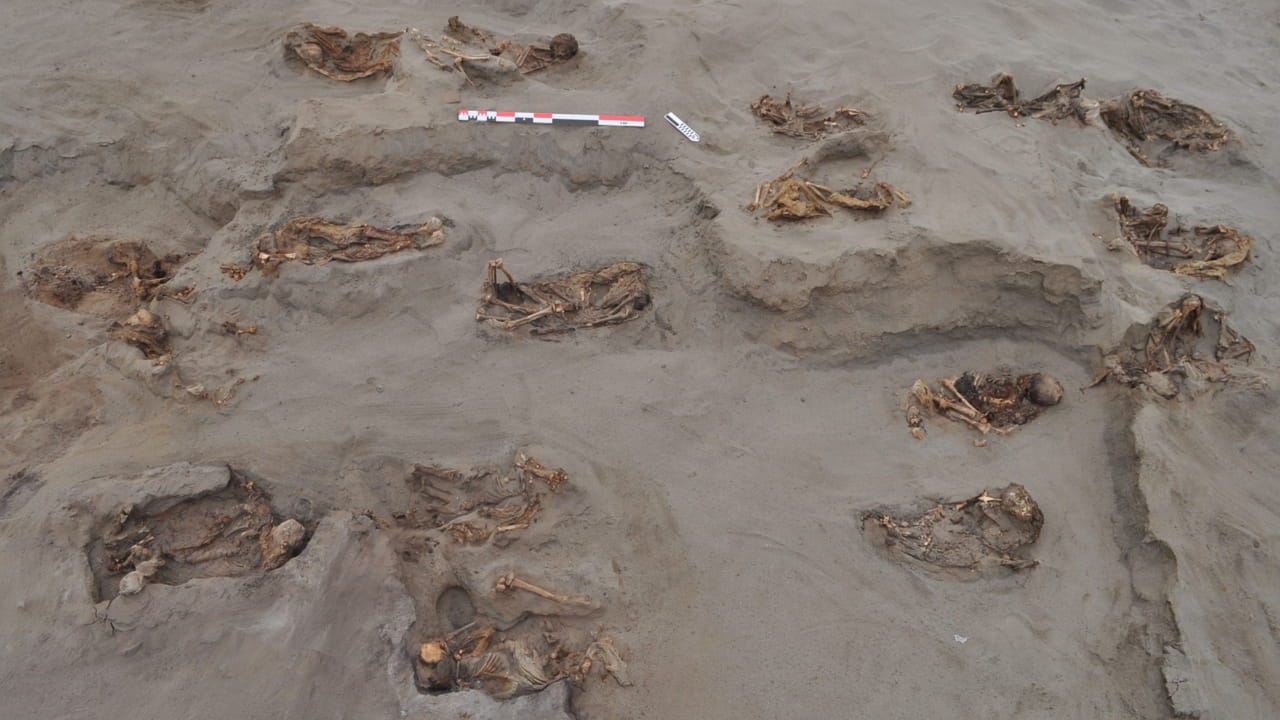
That is a low count for a coast best known in the press for ritual killing. At Huaca de la Luna, a Moche ceremonial center, up to 107 adult men were sacrificed in six closely timed events around 550 to 600 CE, amid evidence of mud and heavy rain from an exceptionally strong El Niño, the periodic warming of Pacific waters that drenches this desert coast. At Huanchaquito-Las Llamas in the Moche Valley, more than 140 children and over 200 young camelids (llamas and their relatives) were sacrificed around 1450 CE, associated with a mud layer that may record El Niño flooding. Neither site is in the new dataset. Finds like these invite a reasonable inference: when the floods came, these societies turned violent, and mass sacrifice was the visible peak of a wider rise in killing over scarce food.
Dr. Thomas J. Snyder of New York University and Dr. Haagen D. Klaus of George Mason University test that inference in a paper published November 9, 2026, in Frontiers in Environmental Archaeology,1 using skeletal records from the Lambayeque Valley Biohistory Project, which Klaus founded in 2002. The Lambayeque Valley Complex (the Lambayeque Valley, for short) consists of five river drainages more than 700 kilometers north of Lima, joined into one water network by the late first millennium CE. The team compiled records for 1,659 people buried at 30 sites, from the Cupisnique period to the Spanish colonial era. Twenty-six were dropped because they couldn’t be placed securely in time, and 1,519 had bones preserved well enough to score. Of those, 25 (1.6 percent) had skull injuries consistent with interpersonal violence, and 77 (5.1 percent) had fractures below the skull of the kind usually attributed to accidents.
Neither kind of injury showed a detectable relationship with the two climate measures tested, highland rainfall and El Niño frequency. The authors also propose, without testing it, that the coast’s mass sacrifices were political and religious acts rather than a product of food shortage. For scale, they note that average rates of skull injury in some regions and periods elsewhere in the Andes reach 30 to 45 percent (Snyder and Arkush 2024).
How do archaeologists measure violence from skeletons?
The method rests on a convention in bioarchaeology: skull injuries count as probable violence, and fractures below the skull as probable accidents. Snyder and Klaus say plainly that this proxy, or stand-in, errs both ways, since a beating that bruises without breaking bone leaves nothing behind and some skull fractures come from falls. Their defense is specific to their question: an undercount doesn’t distort the comparison unless it changes with climate, as it would if fights in drought years tended to stop short of breaking bone.
Climate is harder to measure, because the north coast is a desert that gets a few millimeters of rain a year; the water in its rivers and canals falls in the highlands above about 1,500 meters. So the authors measured drought at the source, using CHELSA-TraCE21k, a global climate simulation that estimates past rainfall in 100-year steps, sampled at random points across the valley’s highland headwaters. Simulations can’t reconstruct how often El Niño struck, so the authors used a per-century frequency record from sediment cores at Laguna Pallcacocha, a lake the paper describes only as near the valley.
The hypothesis is what the authors call a Malthusian pathway, where scarcity breeds violent competition: drought or frequent floods should shrink harvests and push people toward fighting over food, and toward longer hours of risky work that breaks more bones by accident. Each person was assigned to one of 12 cultural periods, and each period got one average for rainfall and one for El Niño frequency. A Bayesian model then estimated how the odds of each kind of injury shifted with those values, alongside age, sex, colonial rule, and burial site, reporting each effect as a credible interval, a range of plausible values. For both kinds of injury, the 89 percent intervals for both climate measures straddle zero: the data can’t tell whether either one raised the odds or lowered them.
I find the skull count convincing and the climate test much weaker, and the weakness comes from that design. Everyone who died in the Late Sicán period, from 1100 to 1375 CE, carries the same rainfall value, so although the model holds 1,633 people, the climate effect rests on at most a dozen period averages. The paper’s own history section describes an event this can’t resolve: a powerful El Niño between 1050 and 1100 CE, followed by a 30-year drought. Folded into averages for the Middle Sicán period (900 to 1050/1100 CE) and the Late Sicán period, each 150 years or longer, that drought shrinks to a modest shift in one or two numbers, set against only 25 injured people. Snyder and Klaus concede that rarity limits their power, which is why the abstract reports no strong evidence for an association rather than evidence against one.
What counts as everyday violence in ancient Peru?
The choice that shapes the headline number most is one the methods section barely describes: which deaths count. The authors study what they call quotidian, or everyday, violence, so like the regional surveys they build on, they remove sacrifice and massacre victims. It matters here: the paper cites evidence that perhaps more than 1,200 people were buried as offerings atop six monumental huacas, or sacred mounds, at the Sicán capital within as little as 50 years at the start of the Middle Sicán period (Klaus and Shimada 2016). Later Muchik communities, the Indigenous people of this coast, carried out smaller sacrifices at the Chotuna-Chornancap complex and at Túcume, both on the study’s site list.
I don’t object to the split itself. Elite-staged mass sacrifice and a fight between neighbors are different social acts, and pooling them would make Lambayeque incomparable with other regions. My objection is that the paper never says how many individuals were removed on these grounds, or how a burial was judged ritual. Burial 48 is a person struck on the head around the time of death at a site with documented sacrifices, and the authors present it as interpersonal violence; I’d want to know what settled that call. And with massacre victims removed too, the measure captures violence between individuals, which may not be where competition over food shows up.
Colonial burials are where I think the measure’s limits show most clearly. After the Spanish conquest, Muchik people were forced into colonial towns and exploited for their labor, and the region lost about 40 percent of its population before a slow Indigenous recovery began around 1600 CE. Yet the authors describe skull injuries in their two large colonial samples, from Mórrope and Eten, as nearly absent. They suggest colonists depended on Indigenous labor, and that much colonial violence, such as whipping, would not reach the bone. Klaus has argued elsewhere (Klaus 2012) that colonial Muchik skeletons record structural violence, harm imposed through the economic and political order, in signs of anemia, stunted growth, chronic infection, and tooth loss.
Did El Niño drive violence in ancient Peru?
The authors rank chronological imprecision as their main limitation. Burials were assigned to periods by relative dating, checked against radiometric dates (ages from radioactive decay) collected since the 1960s, rather than by radiocarbon dating each skeleton, so the analysis sees associations across centuries but not responses to any single flood. “In an ideal world I would like to radiocarbon date the entire sample,” Snyder said in a statement released by Frontiers, the journal’s publisher. The paper also lacks a direct measure of harvests, so the failed crop that should link drought to fighting is an assumption.
The 1.6 percent rate also pools every age and period: 577 of the 1,659 people died before age 15, and the large colonial samples contribute almost no skull injuries, so the rate among pre-Hispanic adults is presumably higher. With no rates reported by period or for adults alone, a reader can’t see whether the 25 cases cluster in particular centuries, or whether the 30 to 45 percent figures from elsewhere were calculated the same way. I also read the demographic table twice, because its age-by-sex counts add up to 1,493 people while its printed totals reach 1,633.
Frontiers’ press release goes further than the paper in several places. Its headline has these societies sacrificing people after catastrophic El Niño flooding; the paper treats the flood link at other sites as possible but unproven, and argues that the Lambayeque sacrifices it reviews were not immediate responses to environmental events. The release reports no link between violence and ecological instability, where the paper found no strong evidence of one, and it credits the 1,633 people with relatively clear dates of death when each was assigned to a cultural period. In the same statement, Klaus said, “Violence and social unraveling are not destined outcomes, ever.” One valley can’t carry a claim that broad, especially since Snyder’s earlier work (Snyder and Haas 2023) found drought associated with more violence in the highest-elevation regions of the south-central Andes.
I’d call the paper partly convincing. The rarity of everyday skull injuries in Lambayeque holds up, because it rests on a large sample and agrees with recent studies finding little everyday violence elsewhere on Peru’s northern and central coast (Rivera Prince 2026; Vega and Mauricio 2024). For this valley, the assumption that sacrifice sat atop widespread everyday killing doesn’t survive the data. The climate result is much weaker: century-scale averages of highland rain and El Niño frequency show no detectable relationship with everyday violence, which says little about whether a single bad decade left a mark.
Two additions would answer most of what remains open: a count of the burials excluded as sacrifices or massacres, with the criteria used, and the test Snyder says he wants. Radiocarbon-date the Middle and Late Sicán burials in the sample, which straddle the El Niño of 1050 to 1100 CE and the 30-year drought that followed, and see whether the skull injuries among them fall in those decades. The Malthusian hypothesis predicts a cluster there. If they turn out to be spread thinly across both periods, the case for Lambayeque as a place where hard times didn’t turn into everyday violence gets much stronger.
Further Reading
Klaus, H. D. (2012). Bioarchaeology of structural violence: theoretical model and case study. In D. Martin, R. P. Harrod, and V. R. Perez (eds.), The Bioarchaeology of Violence, 2nd ed., pp. 29–62. Gainesville: University of Florida Press.
Klaus, H. D., and Shimada, I. (2016). Bodies and blood: Middle Sicán human sacrifice in the Lambayeque Valley Complex (A.D. 900-1100). In H. D. Klaus and J. M. Toyne (eds.), Ritual Violence in the Ancient Andes: Reconstructing Sacrifice on the North Coast of Peru, pp. 120–149. Austin: University of Texas Press.
Rivera Prince, J. A. (2026). Laying siege to violent narratives: disrupting ontostories reveals variability in conflict in the Salinar (ca. 400–200/150 BCE) of the Peruvian Andes. Journal of Anthropological Archaeology 81, 101747. https://doi.org/10.1016/j.jaa.2025.101747
Snyder, T. J., and Arkush, E. (2024). Political organization and gender predict violence in the Andean archaeological record. Proceedings of the National Academy of Sciences 121(44), e2410078121. https://doi.org/10.1073/pnas.2410078121
Snyder, T. J., and Haas, R. (2023). Climate change intensified violence in the south-central Andean highlands from 1.5 to 0.5 ka. Quaternary Research 115, 109–119. https://doi.org/10.1017/qua.2023.23
Vega, M., and Mauricio, A. C. (2024). Resilience and climate instability at the beginning of the Middle Horizon (550–800 A.D.). Bioarchaeology International 7(3–4), 270–292. https://doi.org/10.5744/bi.2023.0011
Snyder, T. J., and Klaus, H. D. (2026). Pax Lambayeque? Trauma, interpersonal violence, and environment over 3,000 years in the Lambayeque Valley Complex, Peru. Frontiers in Environmental Archaeology 5:1889466. https://doi.org/10.3389/fearc.2026.1889466


