

At Riparo Mochi, a rock shelter in the Balzi Rossi cliffs on Italy’s border with France, excavators collected charcoal from a Gravettian hearth for radiocarbon dating, and the samples were stolen before they could be analyzed. The hearth’s date now rests on a single marine snail shell of the genus Bittium, taken from the layer of ash and rain-washed silt that encloses it.
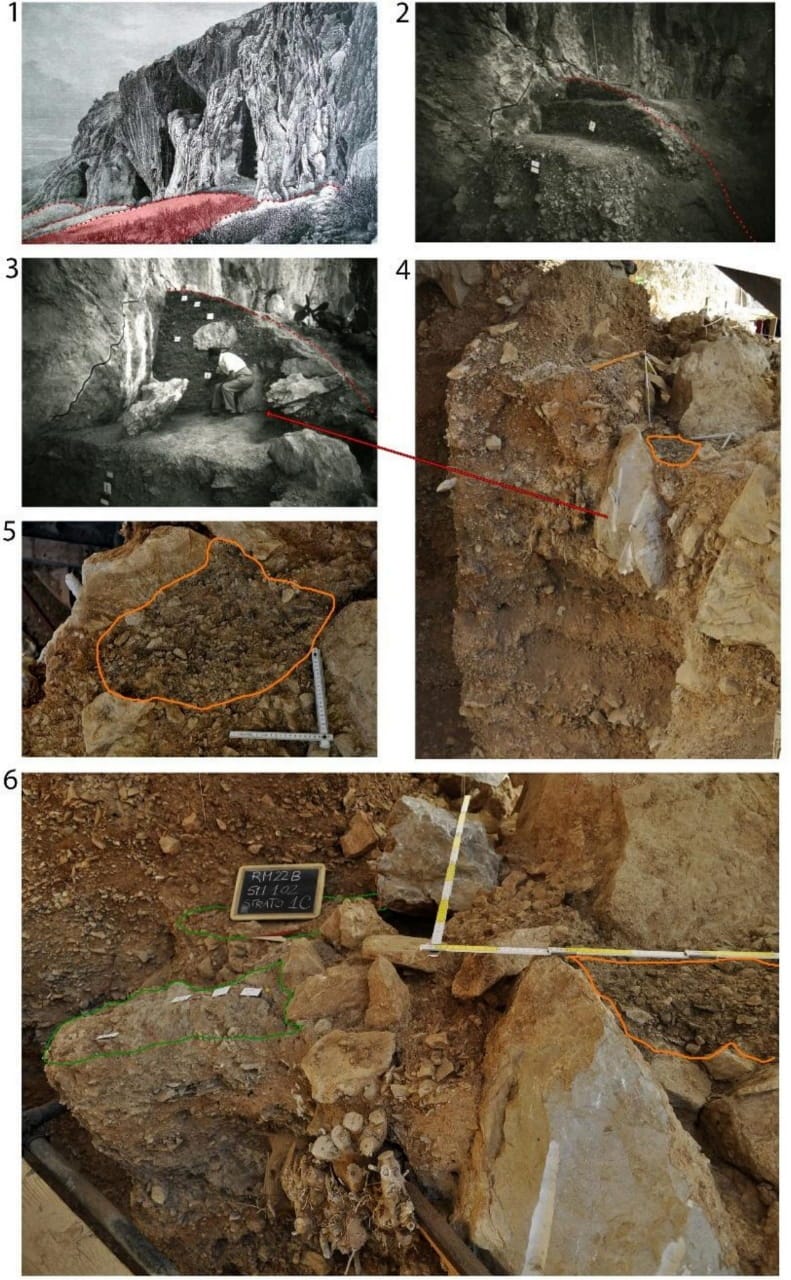
That shell matters because Riparo Mochi has sat awkwardly in the timeline of the Noaillian, a Middle Gravettian toolmaking tradition named for its signature tool, the Noailles burin (a burin is a flake or blade with a narrow sliver, the spall, struck from one edge). The tradition’s oldest dates are in northern Spain and the Pyrenees and its youngest in Italy, yet within Italy the order ran the wrong way. Grotta della Cala in Campania, far to the south, had dates of about 31,000 to 30,000 cal BP (calibrated years before present), while Riparo Mochi, on the coastal route from France where the tradition should have arrived first, began only about 28,000 cal BP.
A new paper in the Journal of Archaeological Science: Reports1 by Fabio Santaniello, Stefano Grimaldi and three colleagues at the University of Trento and elsewhere closes most of that gap. The shell gave a radiocarbon age of 27,003 ± 205 years, which calibrates to 30,802 to 29,901 cal BP at 95.4 percent probability, roughly 2,000 years before the site’s previous earliest date (Douka and colleagues, 2012) and close to Grotta della Cala. The authors call it the earliest date directly attributed to the Noaillian in northern Tyrrhenian Italy, the northern stretch of Italy’s west coast.
They then set it beside a Bayesian model, a statistical method that uses dates and their errors to estimate when the Noaillian began in four regions. Built from 55 screened dates, the model puts the median starts at about 34,000 cal BP in the Vasco-Cantabrian region of northern Spain, 32,300 on the north side of the Pyrenees, 31,000 in Aquitaine and 30,900 in Italy. From that pace, and from how uniform the tradition looks, the authors argue that the Noaillian more plausibly spread with moving people than as a technique passed between neighbors.


