

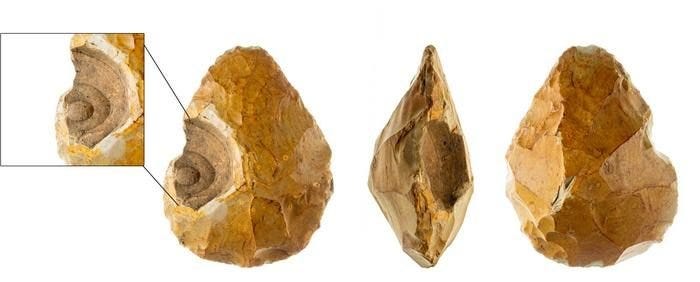
In the Sakhnin Valley in Israel’s Lower Galilee, a survey recorded more than 200 handaxes from the Lower Paleolithic, the earliest part of the Old Stone Age. About ten of them were shaped from flint nodules with a fossil imprint or an odd geological feature inside, and in each the maker left the feature in the middle of the tool’s face, where it could be seen and touched. Such nodules are harder to work, and the valley’s other handaxe makers avoided them.
These handaxes are part of a new case for Stone Age souvenirs, one that runs against a view most readers probably hold. Keeping an object for the memory it carries is usually treated as a late habit of modern humans, from the end of the Old Stone Age onward, and archaeologists have mostly read such objects socially, as carriers of shared meaning or markers of rank.
The paper, a review in Evolutionary Anthropology: Issues, News, and Reviews,1 is by Ran Barkai, a professor of archaeology at Tel Aviv University; Yoav Ram of the university’s School of Zoology; and four colleagues. Its data statement says no new datasets were generated or analyzed. Its core examples come from the team’s earlier work in Israel, which they read as consistent with people keeping objects beyond practical need from about 500 kya (thousand years ago). They propose that these were personal keepsakes, or souvenirs, working as “portable external memory devices.” Once keeping them became routine, the habit may have changed the selection pressures on autobiographical memory, which they define as memory of one’s own experiences plus the family stories folded into one’s identity.
What is the evidence for Stone Age souvenirs?
The archaeological case rests on three groups of objects, all described in earlier papers by members of this team. At Qesem Cave, people deliberately carried in small, round pebbles of colorful flint from about 400 kya onward, through the roughly 200,000 years they used the cave. Ella Assaf, one of the authors, reported in 20182 that the pebbles show no sign of use; the review gives no count. The Sakhnin handaxes, published3 this year by Barkai and Shalata, carry fossils and formations that match outcrops in the valley, tying each tool to a particular spot. The authors grant these were probably working tools and ask why someone kept a feature that did nothing for the tool and made it harder to produce.
In my reading the third group is the strongest, because the comparison that matters is built into the sites. At Revadim and Jaljulia, two Late Acheulean sites (the Acheulean is the Lower Paleolithic handaxe tradition), and at Qesem, which comes after it, people picked up flint tools made and thrown away long before. The giveaway is patina, a weathered skin that forms on discarded flint and takes its color from the conditions where it lay. On a Qesem scraper shown in the review, the old surfaces are whitish and the resharpened edges are brown, fresh flint. Reworking on such pieces was minimal, and magnified wear traces show their second use was generally light. Because fresh tools dominate the assemblage (the full set of recovered artifacts), Bar Efrati of the University of Oxford, a co-author, argues that the old faces were kept by choice rather than for lack of good stone.
The memory half of the argument rests on what the team calls authentication. Psychologists use the term source monitoring for telling whether a memory came from something that happened or from one’s own thoughts. A keepsake adds sensory detail to that judgment; it can’t prove a memory true, the authors stress, only narrow down where it came from. Where alliances and claims to places depend on credible personal memory, people who are better at checking memories against objects should do better. That skill varies between people and is partly heritable, the paper notes, so selection would have had something to act on. Routine curation beyond practical need is what the authors call a “souvenir niche,” after niche construction theory, in which organisms alter their surroundings in ways that feed back on their own evolution.
People had lived in the Levant (the eastern Mediterranean) for at least 1.5 million years before this behavior appears, so the review looks for a trigger and finds it in big game. Prey size there fell through the Pleistocene, the epoch of the ice ages, and the elephant disappeared around 400 kya, along with Homo erectus and the Acheulean. As hunting smaller, more evasive prey pushed people into new territory, the authors propose, portable pieces of places became worth keeping. Barkai said in the press release that objects taken from the new hunting grounds “may have helped them maintain a personal connection with the places that would henceforth provide their livelihood.” The review predicts that the practice should track the decline of large herbivores rather than come before it.
Can archaeology tell a keepsake from a tool?
The patina deserves a slower look, because the time it records works against part of the argument. The whitish skin on that Qesem scraper formed while the flake lay abandoned, and the authors acknowledge that the patinas imply the pieces were found again rather than handed down. So the long interval written on these objects is time when nobody had them. The abstract speaks of the “prolonged retention” of patinated tools, but nothing the review presents measures how long the second owner kept one. Light wear on a resharpened edge fits an object handled now and then for years, and it fits a tool used briefly and dropped; the team itself calls wear its weakest criterion.
That gap matters because of the review’s own test for a souvenir: an individual keeps one object safe over a long period, neither discarding it nor trading it for food, and comes back to it from time to time. The authors use this standard to set aside animal cases, including captive chimpanzees that kept a large crystal in their sleeping quarters for two days before trading it back for food. They concede that such behavior could go unseen, because detecting it means following a known individual and a known object for months. No Paleolithic deposit offers that. A site preserves where objects ended up, and how long anyone kept them, or why, has to be inferred.
I also think Barkai and Ram chose the hardest level of meaning to detect. They focus on personal rather than social meaning because it assumes the least, needing no shared convention and no audience. That is sound as theory, and it is also why a personal keepsake is nearly invisible to archaeology, since by the paper’s own account its meaning need not be legible to anyone but its keeper. The definition of the souvenir niche sidesteps the problem. It covers routine curation “regardless of motive,” while the memory argument depends entirely on the motive.
How strong is the case that keepsakes shaped memory?
I find the evolutionary step the weakest link, because its evidence comes from studies of living people and laboratory animals, such as experiments in which learning to make and use tools changed brain networks in macaques and humans. Such studies can make a mechanism plausible, but they can’t show selection at work in the Middle Pleistocene, when these stones were collected.
The 500 kya figure is a round number for a period, not the age of any object in the review. It gives no dating method for any of the Israeli material and no stratigraphic context (the layer and setting that would date them) for the surveyed Sakhnin handaxes. Its only number for that evidence is the 400 kya start of the Qesem pebbles, and the authors allow that routine souvenir-keeping may have arrived “later than the earliest examples in the archaeological record.”
Their test of failure is also forgiving. The hypothesis fails only when curated items are optimized for use, local and uniform in origin, all three at once, so the Sakhnin handaxes, local by the paper’s own description, don’t count against it.
The press release calls the idea a hypothesis but still goes further than the paper. It describes the work as “a new study” and says researchers “discovered” the Sakhnin handaxes, though the paper is a review with no new data. Its phrase “no apparent practical purpose” doesn’t fit two of the three groups, which are tools. Where the paper calls mnemonic roles “archaeologically plausible,” the release says “the archaeological record shows that objects associated with memories have accompanied humans from half a million years ago.” It also connects that figure to the loss of elephants without mentioning that the paper dates the loss to around 400 kya. And where the paper says keepsake use “might have fed back on selection,” the release states that material culture and neurobiology “influenced one another and contributed to the evolution of autobiographical memory.”
Did early humans keep souvenirs?
My verdict is that the paper is partly convincing. I accept that people at Qesem, Revadim, Jaljulia and Sakhnin kept stones for reasons beyond use, because the pattern repeats and the choices had costs: nodules that were harder to work, and old surfaces left in place when fresh flint was at hand. I’m less sure these were personal reminders, since nothing in the record separates a private memory from a taste for odd stones or from a meaning a whole group shared. As for the claim that keeping them changed how human memory evolved, I can’t find Pleistocene evidence for it anywhere in the paper.
Two of the authors’ own tests could firm up the archaeology using existing collections. If the reworked patinated pieces cluster around hearths and in layers people kept returning to, rather than on knapping floors (where stone was worked) or with stockpiles of raw flint, the idea that they were simply raw material weakens. Provenance work, tracing where the stone came from, could show whether the pieces come from more sources than local collecting could supply, as the pieces-of-places idea predicts. Neither result would separate memory from aesthetics.
The sharpest test is the authors’ own timing prediction. If keepsakes were a response to losing big game, they should follow that loss, and in the Levant the loss the review emphasizes is the elephant’s, around 400 kya. The Qesem pebbles fit. The Acheulean pieces at Sakhnin, Revadim and Jaljulia are harder to place, because the review puts the end of the Acheulean at about the same time and gives none of them a numerical date. The argument needs those dates, set against the Levant’s record of shrinking prey, to show whether keeping stones followed the loss of big game or began before it.
Further Reading
Efrati, B. 2021. “Memory Scrapers: Readymade Concepts and Techniques as Reflected in Collecting and Recycling Patinated Lower Palaeolithic Items at Qesem Cave, Israel.” Cambridge Archaeological Journal 31, no. 2: 337-347.
Efrati, B., and R. Barkai. 2024. “The Magnitude of a Practice: Collection and Recycling of Patinated ‘Old’ Flint Items During the Levantine Late Lower Paleolithic.” Quaternary 7, no. 4: 58.
Efrati, B., R. Barkai, S. N. Cesaro, F. Venditti, et al. 2022. “Function, Life Histories, and Biographies of Lower Paleolithic Patinated Flint Tools from Late Acheulian Revadim, Israel.” Scientific Reports 12: 2885. https://doi.org/10.1038/s41598-022-06823-2
García-Ruiz, J. M., T. De La Rosa, I. Delval, and G. Bustelo. 2026. “On the Origin of Our Fascination with Crystals.” Frontiers in Psychology 17: 1633599. https://doi.org/10.3389/fpsyg.2026.1633599
Hecht, E. E., D. A. Gutman, N. Khreisheh, et al. 2015. “Acquisition of Paleolithic Toolmaking Abilities Involves Structural Remodeling to Inferior Frontoparietal Regions.” Brain Structure and Function 220, no. 4: 2315-2331. https://doi.org/10.1007/s00429-014-0789-6
Quallo, M. M., C. J. Price, K. Ueno, et al. 2009. “Gray and White Matter Changes Associated with Tool-Use Learning in Macaque Monkeys.” Proceedings of the National Academy of Sciences 106, no. 43: 18379-18384.
Barkai, R., E. Assaf, B. Efrati, T. Simon, L. Mudrik, and Y. Ram. 2026. “Homo Memorabiliaxis: Souvenirs and the Evolution of Autobiographical Memory and Self.” Evolutionary Anthropology: Issues, News, and Reviews 35: e70051. https://doi.org/10.1002/evan.70051
Assaf, E. 2018. “Paleolithic Aesthetics: Collecting Colorful Flint Pebbles at Middle Pleistocene Qesem Cave, Israel.” Journal of Lithic Studies 5, no. 1.
Barkai, R., and M. Shalata. 2026. “Lower Palaeolithic Tools of Potency: Handaxes Shaped Around Fossils and Other Extraordinary Features at Sakhnin Valley, Israel.” Journal of the Institute of Archaeology of Tel Aviv University 53, no. 1: 3-33.


