
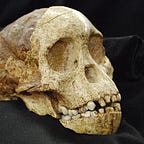
In a new plot of brain shape, the Taung child, a roughly 3-million-year-old skull found in 1924 at the Buxton Limeworks quarry in South Africa’s Northwest Province, sits almost on top of MLD 37/38, an adult from Makapansgat, 670 km to the northeast. The plot compares endocasts, casts of the inside of the braincase that record the brain’s outer shape, and Taung’s comes from a child whose first permanent molar had erupted while the second was still forming. In growth series of 101 chimpanzees (Pan troglodytes) and 84 gorillas (Gorilla gorilla), apes at that dental stage do not overlap their own adults in brain shape, yet Taung plots in the middle of the adult fossils from Sterkfontein. The authors call this peculiar, and I think it is the most important result in the paper, because it is where their case about species is both strongest and most exposed.
That matters because Taung is the holotype of Australopithecus africanus, the specimen that anchors the species name. Most readers picture a well-stocked species behind it, with Sts 5, the Sterkfontein skull nicknamed “Mrs. Ples,” as its typical adult. The paper argues that Taung is, strictly speaking, the only fossil that belongs to A. africanus without dispute, and that several adults long filed under the name, MLD 37/38 among them, probably belong to other species.
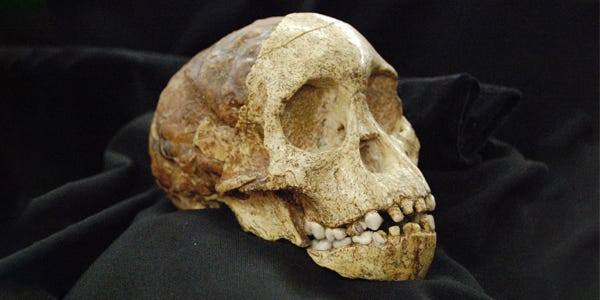
Gabriele Macho (Vrije Universiteit Brussel and University College London) and seven coauthors, including Simon Neubauer and Clement Zanolli, report the work in npj Palaeoecosystems.1 A flowstone lying above the fossil-bearing deposit gives a minimum age of 2.962 ± 0.059 million years (Ma) for the skull, and an earlier paleomagnetic estimate caps it at 3.03 Ma. Using tooth development, brain growth and molar shape, the team asks whether Taung could have grown into the adults assigned to its species, and concludes that the brain-growth results leave little doubt that the Sterkfontein fossils include more than one species. To explain that diversity, the authors propose that climate swings kept moving populations around, with interbreeding probably following where they met.
How old is the Taung child?
Southern African sites lack the volcanic ash layers that give eastern African fossils reliable dates, and Taung’s exact find spot was lost during mining. Published estimates have ranged from 942 thousand years (ka), by uranium-series dating, to 3.03 Ma, the start of the last normal-polarity interval of the Gauss magnetochron, a period identified from the magnetic direction recorded in rock.
The flowstone, a sheet of calcite laid down by flowing water, was dated by the decay of its uranium to lead. The route previously advocated for South African flowstones, uranium-238 to lead-206, needs a correction for uranium isotopes that were out of balance when the calcite formed, and beyond 1.5 Ma the uncertainty in that correction can exceed the correction itself. The uranium-235 to lead-207 route is largely immune, and it gave 2.962 ± 0.059 Ma with little scatter (an MSWD, the standard measure of that scatter, of 0.7).
I find the measurement convincing, because the method was chosen for a stated reason and the result is precise, but what it means for the fossil is less certain than the paper or the press release suggests. The two routes give ages for the same flowstone that do not overlap, a mismatch the authors tentatively blame on uranium moving after the rock formed, and they read both ages as minimums by assuming the rock only gained uranium; loss would make them too old, and the main text does not say why gain is likelier. No radiometric ceiling has been found despite further drilling, so the 3.03 Ma cap rests on paleomagnetic data from a 2013 chapter2 by A. I. R. Herries and colleagues.
Does the Taung child share a species with the adult fossils?
The adults in question are Sts 5, Sts 60, Sts 71 and StW 505 from Sterkfontein, in the Cradle of Humankind about 390 km northeast of Taung, plus MLD 37/38, all attributed to A. africanus. The weakest of the three comparisons is tooth development: scored for 11 Australopithecus and 16 Paranthropus fossils, it gives the A. africanus fossils a markedly different slope from every other taxon when first-molar development is set against first-incisor development, a possible sign that more than one species has been lumped together. One Makapansgat specimen, MLD 2, may be skewing that line, and the authors warn against over-interpreting such small samples, so I take the slopes as a hint.
Brain size narrows the field only a little. The adults’ endocranial volumes range from 391 to 568 ml, a spread the authors find compatible with one species by chimpanzee and gorilla standards. Apes at Taung’s stage have reached about 92 percent (chimpanzees) and 87 percent (gorillas) of average adult volume, whereas Taung, at 402 to 410 ml, would have reached only 71 percent if it were going to grow into the large-brained StW 505.
The argument gets its force from brain shape, measured with 935 landmarks and semilandmarks (matching anatomical points, plus points spread along curves and surfaces) on every endocast, fossil and ape, after the fragmentary fossils were rebuilt from CT scans. Projecting the direction and amount of change seen in growing apes forward from Taung, the team finds the child could have grown into a brain shaped like Sts 5 or Sts 60 but not like Sts 71, StW 505 or MLD 37/38, even allowing for differences in the timing and amount of growth. As I read the plot, MLD 37/38 drops out precisely because it sits where Taung sits: a child with a lot of shape change still ahead of it should end up somewhere else.
I find this the strongest evidence in the paper for more than one species, because it uses dense shape data and large ape growth samples rather than a few scored teeth. Its weak point is the assumption underneath, which the authors state openly: that these brains kept changing shape after the first molar erupted, in the direction and roughly the amount seen in living apes. Chimpanzee, gorilla and human growth models all predict large changes from Taung’s stage onward, so the assumption is reasonable, but the paper has no australopith growth series to test it, and the plot covers only two shape axes, which carry 49.5 percent of the variation.
The same kind of reasoning has already given a different answer. A 2006 simulation3 of Taung’s facial growth by K. P. McNulty, S. R. Frost and D. S. Strait found Taung closer to Sts 71 than to Sts 5, judging the gap from Sts 5 extreme by the standards of living African apes and humans. Two projections along growth paths borrowed from living species disagree about the same pair of adults, and until they are reconciled I treat the Sts 71 question as open.
The molars pull Taung somewhere else again: on the dentino-enamel junction, the buried boundary between enamel and dentine that forms early and barely changes with wear, Taung’s lower first molars sit at the edge of the A. africanus cluster and inside the range of Paranthropus robustus on the main axis, though the first two axes explain less than 38 percent of the shape variation.
What the Taung study can’t tell us
The authors are frank that no clear picture emerges, with no consistent clustering of specimens, which they put down to small samples and fossils scattered widely in time and space.
The climate and hybridization proposal is the part the data support least, since the paper never tests hominin hybridization directly. Marine cores off the Limpopo record more variable climate between 4 and 2.5 Ma than from 2.5 to 1.6 Ma, and the authors suggest that hominins tracked shifting habitats and could have interbred where populations met along the Zambezian and Natal/Kalahari biogeographic boundary, which today runs through the Limpopo valley at Makapansgat. They raise the obvious problem themselves, that the Cradle of Humankind lies about 400 km south of the Limpopo and Taung farther still, and answer that hybrids can range deep into a parent species’ territory and that the boundary may have lain farther south at the time.
The pollen evidence is thinner still, coming from an exploratory pilot study of two undated bulk-rock samples, 172 g and 230 g, taken from above or below the dated flowstone, with 30 grains counted in each; a sample from above the flowstone would postdate the fossil. Among the grains is Podocarpus, a tree whose forests today are largely confined to the wetter eastern Escarpment about 400 km east of semi-arid Taung. The paper does not say how many of the 60 grains were Podocarpus, and I would want that number before reconstructing a forest from it.
The press release pushes all of this harder than the paper. Professor Gabriele Macho of the Archaeology, Environmental Changes and Geo-Chemistry (AMGC) research group at Vrije Universiteit Brussel (VUB) said in the university’s statement, “For over 100 years, we assumed the Taung Child was just one of many similar fossils from the era,” and “Our findings turn that on its head.” The paper traces doubts about the grouping to the 1980s and says its analyses confirm that A. africanus is poorly defined. The release also presents hybridization as established, where the paper calls it probable, and describes a forested setting, where the paper reconstructs a savanna with relatively more trees and calls the extent of forest cover unclear.
Where this leaves Australopithecus africanus
My verdict is that the paper is partly convincing. The 2.962 Ma floor is a careful measurement that, if the flowstone gained rather than lost uranium, puts Taung in the Pliocene. The brain-growth analysis gives real weight to the old suspicion that more than one species sits under the name A. africanus, but it depends on five adult endocasts, some rebuilt from fragments, and on growth paths borrowed from living apes, and it disagrees with the facial simulation about Sts 71. The climate account, part of what the authors call a first step, remains untested.
What would settle the species question is a second young brain. An endocast from another child at Taung’s dental stage, from Sterkfontein or Makapansgat, would show whether children of these hominins plot among the adults, as Taung does, or apart from them, as young apes do; the first result would undercut the projection that excludes Sts 71, StW 505 and MLD 37/38, and the second would support it.
The dating question needs only a layer of rock: a datable carbonate beneath the Taung deposit, which the team’s drilling has not found, would turn the 2.96 to 3.03 Ma window from a minimum age plus a magnetic inference into a bracketed age. Until one turns up, the defensible statement is that the Taung child is at least 2.96 million years old.
Macho, G. A., Neubauer, S., Zanolli, C. et al. The Taung child and the biogeographic and palaeoclimatic drivers of southern African hominin diversity. npj Palaeoecosystems 1, 7 (2026). https://doi.org/10.1038/s44513-026-00008-2
Herries, A. I. R. et al. A multi-disciplinary perspective on the age of Australopithecus in Southern Africa. In The Paleobiology of Australopithecus (eds Reed, K. E., Fleagle, J. G. & Leakey, R. E.) 21–40 (Springer Netherlands, 2013).
McNulty, K. P., Frost, S. R. & Strait, D. S. Examining affinities of the Taung child by developmental simulation. Journal of Human Evolution 51, 274–296 (2006).


