

Ancient DNA from the coprolites (preserved feces) of Bronze Age dogs in Italy shows that the animals had not yet evolved the extra copies of the amylase gene that set dogs apart from wolves. Their gut microbes, though, were producing alpha-amylase, the enzyme that breaks down starch, at levels well beyond those seen in modern dogs. In a new review of dogs and human evolution, Kyle C. M. Smith, a postdoctoral research scholar in NC State’s College of Veterinary Medicine, reads this 2021 result1 from Rampelli and colleagues as a sequence: the microbes let the dogs take starch into their diet, and that opened the way for natural selection on the dogs’ own genes.
Smith proposes that people may have done something similar with milk, since humans who consume dairy but are not lactase persistent (they stop producing lactase, the enzyme that digests milk sugar, after childhood) have higher levels of Bifidobacterium, a gut bacterium that can break down lactose. Most anthropologists, asked for an animal that can tell us about human evolution, would name a primate, probably the chimpanzee (Pan troglodytes). Smith argues that the domestic dog (Canis familiaris), the animal with the longest evolutionary history alongside humans, deserves a place beside the primates.
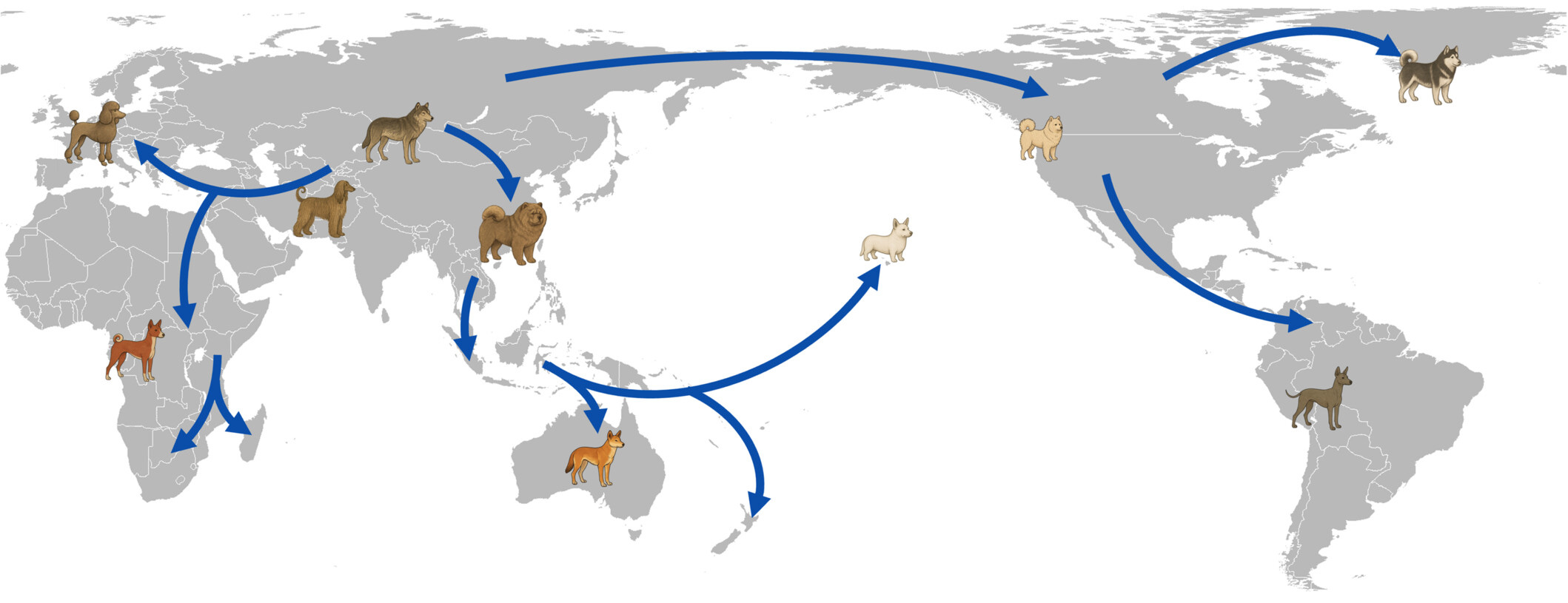
The review, “Why Anthropologists Should Study Dogs,” appears in Evolutionary Anthropology: Issues, News, and Reviews,2 and Smith, its sole author, adapted it from a chapter of his 2025 Penn State dissertation. It draws on 121 references rather than new data to argue that dogs could serve four goals of anthropology: analyzing evolutionary adaptations, understanding humanity’s past, examining cultural diversity, and assessing what influences human health. I think the case is strongest where it asks the least of dogs: they make good witnesses to human history but weaker independent tests of how humans adapted, because they share so much of their people’s lives.


