

Burial 25 in the Middle Nasca cemetery (325-440 CE) at Jauranga, in the Palpa Valley of southern Peru, held two infants in one ceramic vessel, one above the other. One, JA13A, had a single eye socket in the midline of her face, the skeletal signature of cyclopia. Her teeth had reached the stage expected 2 to 4 months after birth, while her limb bones matched 36 to 40 weeks of gestation. The other, JA13B, had no skeletal anomalies and was younger, at about 32 to 36 gestational weeks.
Cyclopia is the most severe craniofacial form of holoprosencephaly (HPE), in which the embryonic forebrain does not fully separate. It occurs in about 1 in 100,000 births and is typically lethal before or shortly after birth. I suspect most readers assume that bones can describe such a malformation without reaching its cause, and that a community would have buried so visibly different an infant differently.
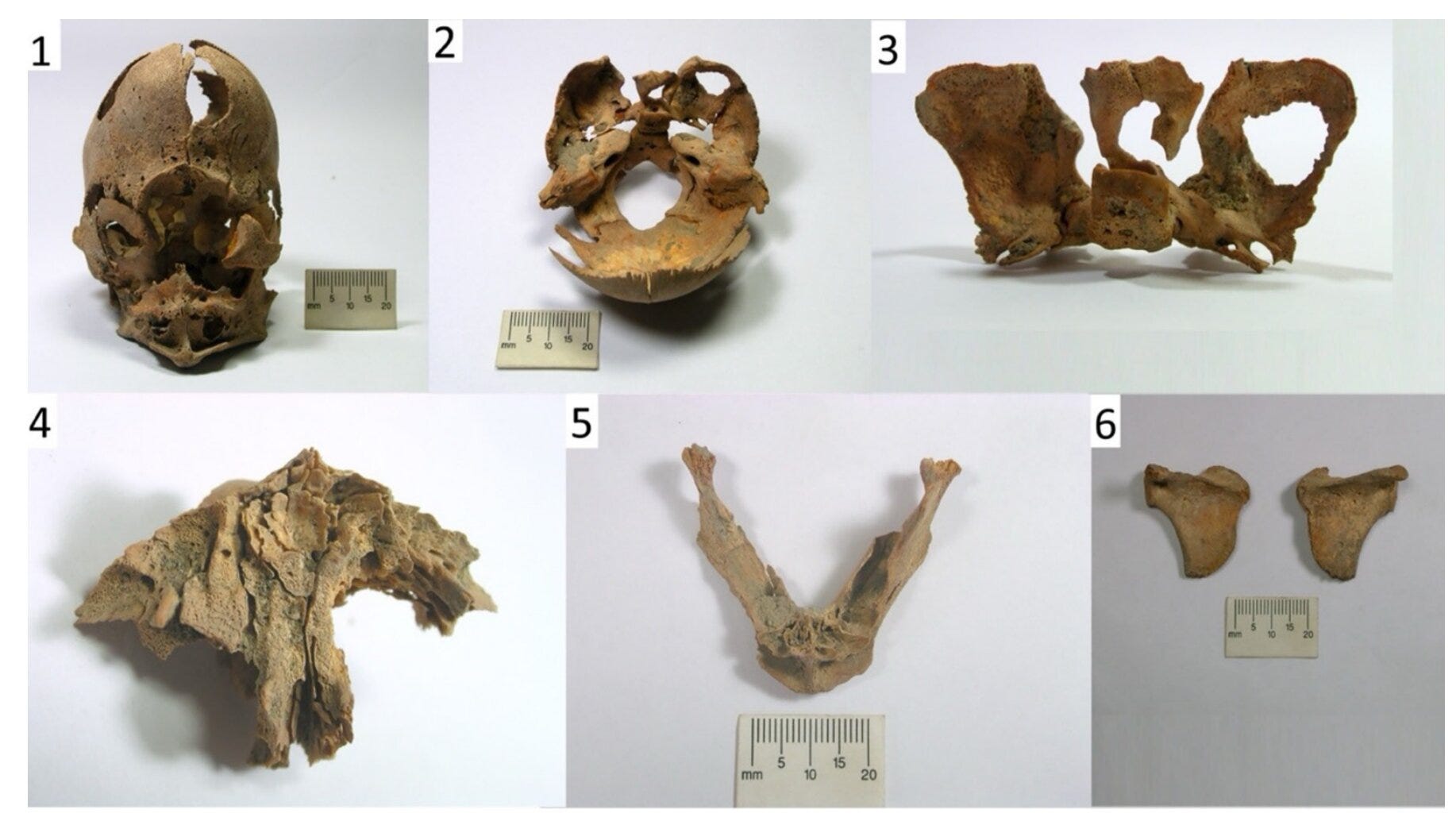
In a Brief Report in the Proceedings of the National Academy of Sciences,1 Elsa Tomasto-Cagigao (Pontificia Universidad Católica del Perú), Lars Fehren-Schmitz (University of California Santa Cruz) and five colleagues report that JA13A carried three copies of chromosome 13 where two are expected, a condition called trisomy 13, which they identify as the likely cause of her cyclopia. Both infants were genetically female, and their mitochondrial DNA, inherited from the mother, belongs to different lineages (haplogroup D1 in JA13A, C1 in JA13B), which rules out a maternal relationship. Urn burial, meaning burial in a ceramic vessel, was an established Nasca treatment for young children, and the authors conclude that JA13A’s condition did not result in archaeologically distinct funerary treatment.


