

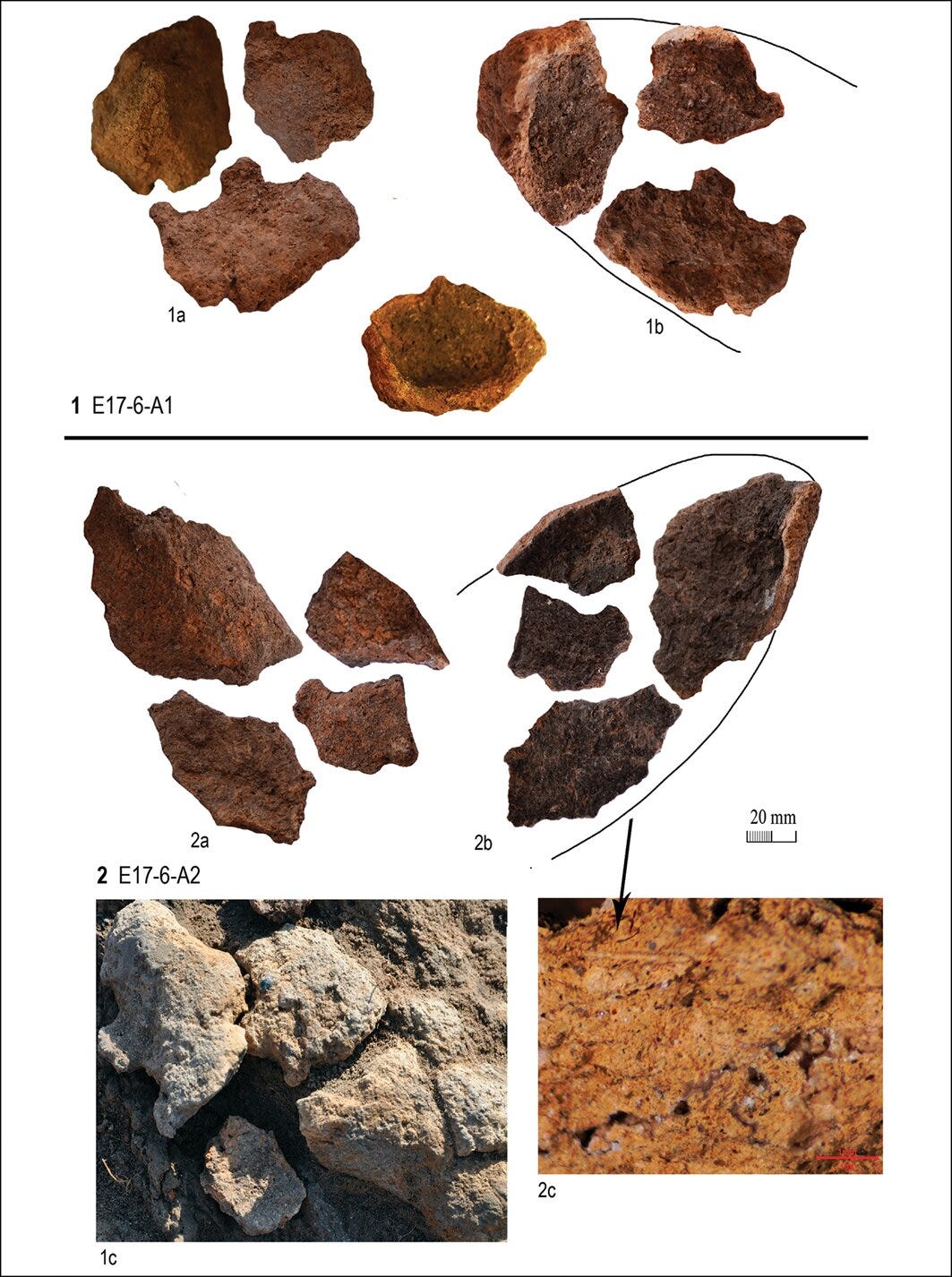
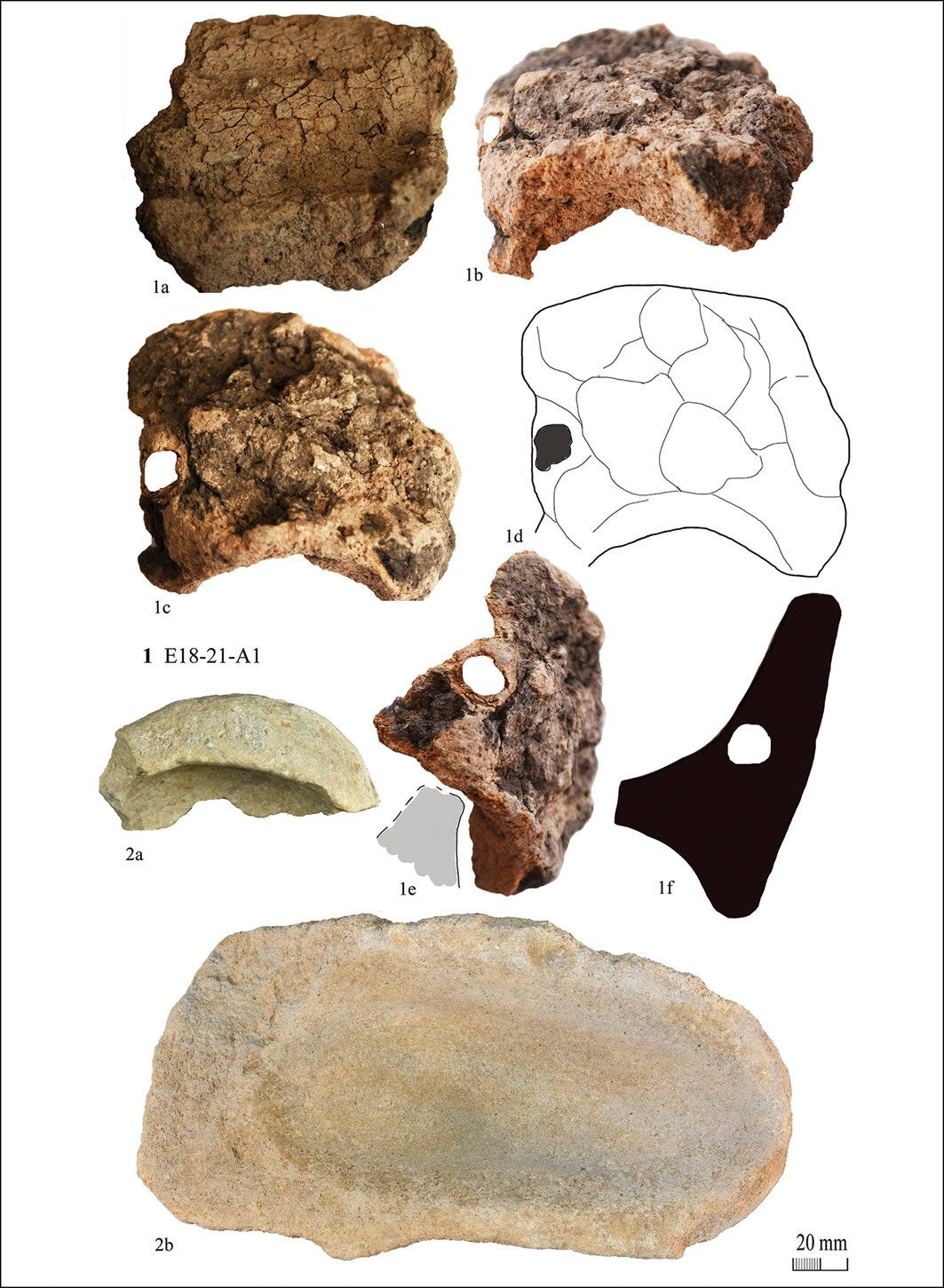
The strangest object in the new paper on Çemka Höyük pottery is a thick piece of fired clay with a hole pierced in it, found on the floor of a fully subterranean, elliptical building in Mardin Province, Türkiye, in a level dated to c. 9350 cal BC. Catalogued as E18-21-A1, it is a segment of something probably oval, with an estimated maximum diameter of 370 mm and a height of 100 to 120 mm, built from uneven slabs of clay in at least three layers. It has no flat base, only a concave pedestal, and two holes about 15 mm wide were pierced at an angle before the clay was heated. The authors think it was an extension, added to a shallow container of another material, probably stone, to increase its capacity.
A clay extension for a stone bowl would be a minor curiosity in most periods, but building level 2 at Çemka, where all the fragments in the study were found, belongs to the Pre-Pottery Neolithic A (PPNA), which the paper dates to 9600 to 8700 BC. The period’s name states the assumption most readers bring to it: that the early settled communities of Southwest Asia lived for a very long time without pottery. Widespread use of ceramics in the region is placed in the seventh millennium BC, more than two thousand years after this level.
The paper, published in Antiquity1 by Ergül Kodaş, Natalia Petrova, Maria Daghmehchi and Rana Özbal, describes 46 low-fired clay fragments from that level. The authors assign them to nine vessels and analyse eight. They argue that the clay was heated on purpose to roughly 600 to 700°C, which would make the fragments some of the earliest known pottery in Southwest Asia. They read the variety of forms as a record of people working out what clay could do, long before they relied on it.
I think the paper shows that people at Çemka made and fired clay vessels during the PPNA. I am less persuaded by the count of nine and by the idea that every object was fired by intention, and both doubts come from the paper’s own descriptions.


