At Eynan-Mallaha, a Natufian settlement in the Hula Basin of Israel’s Upper Jordan Valley, someone in the Early Natufian (about 15,000 to 13,000 calibrated years before present, written cal BP) pinched light brown clay into a human torso 15 millimeters tall. It has two arms held at different angles and a belly that pushes forward. On its back are two fingerprints. The first runs vertically, and its ridges are wide enough to belong to an adolescent or an adult. The second crosses it and partly covers it, and its ridges are narrow enough to point to a child.
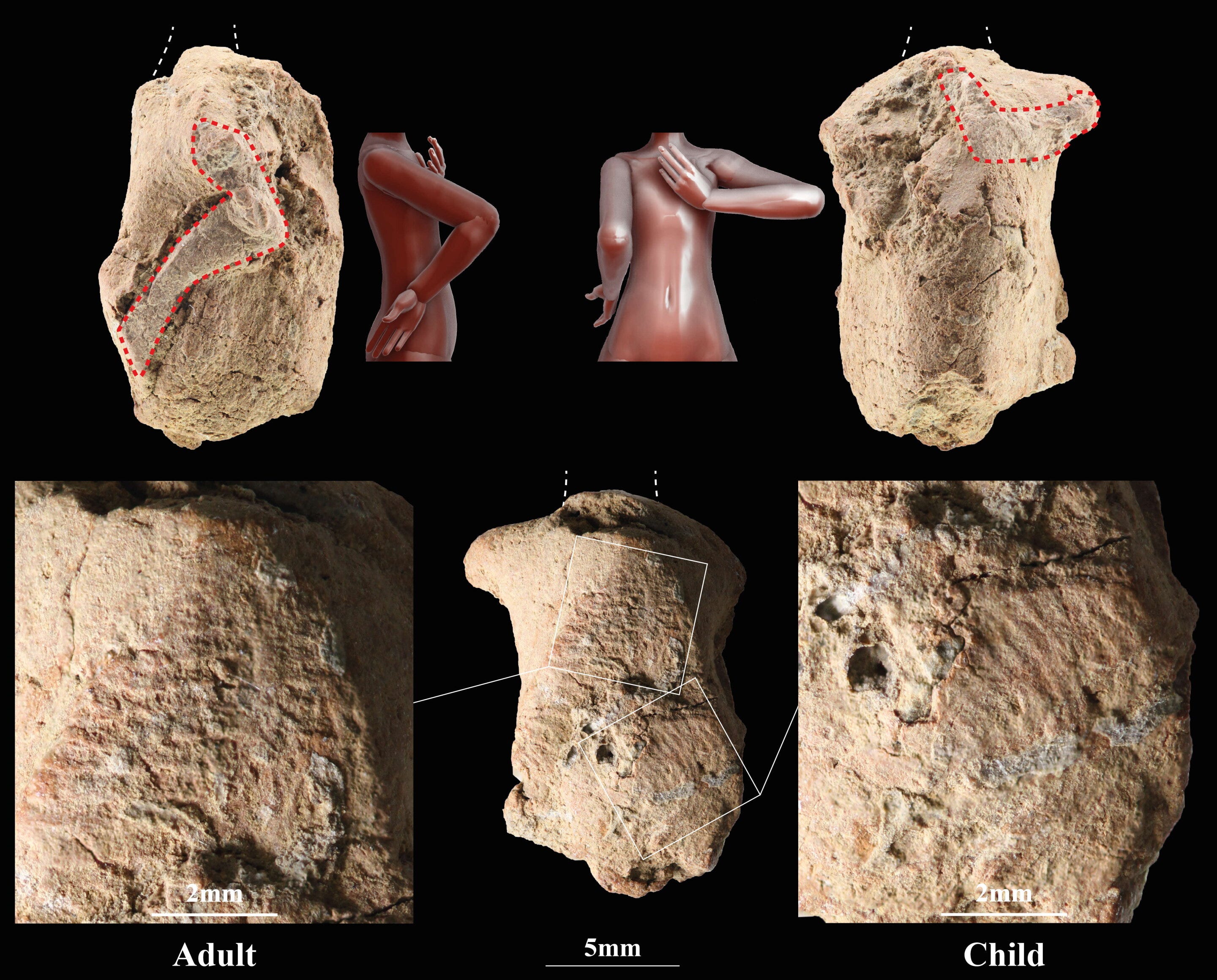
That object, catalogued as EM75 4551.17, is one of 15 Natufian clay figurines described in a new paper, and it carries the study’s most appealing idea: an adult and a child working on the same figure. The bigger claim is about timing. The standard account in Near Eastern archaeology, tied to Jacques Cauvin’s “revolution of symbols,” holds that modeling figures in clay arrived in Southwest Asia with the first farming villages of the Neolithic. In that account, the Natufian hunter-gatherers who came before carved their figures in bone and stone. Before this paper, only two clay figurines were known from the whole Natufian.
What did the study find?
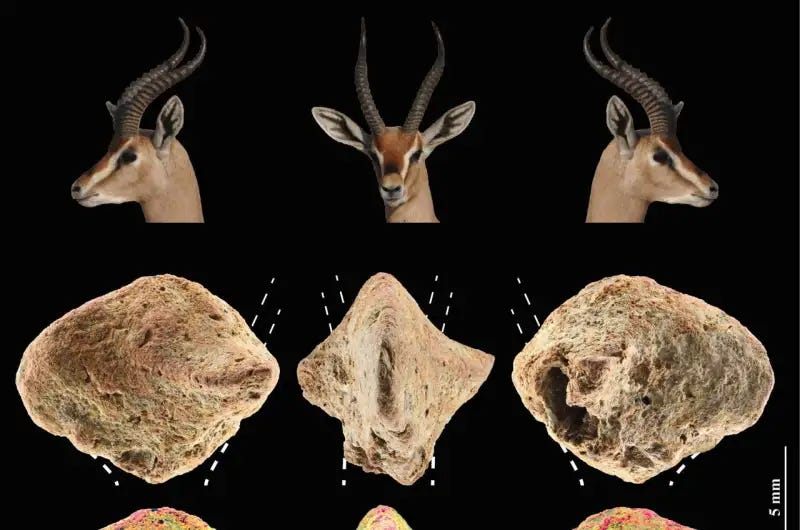
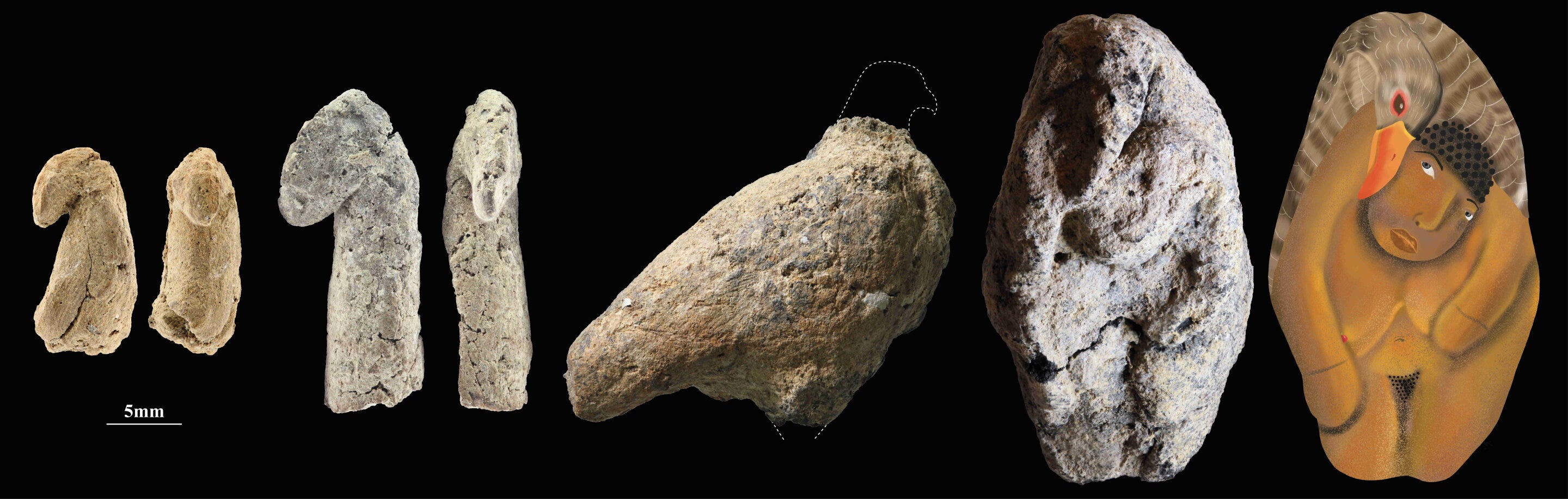
The paper, by Laurent Davin of the Hebrew University of Jerusalem and eight colleagues, appeared in PLOS One1 on November 11, 2026. Davin, Marion Sindel, Mina Weinstein-Evron and the rest of the team re-sorted about 40 kilograms of heated clay and sediment lumps from three Natufian sites in Israel: el-Wad Terrace on Mount Carmel, Hayonim Terrace in the western Galilee, and Eynan-Mallaha. These lumps had been stored for decades on the assumption that they were waste from making red pigment. From them the team recovered 154 artefacts they classify as figurative. Fifteen are figurines: 11 birds, two hoofed mammals and two humans. The other 139 are small clay rods the authors call cylinders, which they read as most probably broken bodies and limbs of figurines. All 15 figurines come from Hayonim Terrace and Eynan-Mallaha. El-Wad Terrace produced only cylinders.
A word on dates, since several are in play. The Natufian is the last Epipalaeolithic culture of the Levant, which the paper dates to 15,000 to 11,650 cal BP. Its people were the first in the region to live in permanent settlements, and they did so before farming. The paper divides it into Early (c. 15,000 to 13,000 cal BP), Late (c. 13,000 to 11,650 cal BP) and Final (c. 12,500 to 11,650 cal BP) phases. Those last two ranges overlap as printed. Each figurine is dated by the phase of the layer it came from, not by a date on the object itself. The first farming-era phase, the Pre-Pottery Neolithic A (PPNA), begins about 11,650 cal BP and has yielded fewer than 15 clay figurines across the entire Levant. The authors point out that their three sites alone already outnumber every known PPNA clay figuration.