

A woman buried at Tanna, in southern Vanuatu, died around 2,750 years ago carrying almost none of the ancestry her Southeast Asian-descended neighbors would have recognized as familiar. She had arrived, or her recent ancestors had, from somewhere else entirely: a Papuan-related population whose closest present-day proxy sits in the Bismarck Archipelago, more than a thousand miles to the west. Her genome is the earliest direct evidence anyone has found for this second wave of people entering Remote Oceania, and she died just three centuries after the first wave got there.
That timing matters, because it collapses an assumption a lot of Pacific archaeology has quietly rested on. The initial settlement of these islands, by seafaring populations associated with the Lapita culture, was fast. Within two centuries of reaching Vanuatu around 3,000 years ago, related groups had pushed on to Fiji and then to Tonga, carrying pottery styles and a shared Southeast Asian-related genetic signature the whole way. If you stopped the story there, Remote Oceania would look like a single clean expansion event, its people descended in a straight line from that first pulse of colonists.
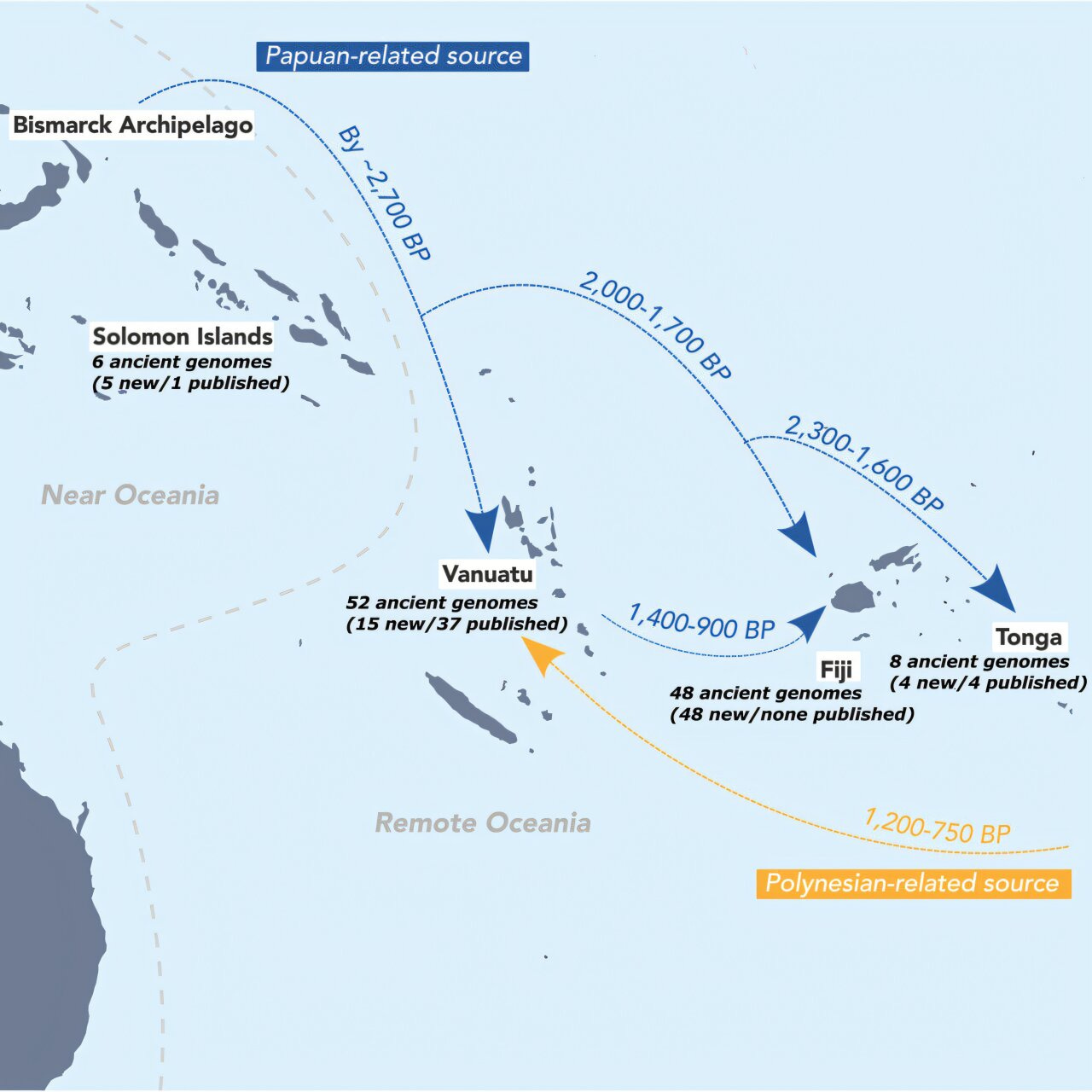
They aren’t. A new ancient DNA study,1 led by Michal Feldman and Cosimo Posth’s team at the University of Tübingen and the Max Planck Institute for Evolutionary Anthropology, sequenced genomes from 72 individuals spanning the last three millennia across Vanuatu, Fiji, Tonga, and the eastern Solomon Islands, filling in a region that had never had ancient genomic data from Fiji at all. What emerges is a second, much slower migration running underneath the first one, plus a third, later pulse from Polynesia moving back in the opposite direction. The genetic diversity that makes today’s Remote Oceania one of the most linguistically fragmented parts of the planet, over two hundred languages packed into a few island chains, traces back to these layered arrivals colliding with people already there.


