

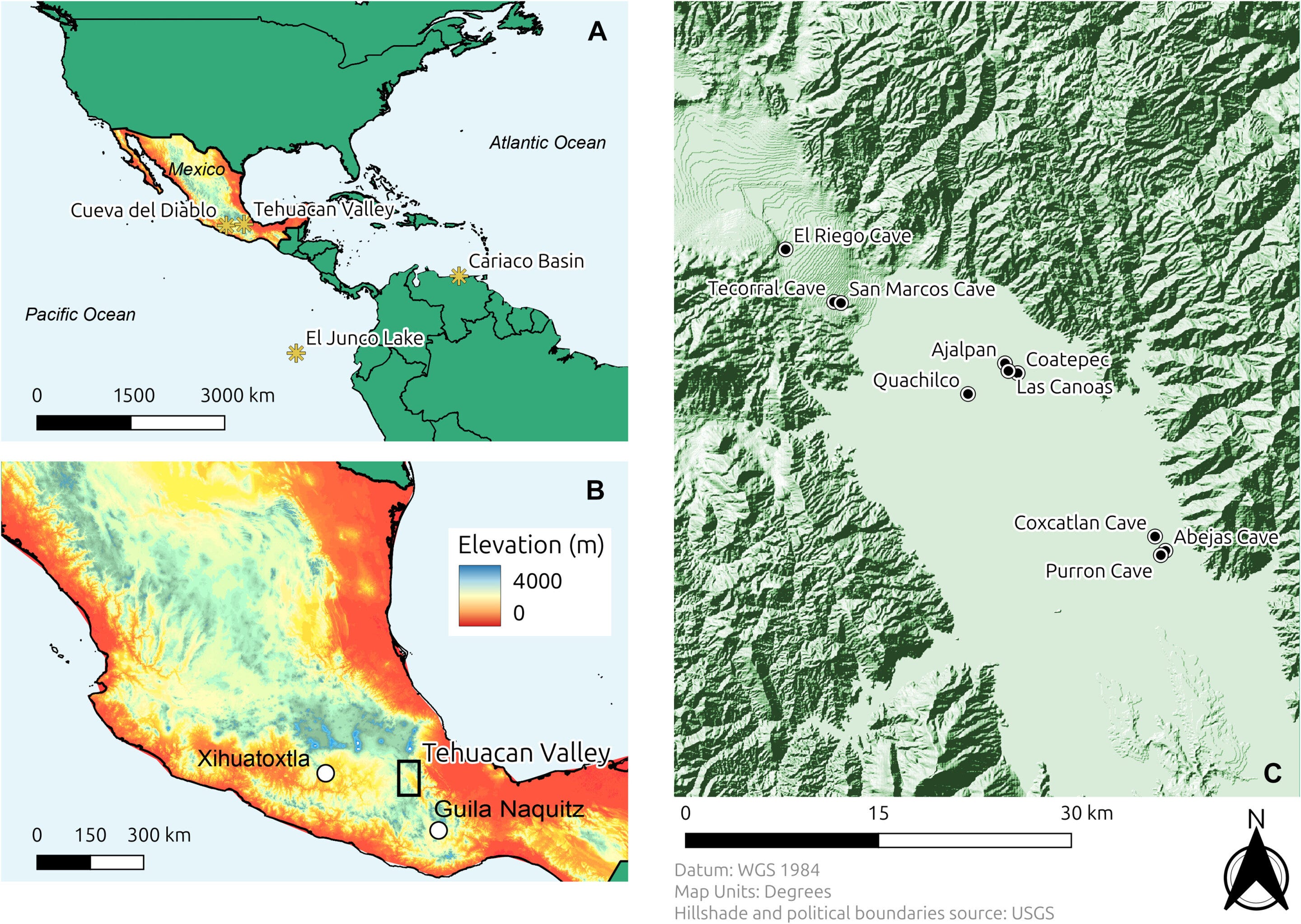
A single rabbit mandible stands for the Purron phase, roughly 4550 to 3250 cal BP (calibrated radiocarbon years before present), in a climate reconstruction of the Tehuacan Valley in Puebla, Mexico, published this year in Science Advances. Those thirteen centuries contain the drought of 4200 to 3800 cal BP that dried much of the Northern Hemisphere. That drought sits at the center of one leading explanation for why people in Mesoamerica took up maize farming in earnest.
The explanation exists because of a long delay. Maize (Zea mays) was domesticated from a wild grass, teosinte, in the lowlands of southwestern Mexico before 9000 cal BP. It became widespread across the Americas only between about 4500 and 3500 cal BP, and in between, seasonally mobile people grew it at a low level. Researchers still disagree over whether hardship, such as drought or population pressure, pushed people onto crops or a kinder climate made farming pay. Rosenswig, in papers from 2015 and 2021, gave hardship a specific trigger. In his model, a drought lasting several centuries made part-time cultivators farm harder and select for higher-yielding maize, which left them ready to expand when the rains returned.
Andrew D. Somerville of Iowa State University and nine co-authors test1 the climate side of that debate. They measured stable isotopes in 180 deer and rabbit bones excavated at 10 sites in the valley. They find that maize first appears there around 5400 cal BP, in the Abejas phase (6300 to 4550 cal BP). At that time the bones indicate a wetter valley with more trees and shrubs than in the Early Holocene. Intensification came centuries later, possibly during a shift from dry to wet conditions. A companion paper in Quaternary Science Reviews2 measures the same isotopes in 20 dogs to track how much maize people ate. I think the wet-arrival claim holds up well, and the drought claim needs far more bone than the team had.


