

In the second millennium BCE, Babylonian observers kept records of the planet Venus, and in certain years the planet seems to have been unusually hard to see. A team led by Charlotte Pearson of the University of Arizona’s Laboratory of Tree-Ring Research thinks volcanic haze may be the reason. Phys.org’s summary of their new paper names the eruption that fits best: Aniakchak, in Alaska, around 1628–1627 BCE. The team looked for that match because it bears on Mesopotamian chronology, the calendar dates historians attach to Babylonian and Assyrian history.
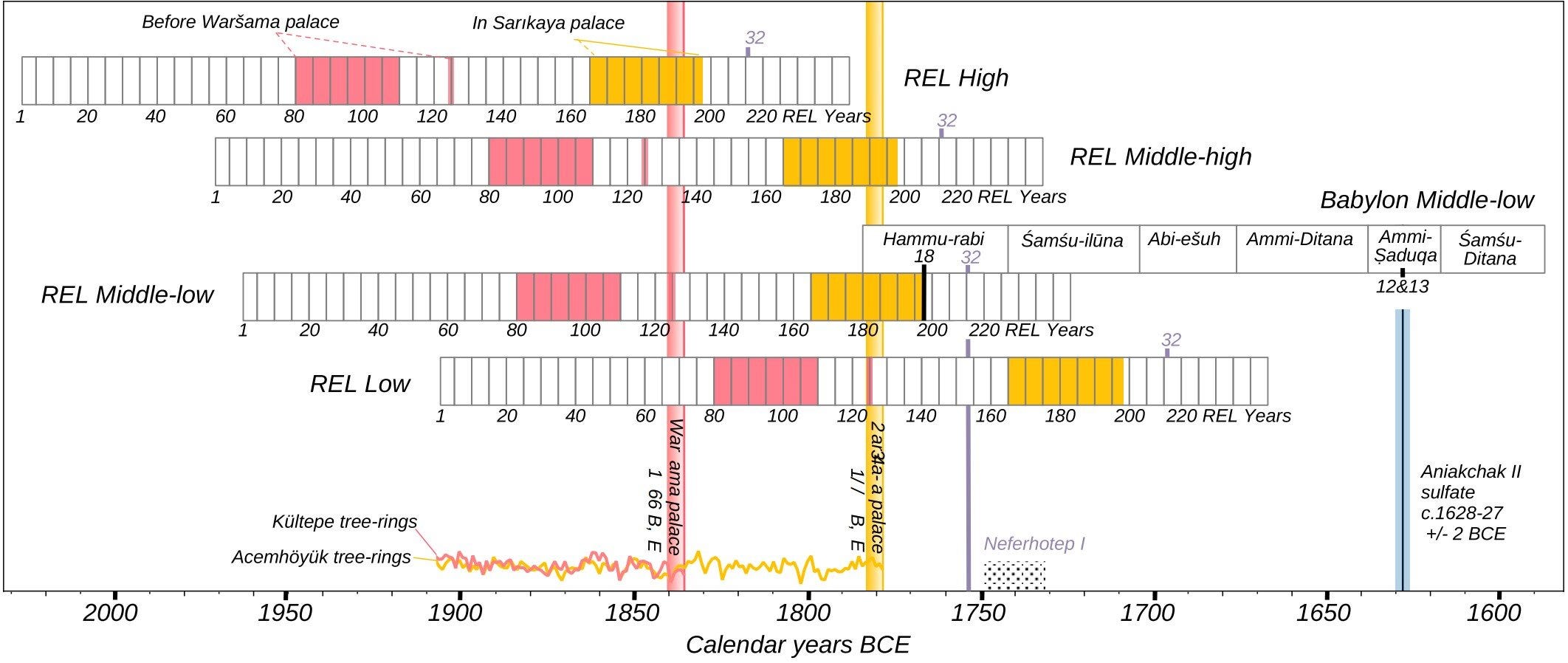
Those dates are less fixed than most readers assume. Historians know who ruled and in what order, from king lists and administrative records, but that sequence has never been firmly tied to calendar years. The astronomical observations in those records can be fitted to more than one set of years. Each fit gives its own framework, and the paper lists them as high, middle, low and ultra-low. A date you meet for a Babylonian king in a survey book belongs to one of those frameworks, and switching to another moves the whole sequence of kings together.
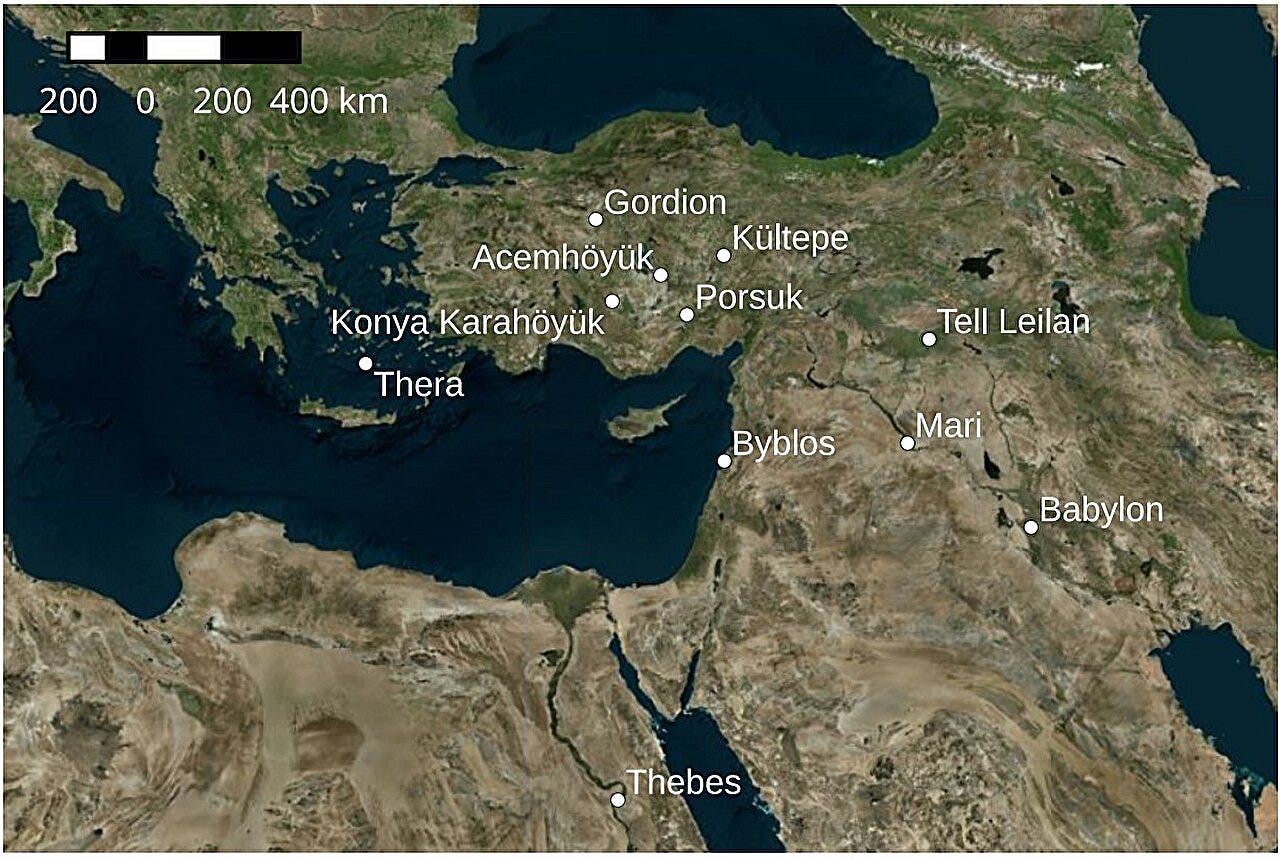
The paper was published in PNAS1 by Pearson, Nicolas Brehm, Lukas Wacker and six coauthors at institutions in the United States, Switzerland, Norway, Austria and Britain, and it does two things. First, it anchors a combined tree-ring chronology to calendar years from 2072 to 744 BCE. The chronology is built from archaeological timbers in Anatolia (modern Türkiye). Second, it combines those tree-ring dates with archaeological and ice-core evidence to test the competing frameworks for Mesopotamia between 2000 and 1500 BCE. The authors conclude in the abstract that the remaining dating uncertainties “are constrained in strong support of the middle–low chronology,” a variant whose name places it between the middle and low frameworks.
Most of the paper sits behind the PNAS paywall. What I have read is the abstract and significance statement, the paper’s front matter and the first entries of its reference list, plus Phys.org’s write-up by Paul Arnold. The abstract gives the span of the tree-ring record and the verdict. None of the specific event dates in the Phys.org story appear in the abstract, including 1587 BCE for the fall of Babylon, so I credit each of them to Phys.org as it comes up.


