

Four of the five pottery filters analyzed from Wayaoli, a Late Neolithic site in China’s Zhejiang Province dated to around 5300 to 5000 BP (years before present), carried microscopic plant fibers. Most of them were bast fibers (fibers from the inner bark of plant stems) suited to weaving cloth, and no such fibers turned up on the cauldrons, jars, or plates analyzed with them. That distribution is the most specific result in a new study of Neolithic rice alcohol, and it is the main reason I take the study’s picture of a cloth-lined brewing filter seriously.
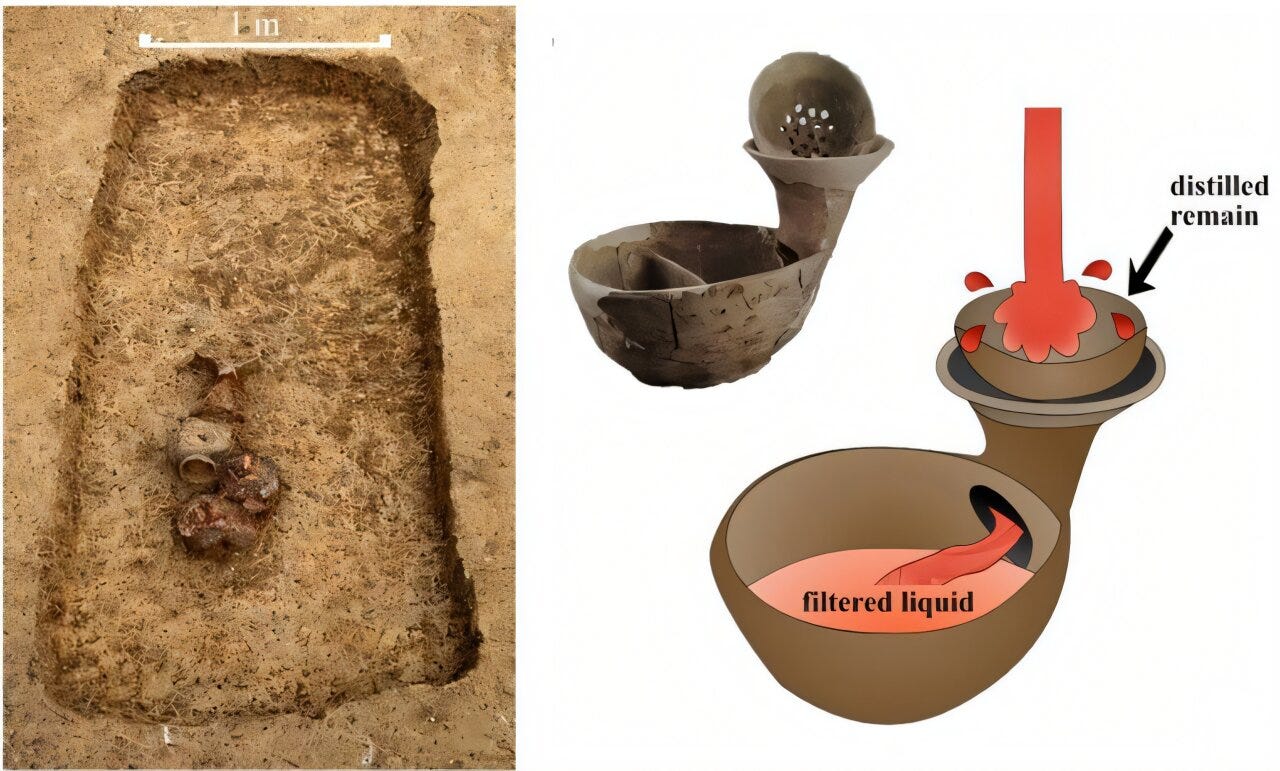
Archaeologists already knew these filters well. They are a distinctive pottery type of the Songze culture and of the Liangzhu culture that followed it in the Lower Yangzi region, built as an upper bowl joined to a lower one so liquid could drain through. Archaeologists have long suspected they were used for alcohol, but shape alone cannot rule out other jobs such as processing grain or purifying water. Rice brewing here was also known to be old: a 2024 study1 by Liu and colleagues reported rice fermented with Monascus mold at Shangshan, another Zhejiang site, roughly 10,000 to 9,000 years ago. So the working assumption has been that the filters were probably brewing gear, and the new paper tests it with residues from the vessels themselves.
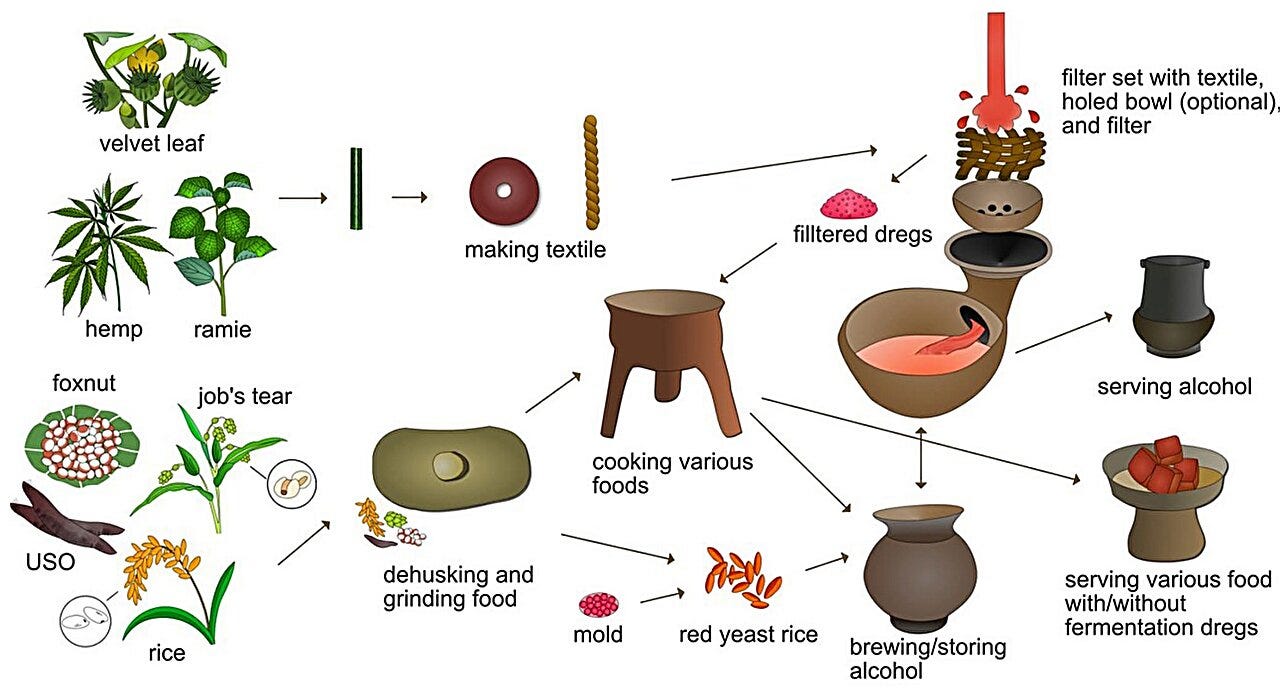
Ran Chen of the University of Arizona, Yalin Liu and Guoping Sun of the Zhejiang Provincial Institute of Cultural Relics and Archaeology, and two colleagues from the Fuyang Museum published the study on 4 November 2026 in Archaeological and Anthropological Sciences.2 They examined 16 pottery vessels from Wayaoli, whose occupation runs from the Late Songze into the Early Liangzhu period. Besides the five filters, they analyzed cauldrons for cooking, jars for storage, and plates for serving, for comparison. All five filters held rice residues and remains of Monascus, a mold used in traditional red rice brewing, and some starch grains showed damage consistent with cooking and fermentation. Foxnut starch, from an aquatic plant with edible seeds, also turned up in the filters and may have been a second ingredient, though the residues don’t establish a recipe. The authors conclude that the filters were used to make a rice-based fermented drink, colored red by the mold, and that textiles of bast fiber were laid in them to strain it.


