

On the shore of a vanished lake in Saudi Arabia’s Empty Quarter, at a site dated to about 125,000 years ago, several stone points carry residues where a weapon ought to have them. Microscopic analysis found animal tissue near the tips, and plant resin and fibers at the bases, where a point would have been hafted, meaning glued and bound to a shaft. Chemical markers linked to Acokanthera schimperi, the arrow-poison tree, turned up on several points as well. If those markers mean what the paper’s title says, these are poisoned hunting weapons, made by people living beside fresh water in what is now one of the driest regions on Earth.
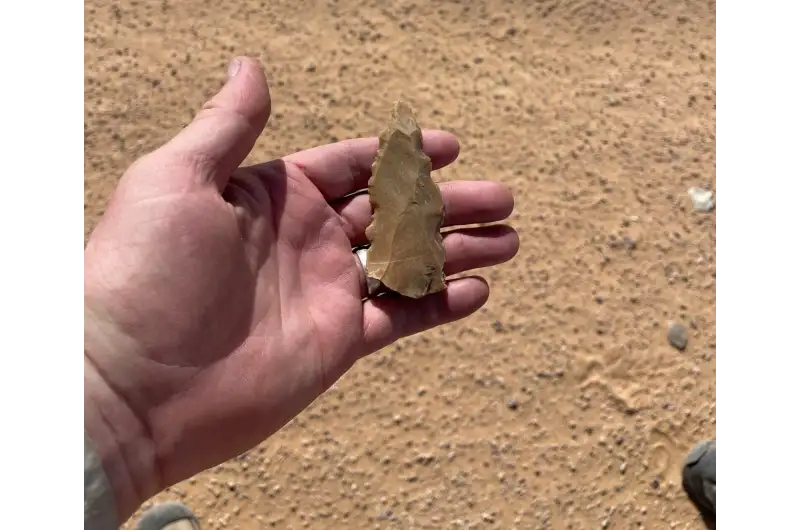
That would be a surprise on two counts. Arabia tends to enter accounts of Homo sapiens leaving Africa as ground that people crossed during wet spells on their way to somewhere else, and the new paper’s own abstract concedes that the Saharo-Arabian archaeological record remains sparse. Poison is something most readers associate with the arrows of recent hunter-gatherers, partly because it is organic and almost never survives on a stone tool for an archaeologist to find.


