

Sometime between 1740 and 1540 cal BC (calibrated calendar years), in the Bronze Age of southern Spain, a woman was laid on the floor of a rock-cut chamber at Cape Trafalgar with two gold earrings, three silver beads, an ivory comb and several beads of green mica. Hers was the only articulated skeleton in the chamber when archaeologists opened it in 2021. The bones of at least seven other people had been gathered into sets along the walls, and after her burial the entrance was blocked with stones.
The chamber belongs to Tomb I of the Trafalgar megalithic necropolis, a kind of cemetery the usual account assigns to an earlier age. Megaliths are tombs built of large stone slabs, and in southern Iberia they go with the collective burial rites of the Copper Age, or Chalcolithic. On that account, single graves in stone boxes called cists took over in the Bronze Age, and megalithic tombs became smaller and rarer between about 2200 and 2100 cal BC. Bronze Age bones inside a megalithic tomb are therefore read, by default, as the reuse of an old monument.
Eduardo Vijande-Vila and Juan Jesús Cantillo-Duarte of the University of Cádiz, with colleagues, report in PLOS One1 that the two tombs excavated so far held at least 20 people, 13 in Tomb I and seven in Tomb II, and that 16 of them have been radiocarbon dated. By the authors’ summary, both tombs were receiving the dead between 1875 and 1625 cal BC; the latest of the 16, who died between 1610 and 1440 cal BC, lay in the corridor of Tomb I. The authors also propose that the tombs were built in the early 2nd millennium BC and not inherited from the Copper Age, which would make Trafalgar one of the latest megalithic cemeteries founded in Iberia. I think the dates establish the first claim. The second is a hypothesis, the authors call it one, and I’d keep the question mark they put in their title.
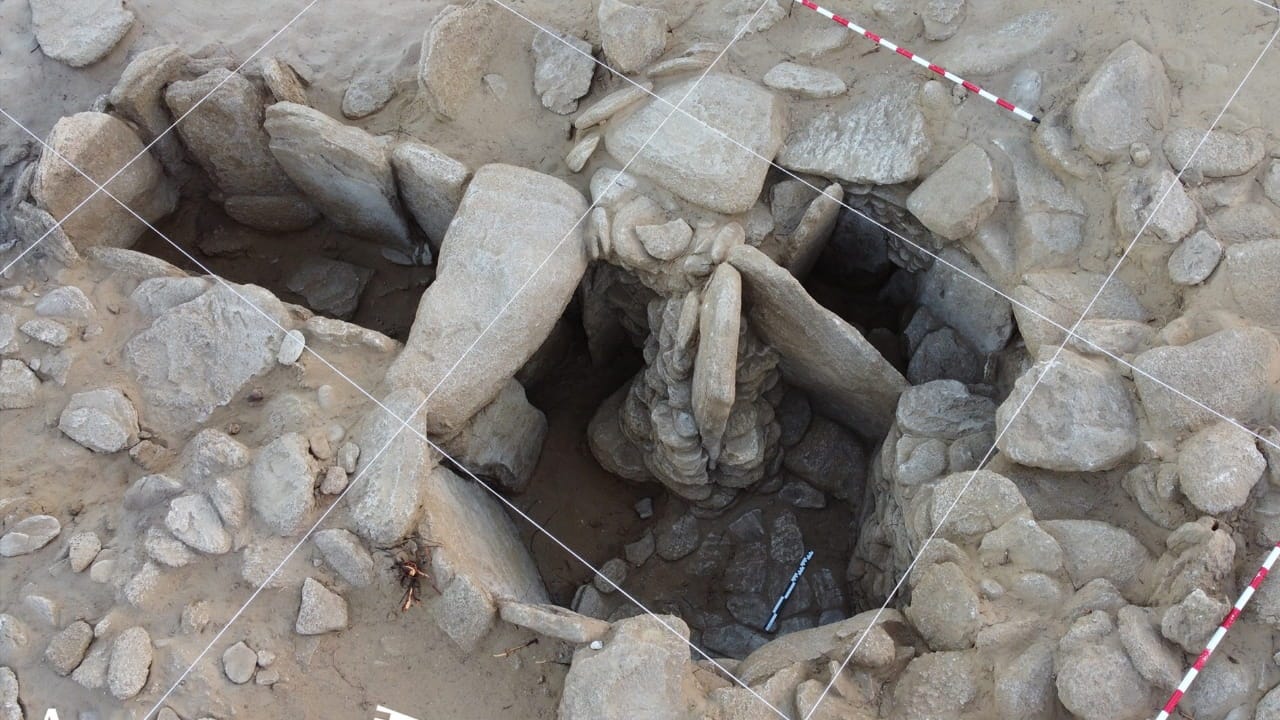
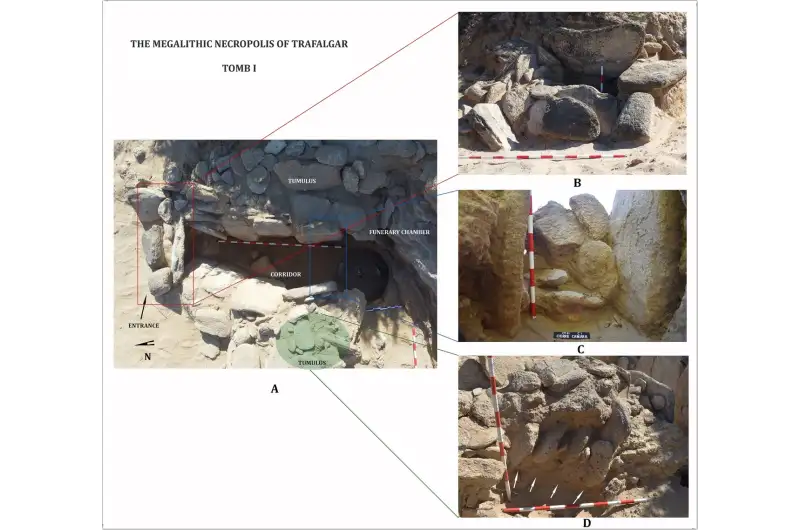
The tombs lie about 180 m apart and differ in plan. Tomb I has a corridor of upright slabs (orthostats) leading to a hypogeum, a chamber cut into the bedrock. Tomb II is a tholos: a round chamber walled with orthostats and roofed with a false dome of masonry courses that step inward until they close. Both lay under stone mounds, and neither is large. Tomb II’s chamber is 2.90 m across at its widest, so the press release’s “massive stone tombs” describes the megalithic tradition better than these two.


